
When 'Close Enough' Isn't: The Hidden Risk of Ingredient Substitution
Maggi seasoning is not soy sauce. Pomelo is not grapefruit. When a kitchen swaps one for the other because they look, smell or taste alike, the allergen, medication-interaction and labelling profile can change completely — and the recipe data almost never gets updated to reflect it.
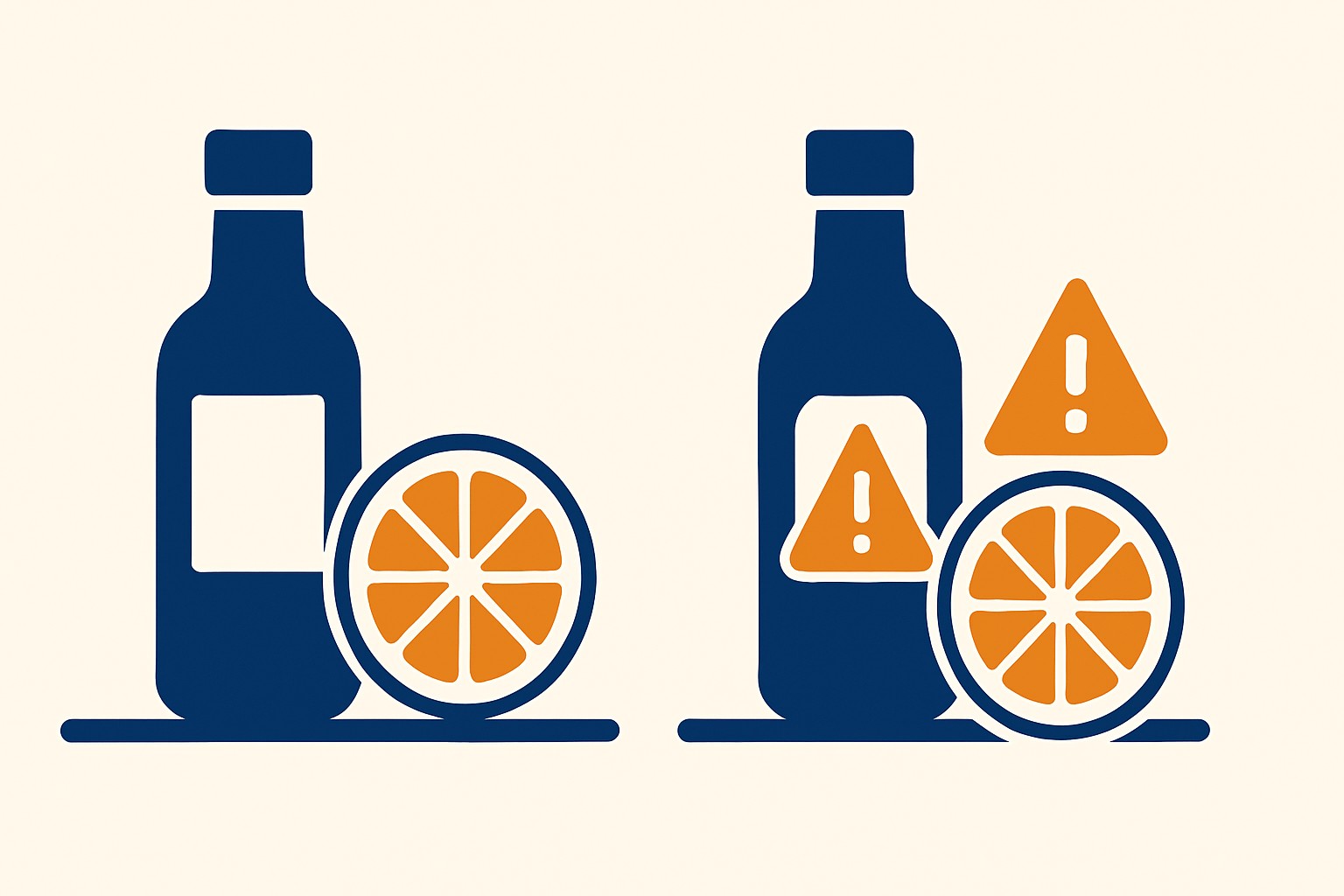
“It’s Basically the Same Thing”
Every professional kitchen has a version of this conversation: stock runs short, a supplier substitutes a line item, or someone decides a cheaper product will do — because it looks the same, smells the same, or does roughly the same job in the pan. Maggi seasoning stands in for soy sauce. Pomelo stands in for grapefruit in a fruit salad. Almond butter stands in for peanut butter on a “nut-free-friendly” board. Coconut cream stands in for dairy cream to make a dish “dairy-free.”
In the moment, the swap looks harmless. The dish still tastes right, the colour is right, the texture is right. What almost never happens at that moment is a re-check of the recipe’s allergen declaration, medication-interaction flags, or nutrition data — because nobody thinks of it as a different ingredient. It’s treated as the same ingredient, just from a different shelf. That gap between “tastes equivalent” and “is legally and medically equivalent” is where the risk sits, and it is routinely underestimated.
Maggi Seasoning Is Not Soy Sauce
Maggi liquid seasoning (the Swiss-origin Nestlé product, not the instant noodles sold under the same brand in some markets) is a savoury, dark, salty liquid that reads as an obvious soy sauce substitute on flavour alone. It isn’t one. Traditional soy sauce is a fermented product made from soybeans, usually combined with roasted wheat; Maggi seasoning is built from hydrolysed vegetable protein, historically wheat-gluten-based. The allergen picture that follows is not a minor footnote — it can flip in either direction depending on which product you started from:
- A kitchen substituting Maggi for soy sauce to accommodate a soy allergy may inadvertently serve wheat/gluten instead — safe for the soy allergy, unsafe for a coeliac or gluten-free guest.
- A kitchen substituting soy sauce for Maggi to accommodate a gluten-free request may be fine if it reaches for tamari (traditionally wheat-free) — but not if it reaches for a standard soy sauce, which typically contains wheat.
Under EU Regulation (EU) No 1169/2011, both wheat/gluten and soybeans are on the mandatory 14-allergen declaration list, and they are two separate entries — declaring one correctly does nothing to cover the other. Sodium and glutamate levels also differ between the two products, which matters for both nutrition labelling and recipe costing, not just allergen safety.
 Same colour, same shelf, same job in the pan — different allergen on the label. Wheat/gluten and soybeans are declared separately under EU food-information law.
Grapefruit Is Not Pomelo
Grapefruit contains furanocoumarins (compounds such as bergamottin) that inhibit an intestinal enzyme, CYP3A4, responsible for metabolising a long list of common medications — certain statins, some calcium-channel blockers, and immunosuppressants among them. The FDA has published consumer guidance on this for years, and it is a well-documented interaction in the clinical literature, including a widely cited CMAJ review by Bailey et al. (2013) on grapefruit–medication interactions. We’ve covered the clinical side of this in more depth in Drug-Food Interactions: What Every Kitchen Team Needs to Know.
Pomelo — grapefruit’s much older parent citrus — is generally regarded as lower-risk on this specific interaction, which is exactly why it sometimes gets treated as a “safe” swap-in for grapefruit on a therapeutic menu, or the reverse: grapefruit gets used because “it’s basically a small pomelo” in a fruit course where nobody double-checked the resident’s medication list. Two problems make that swap far less safe than it sounds:
- Furanocoumarin content is not a fixed, guaranteed-zero value for every pomelo — it varies by variety and by how much the fruit has hybridised with grapefruit or other citrus further up the supply chain. “Lower risk” is not “risk-free,” and it is not a substitute for checking the specific product against a resident’s medication profile.
- In institutional catering — hospitals, care homes, rehabilitation centres — the citrus on the plate is frequently decided at purchasing or back-of-house level, disconnected from the dietitian who signed off the therapeutic diet. A produce swap that never touches the clinical record is exactly the failure mode drug-food interaction management is supposed to prevent.
 Same cutting board, same colour inside — one carries a well-documented drug interaction, the other generally doesn’t. “Generally” is doing a lot of work in that sentence.
Three More Swaps That Look Interchangeable and Aren’t
These are not exotic edge cases — they turn up in ordinary kitchens for ordinary reasons (cost, availability, a “healthier” or “allergen-friendly” rebrand):
- Peanut butter ↔ almond or cashew butter. Peanuts are legumes; tree nuts are botanically unrelated. Swapping one for the other doesn’t reduce allergen risk, it changes the allergen category entirely. A guest cleared for “no tree nuts” can still react to peanuts, and vice versa — the FDA’s “Big 9” and the EU’s 14-allergen list both treat peanuts and tree nuts as distinct, separately declarable allergens.
- Worcestershire sauce as a soy sauce or umami stand-in. Classic Worcestershire sauce is built on fermented anchovies. A kitchen using it to deepen a sauce marked vegetarian, or as a “soy-free” umami swap for a soy-allergic guest, can unknowingly introduce a fish allergen into a dish that was never supposed to contain one.
- Coconut cream/milk as a dairy substitute. Botanically, coconut is a drupe, not a tree nut — but food-allergen law doesn’t follow botany consistently across markets. The FDA has treated coconut as a tree nut for labelling purposes since 2006 guidance under FALCPA, while the EU’s Annex II tree-nut list (almond, hazelnut, walnut, cashew, pecan, Brazil nut, pistachio, macadamia) does not include coconut at all. The same “dairy-free, tree-nut-free” claim can be accurate in one jurisdiction and technically wrong in the other — a real problem for any operator running menus across multiple markets.
 Three more pairs that read as interchangeable at a glance: different allergen category, a hidden fish ingredient, and a jurisdiction-dependent nut classification.
Why This Keeps Happening
None of these mistakes come from careless cooks. They come from a structural gap: the substitution decision is made in the moment, at the pass or in purchasing, and the recipe record is not. The allergen tag, the drug-interaction flag, and the nutrition panel were all set when the original ingredient was entered — nobody re-runs that step when a cheaper, more available, or “close enough” ingredient quietly takes its place. The dish looks unchanged on the menu. The data behind it is now wrong.
Building the Check Into the Recipe, Not Into Memory
This is precisely the failure mode recipe costing software is meant to close. In CalcMenu, every ingredient carries its own allergen, cost and nutrition data at the source — so a substitution is not a silent swap of one line for a “similar” one. Changing Worcestershire sauce for soy sauce, or a tree-nut butter for peanut butter, is not just a taste decision inside CalcMenu: it recalculates the recipe’s allergen declaration, its cost, and its nutrition figures in the same step, and surfaces the change instead of burying it. The goal is that “close enough” stops being a judgment call made once, from memory, and becomes a check the system runs every time.
Not sure your recipe data would catch a substitution like this before it reached a plate? Book a free 15-minute call with our team — no commitment: Schedule a call.
Explore CalcMenu's recipe management software for restaurants, hotels & catering to see how it applies to your kitchen.
Related sectors
Comments
Comments coming soon.