
The Inca invented freeze-drying — using mountain frost, sunlight, and people walking on potatoes with their bare feet — 500 years before anyone had a freezer
Chuño, freeze-dried potato, let the Inca Empire store food for years and feed imperial projects across Peru. Archaeologists recently found 500-year-old examples still intact. It's the same preservation science modern freeze-drying uses — done entirely with weather and labor.
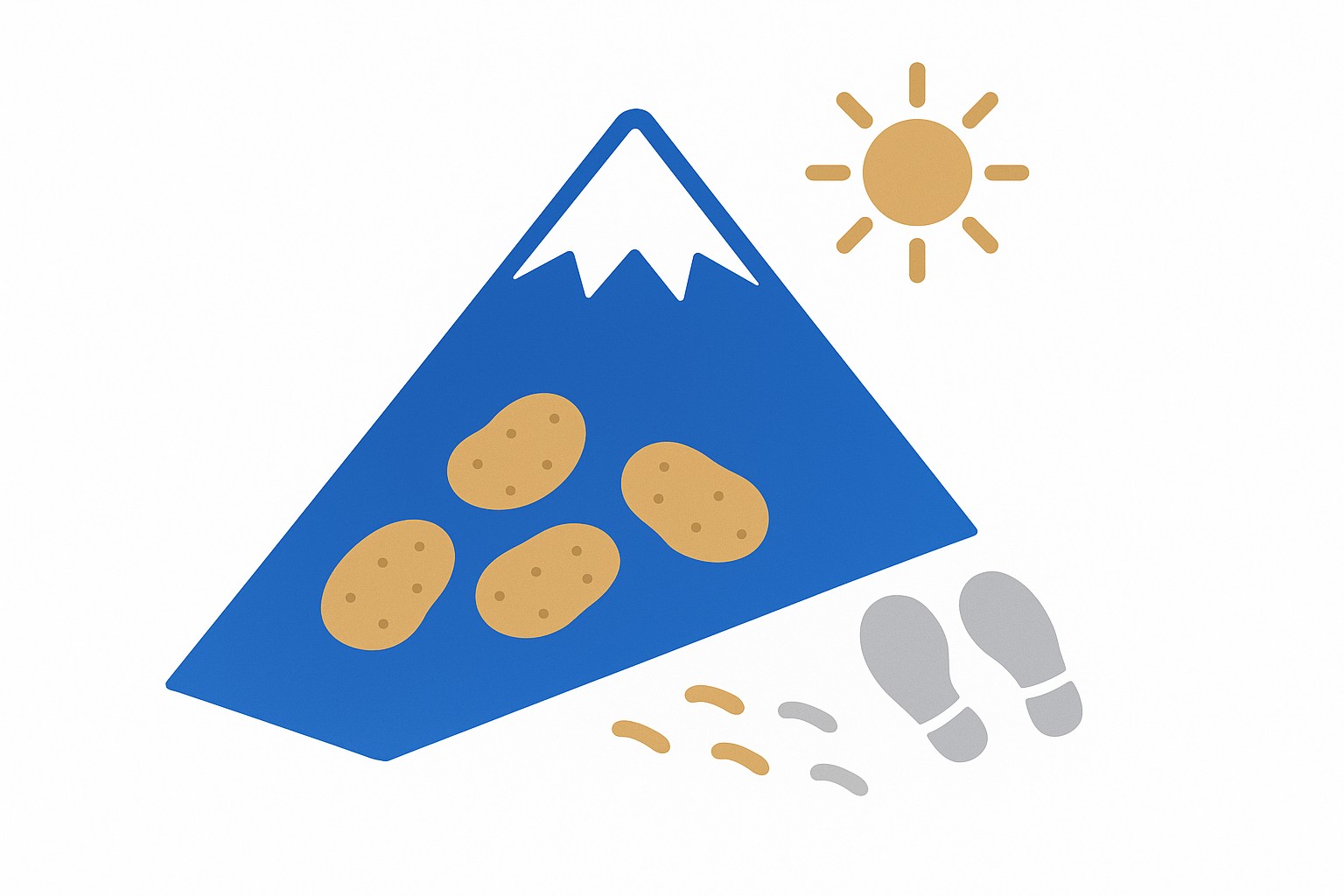
Freeze-drying, invented without a single machine
Freeze-drying sounds like modern food-science technology — and functionally, it is exactly that. What’s genuinely surprising is that Andean peoples worked out the same physical process, using nothing but altitude, weather, and manual labor, at least as far back as the 13th century, before the Inca Empire even existed.
The problem: potatoes that are either perishable or poisonous
Fresh potatoes rot within a week in warm conditions, and several Andean varieties are naturally bitter and toxic unless specifically processed first. Neither problem has an obvious solution at high altitude, far from any preservation technology — so Andean communities invented one.
Chuño: mountain frost and bare feet as the entire process
Chuño — from the Quechua word ch’uñu — is made by laying potatoes out on straw or blankets at high altitude and exposing them to extreme overnight frost, then thawing them in intense daytime sun. To make black chuño, the potatoes are then physically trampled — villagers walking over the frozen, thawed potatoes on cloths to squeeze out the remaining moisture — and the freeze-thaw-trample cycle is repeated over several days until fully dried. White chuño, made specifically from the naturally toxic bitter potato varieties, requires an additional soaking step over several weeks after the freeze-thaw cycle, which leaches out the toxins along with the moisture, producing a lighter, longer-lasting product.
The physics is genuinely identical to industrial freeze-drying: extreme cold causes water in the potato to sublimate rather than simply evaporate, preserving the structure and nutritional content far better than ordinary sun-drying alone would. The Inca just achieved it with weather and human feet instead of a vacuum chamber.
Storage for years, and a tool of imperial administration
Chuño’s real significance wasn’t just as a household staple — it became state infrastructure. The finished product could be stored safely for years in state-controlled warehouses, and Inca administrators used chuño production deliberately as a strategy to build food reserves that could support large-scale imperial projects: construction, military campaigns, and famine buffering across a genuinely vast, geographically difficult empire. Archaeologists have recently excavated 500-year-old freeze-dried potatoes from Inca coastal sites in Peru, still recognizable after five centuries, direct physical evidence of a state logistics system built on this exact preservation technique.
Why this belongs alongside every other preservation story in this series
Chuño sits in the same category as Mongol borts, Viking salted fish, and Rumford’s engineered soup — a preservation technology invented specifically to solve a hard logistics problem, that then became infrastructure for something much larger than individual household food storage. What makes the Inca case unusual is the sophistication of the underlying science: they were exploiting sublimation, the exact physical principle modern freeze-drying equipment is built around, using nothing but geography and timing.
What this means for thinking about “low-tech” preservation
Chuño is a useful reminder that sophisticated food science doesn’t require industrial equipment — it requires understanding the actual physics of what you’re trying to achieve, and having the discipline to execute a precise, repeatable process. The Inca didn’t have a freeze-dryer; they had a repeatable protocol that produced the same outcome, reliably, at empire scale.
How CalcMenu supports precise, repeatable preservation processes
Whether preservation happens via mountain frost or modern equipment, the underlying requirement is the same: a repeatable process with a knowable, accurate cost and yield.
- Accurate yield tracking through preservation processes, whatever the method — freeze-drying, dehydrating, curing.
- Consistent recipe costs regardless of how labor-intensive the preservation step is.
- Shelf-life-aware inventory management, so long-storage ingredients are tracked as precisely as fresh ones.
CalcMenu can’t replicate a 500-year-old Andean freeze-drying protocol. It can make sure whatever preservation process your kitchen actually uses is costed with the same precision.
Related reading
- Mongol borts and qurut, the dried-meat-and-dairy preservation system that made an army’s logistics as precise as the Inca’s freeze-drying protocol
- Viking salting, smoking and fermenting, the North Atlantic version of the same preservation-as-infrastructure principle
- 5,000 years of food preservation history, from salt to magnetic fields, the wider arc chuño’s sublimation science belongs to
- How the potato reshaped European cuisine after the Columbian Exchange, the other half of chuño’s own ingredient’s global story
Relying on preserved, dried, or shelf-stable ingredients? Book a free 15-minute call with our team — no commitment: Schedule a call.
Sources
- Cool Inventions: How The Incas Gave Us Freeze-drying – Mayorga Coffee
- Two 500-Year-Old Freeze-Dried Potatoes Show How the Inca Empire Fed People Across Peru – ZME Science
- The Potatoes You Freeze-Dry With Your Feet – Atlas Obscura
- Inca’s Food Preservation – A Gift to the World – Kuoda Travel
Explore CalcMenu's recipe management software for restaurants, hotels & catering to see how it applies to your kitchen.
Related sectors
Comments
Comments coming soon.