
How the world's biggest food events plan for a known date
Most kitchens fight uncertain demand. A handful of events on Earth have the opposite problem: a fixed date, a known scale, and food logistics measured in millions. What Hajj, Kumbh Mela, Oktoberfest and Thanksgiving have in common — and what any kitchen planning for a predictable spike can take from them.
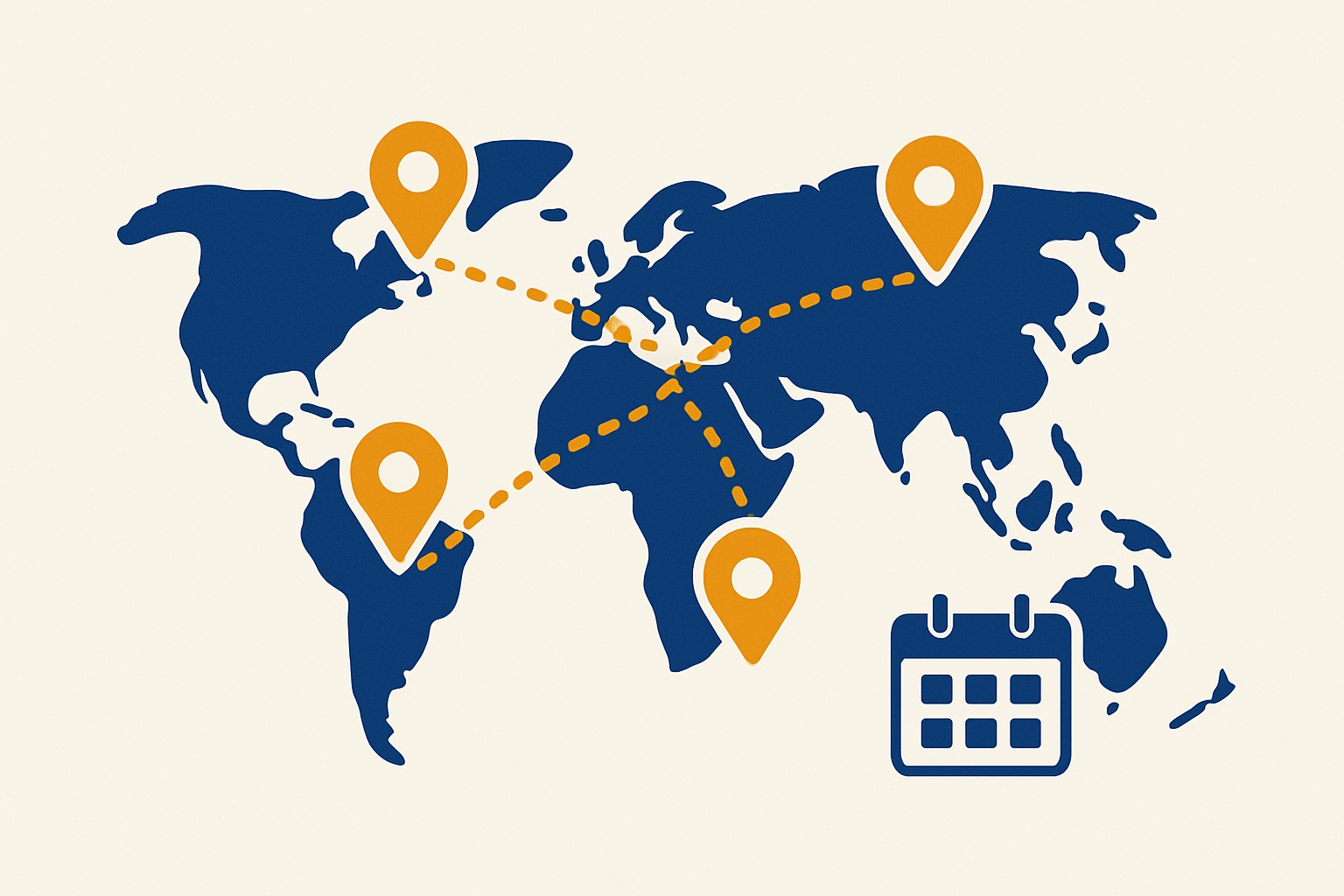
Our guide to in-house butchery made the case that camps and cruise ships are the clearest case for whole-carcass buying, because a known, contracted headcount removes the planning risk that sinks most kitchens’ worst-case scenarios. A handful of events on Earth take that same principle to a scale no restaurant, camp or ship will ever approach — a fixed calendar date, a population in the millions, and food logistics built entirely around demand nobody has to guess at.
They’re worth studying not because any kitchen will ever operate at this scale, but because they show, in the most extreme form possible, what happens when forecasting risk drops to nearly zero: the whole problem becomes infrastructure, mechanization and workforce, not guesswork.
Hajj and Eid al-Adha: the world’s largest automated abattoir
During Hajj, over a million animals are sacrificed within a span of about three days as part of Eid al-Adha, a central ritual for millions of Muslim pilgrims in Mecca. Saudi Arabia’s Adahi Project, based in Mina, was built specifically to handle this: a facility employing around 25,000 people, including roughly 17,000 trained butchers, running mechanized processing lines, flash-freezing and cold storage at a scale built for one predictable multi-day peak each year.
What makes it more than a slaughter operation is the distribution system behind it. The project was established in 1983 after demand from a growing number of pilgrims outstripped what the existing local abattoirs could process — and it now exists to get that volume of meat safely frozen, packaged and distributed to people in need around the world, not just consumed locally. The logistics challenge isn’t only “process a million animals in three days” — it’s “process, freeze, package and ship that volume before any of it spoils.”
Kumbh Mela and langar kitchens: feeding at the scale of a human gathering
Kumbh Mela is the largest human gathering on Earth, drawing crowds that at peak events have been estimated in the hundreds of millions across its weeks-long duration. Feeding that population runs largely on langar — free community kitchens, a tradition rooted in Sikh practice and widely embraced across the gathering — staffed mostly by volunteers and organised around a strictly vegetarian, simple menu: khichdi, plain vegetables, rice, flatbread.
The logistics are civic-scale rather than industrial: authorities set up food storage depots that supply a network of over a hundred distribution points spread across the event grounds, so pilgrims can reach a meal without long journeys or dangerous crowding. It’s a different model from Mina’s mechanized processing — labor- and volunteer-intensive rather than automated — but it solves the same underlying problem: known scale, fixed dates, and a distribution network built to match.
Oktoberfest: 16 days, half a million chickens
Munich’s Oktoberfest is a purely secular counterpoint, and its numbers are just as extreme in their own category: roughly 500,000 roast chickens, 230,000 sausages and 80,000 pork knuckles served over sixteen days, alongside several million litres of beer. None of that volume is guesswork — tent operators and suppliers plan it against decades of consistent, well-documented demand for the same fixed two-and-a-half-week window every year.
The scale shows up in compliance too: Munich’s food safety authority inspects close to 400 festival food businesses every year the event runs, on top of daily hygiene, labelling and personnel checks throughout the sixteen days. A predictable calendar date doesn’t reduce the food-safety burden — if anything it concentrates it, the same way HACCP discipline has to tighten, not loosen, whenever volume goes up.
Thanksgiving: 21% of a country’s annual turkey supply, in one day
Thanksgiving is the least exotic example and arguably the most extreme one: Americans eat an estimated 46 million turkeys on a single day, roughly a fifth of the entire annual US turkey production compressed into about 24 hours. There’s no festival ground, no pilgrimage, no central kitchen — just a country’s poultry supply chain planning, months in advance, around one fixed date on the calendar that every producer, distributor and retailer already knows.
It’s the cleanest illustration of the whole principle: when the date and the rough scale are known that far ahead, an entire national supply chain can plan production, cold storage and distribution around it with almost no forecasting risk at all — the same lever production planning pulls for a single kitchen with a banquet on the calendar, just multiplied by 300 million people.
What all four have in common
None of these events run on hope. Each one turns a fixed date and a known (or knowable) scale into infrastructure built specifically for that peak: Mina’s mechanized processing and cold chain, Kumbh Mela’s depot-and-distribution-point network, Oktoberfest’s supplier contracts and inspection surge, Thanksgiving’s months-ahead national production ramp. In every case, the organisers aren’t reacting to demand — they’re executing a plan against a number they already knew.
That’s the same lever our guide to food gammes covered at kitchen scale: planning risk is the cost of not knowing demand in advance, and it disappears — or at least shrinks dramatically — the moment the date and the scale are fixed. These four events are what that looks like taken to its logical extreme.
What a normal kitchen can actually take from this
No restaurant will ever process a million carcasses in three days or feed hundreds of millions of people over several weeks. But every kitchen has its own, much smaller version of a fixed-date, known-scale event — a wedding, a corporate banquet, a holiday menu, a contracted headcount for a conference — and the same principle applies at whatever scale it happens on:
- A known date and a known headcount should be planned like Thanksgiving, not like a normal Tuesday — production, purchasing and staffing built around the number in advance, not adjusted on the fly.
- Mandatory pre-ordering for large events does at kitchen scale what national supply chains do for Thanksgiving: converts an unknown into a number production can actually plan against, days ahead of service.
- Compliance doesn’t relax just because the event is predictable — Oktoberfest’s inspection surge is the reminder that a bigger, calendar-fixed peak needs more HACCP discipline, not less.
- Food cost for a fixed-date event should be built from the confirmed headcount and the real yield, the same way a national turkey supply chain prices against confirmed demand, not a guess.
- Multi-site or multi-outlet operations can borrow the langar model directly: a central supply point feeding several distribution outlets, with multi-site standards keeping the same recipe, cost and quality consistent across every one of them.
To see how CalcMenu turns a confirmed headcount and a fixed date into a production plan your kitchen can actually execute — at any scale — request a demonstration.
Related reading
- Pilgrimage food at the Camino de Santiago and Hajj, a closer look at the same Hajj logistics and the very different scale of the Camino’s pilgrim menu
- Stadium and concert concessions, the same fixed-date, known-scale planning problem at a single-venue rather than a national scale
- Alexander the Great’s army, a military-scale version of the same known-headcount, zero-guesswork logistics discipline
- 2,000 years of crisis feeding, where the demand is the opposite problem — unpredictable rather than fixed — but the same infrastructure discipline applies
Sources
- Kingdom’s Adahi Project Achieves Full Operational Readiness for Hajj 1446 AH — Saudi Press Agency, on the Mina facility’s 25,000-strong workforce, 17,000 trained butchers and one-million-animal, 84-hour processing capacity
- Saudi Arabia Project for Utilization of Hady and Adahi — Saudipedia, on the project’s 1983 founding and its distribution network to beneficiaries in 27 countries
- Half-billion people attend Hindu festival in India — VOA News, on the Maha Kumbh Mela 2025 attendance figures
- Maha Kumbh 2025: Understanding the Logistics Behind the World’s Largest Gathering — Logistics Insider, on the five food storage depots supplying 138 distribution centres
- Langar (Sikhism) — Wikipedia, on the origin and practice of the free community kitchen tradition
- Oktoberfest Stats — Oktoberfest Tent, on annual food and beer consumption figures
- Oktoberfest 2025 – A preliminary summary of 16 days — Oktoberfest.de (official festival site), on the food safety inspection count
- Here’s How Many Turkeys Are Killed Each Year For Thanksgiving — Time, on USDA turkey consumption and production figures
Explore CalcMenu's recipe management software for restaurants, hotels & catering to see how it applies to your kitchen.
Related sectors
Comments
Comments coming soon.