
Solution
Cut waste by starting with the data
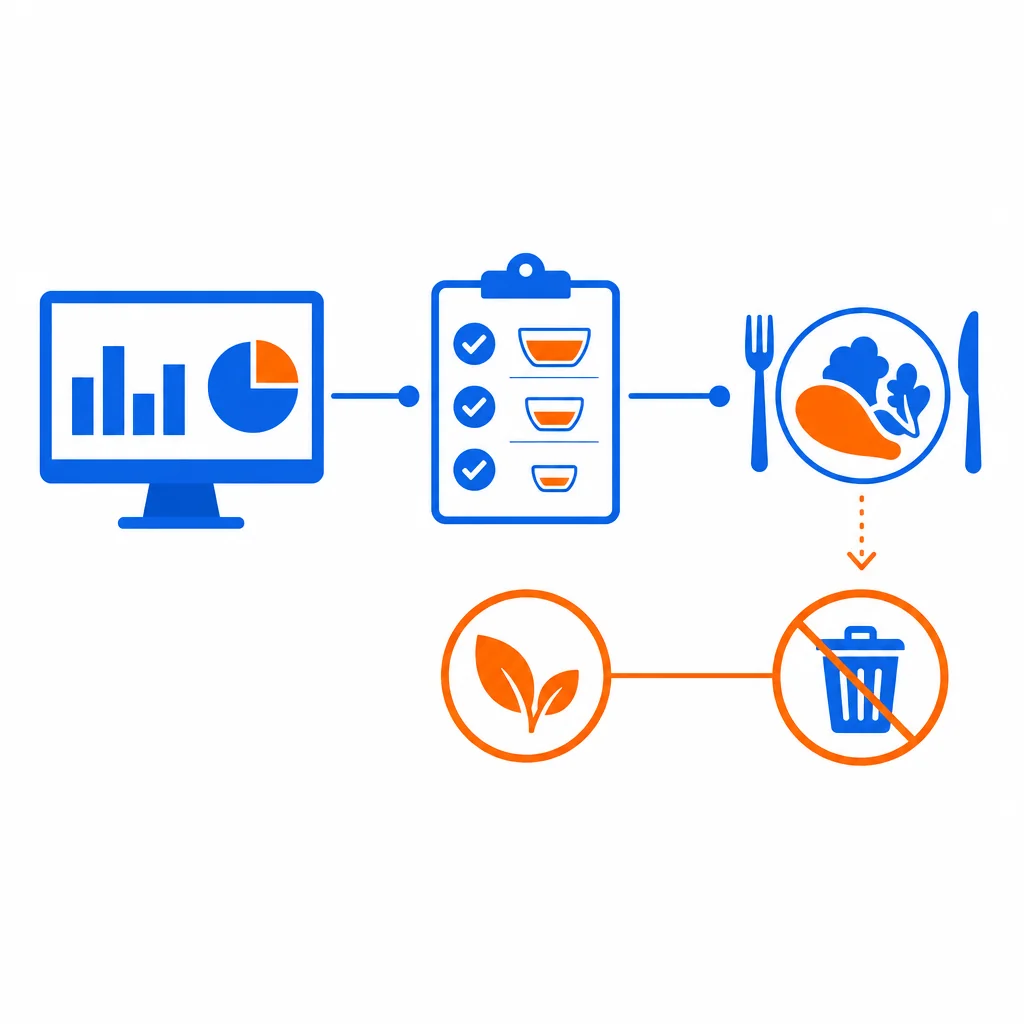
CalcMenu gives your teams real quantities, cost per portion and menu traceability. Less overproduction, fewer labelling errors, fewer meals thrown away — without adding complexity to the day-to-day.
Before / after
CSR reports, food carbon footprints and grant application files take weeks to assemble. The annual EGAlim report is behind schedule.
CalcMenu calculates the environmental impact of your recipes (Agribalyse ADEME/INRAE), generates your CSR reports and grant application files, and updates environmental labelling in real time. The carbon footprint becomes routine.
Why this feature matters
This feature is built directly into the CalcMenu recipe and menu database. The same data serves kitchen, service, and administration—no re-entry, no paper versions.
CalcMenu gives your teams real quantities, cost per portion and menu traceability. Less overproduction, fewer labelling errors, fewer meals thrown away — without adding complexity to the day-to-day.
What it gives you
Production matched to real demand
CalcMenu calculates requirements from validated menus and orders by floor or site. You prepare the right amount, not double 'just in case'.
Portions and costs under control
Every recipe shows portion weight and food cost. Variances show up immediately: you correct before waste becomes a habit.
Less paper, fewer errors
Digital recipe cards, menus and labels replace paper. When a dish or allergen changes, the information updates everywhere at once.
Agribalyse: carbon footprint per recipe and ingredient
CalcMenu integrates Agribalyse data (ADEME/INRAE) to automatically calculate the environmental impact of each recipe: CO₂ emissions, water consumption, land use. You get an environmental score per dish, per menu and per period — ready for your CSR reports, EGAlim and environmental labelling.
Sustainability reports ready for grants and CSR audits
More and more funders, certifiers and CSR frameworks ask local authorities, healthcare facilities and businesses to document food waste reduction and carbon impact. CalcMenu automatically generates traceable food carbon footprint, waste reduction and environmental impact reports — ready to attach to grant applications and CSR audits. No more weeks of manual collection.
EGAlim diner information and environmental labelling
The EGAlim law requires institutional caterers to inform diners about the share of sustainable and quality products in menus, and France's Climat et Résilience law is rolling out environmental labelling for food — still voluntary today. CalcMenu calculates the carbon score of each menu, generates displays for kiosks, screens and paper menus — and updates them in real time when a recipe changes. You are ready for both.
How it works
Import your recipes and sales
CalcMenu calculates costs and portions from your existing recipe specs. You immediately see where planned quantities diverge from reality.
Plan by site, by day, by menu
KitchenPlan and floor orders give teams the right production volume. Fewer leftovers, less catch-up at the end of service.
Measure and adjust
Track actual cost per menu and production variances. Chefs adjust quantities, portions and workflows to reduce waste week after week.
Enable the Agribalyse module
CalcMenu automatically enriches your recipes with ADEME/INRAE environmental data. Each ingredient receives its carbon, water and land score. The balance is calculated in real time — no manual entry, no external spreadsheet.
Generate CSR and sustainability reports in one click
Select the period, site and report type (carbon footprint, waste reduction, environmental impact). CalcMenu exports in PDF or Excel format, ready to attach to grant applications and CSR audits. Data is traceable and verifiable.
Display environmental scores on your menus
CalcMenu automatically pushes carbon scores to your digital screens, reception kiosks and paper menus. When a recipe changes, the display updates everywhere — ready for EGAlim diner information and environmental labelling, without manual intervention.
Most Food Waste Is Decided Before Service Starts
By the time food is scraped into a bin, the decision that created that waste was usually made hours or days earlier: a production plan built on guesswork instead of real orders, a recipe with no reliable portion weight, a menu change that never reached the kitchen floor. Measuring what ends up in the bin is useful — but it only shows you the symptom.
CalcMenu works upstream of the bin: it calculates the quantities your kitchen actually needs from validated menus and orders, tracks portion weight and cost per recipe, and flags variances before overproduction becomes routine.
CalcMenu vs Winnow, Kitro, Leanpath, Orbisk & Too Good To Go for Business
If you’re comparing CalcMenu to a waste-scanning camera-and-scale system — Winnow, Kitro, Leanpath, Orbisk, and similar tools — or to a surplus-redistribution platform like Too Good To Go for Business, here’s the honest comparison: these solve a different part of the waste problem, and most kitchens get more value running them together than picking one over the other.
Winnow, Kitro, Leanpath, and Orbisk install a camera and/or smart scale above or inside the kitchen bin. Every time food is thrown away, the system weighs and photographs it, then uses AI to identify what was wasted and builds a dashboard of loss by category. These are legitimate, effective products: independent reporting on this category cites waste reductions of up to 50% and payback periods as short as a few months once the hardware is installed.
CalcMenu takes a different, earlier point in the chain. It doesn’t measure what’s already in the bin — it reduces how much gets there in the first place, by tying production quantities to real demand, and it does this without any additional hardware, camera, or bin-side device, because it runs on the menu, recipe, and order data your kitchen already has.
| CalcMenu | Winnow / Kitro / Leanpath / Orbisk | Too Good To Go for Business | |
|---|---|---|---|
| Approach | Prevention — plans production from real menu and order data | Measurement — weighs and photographs waste at the bin | Redistribution — resells or donates surplus that already exists |
| Hardware required | None — uses data you already have (recipes, menus, orders) | Yes — dedicated camera and/or smart scale per bin | None for the core app, though enterprise retail tooling exists |
| What it tells you | How much to produce, and where portions or costs are drifting | What was thrown away, by category and cost | What surplus is available for pickup or donation |
| Best used | Before and during production planning | At the point of disposal, to quantify and categorise loss | After the fact, for food that would otherwise be thrown away |
Is CalcMenu a Winnow, Kitro, Leanpath, or Orbisk alternative?
Not exactly — and it’s worth being upfront about that. If what you need is bin-level measurement (exact grams of waste per dish, photographed and categorized as it happens), Winnow, Kitro, Leanpath, and Orbisk do that better than CalcMenu, because that’s the one thing they’re built for. What CalcMenu replaces is the guesswork upstream of the bin: production quantities based on real orders instead of habit, recipe costs that update automatically, and portion control that catches drift before it becomes waste. A kitchen that already has bin-scale hardware installed can still use CalcMenu to plan tighter production in the first place — the two approaches address different points in the same problem, and a lower starting volume of waste only makes a bin-side measurement tool more effective, not redundant.
Is CalcMenu a Too Good To Go for Business alternative?
No — they’re not solving the same problem. Too Good To Go for Business helps you resell or give away surplus food that already exists, after the fact. CalcMenu helps you produce closer to actual demand so there’s less surplus to begin with. A kitchen can use both: CalcMenu to tighten production planning, and Too Good To Go for Business as a safety net for whatever surplus still slips through.
How CalcMenu Reduces Waste in Practice
- Production matched to real demand. Requirements are calculated from validated menus and orders by floor or site, so kitchens prepare the right amount instead of a safety margin “just in case.”
- Portions and costs under control. Every recipe shows portion weight and food cost, so variances between plan and reality show up immediately — before they become habitual overproduction.
- Fewer paper-driven errors. Digital recipe cards, menus and labels replace paper versions. When a dish or allergen changes, the update reaches every document at once.
Carbon Footprint, Not Just Bin Weight
CalcMenu integrates Agribalyse data (ADEME/INRAE) to calculate the environmental impact of every recipe — CO₂ emissions, water use, land use — giving an environmental score per dish, per menu, and per period. Waste-scanning hardware tells you what was thrown away; this tells you the carbon cost of what was served in the first place, ready for CSR reports, EGAlim compliance, and environmental labelling.
Reporting Without the Manual Collection
CalcMenu generates traceable food carbon footprint, waste reduction, and environmental impact reports in one click, exportable to PDF or Excel and ready to attach to grant applications and CSR audits — replacing the weeks of manual data collection that funders and certifiers increasingly require.
To see how production planning and carbon reporting fit into your kitchen’s existing recipe and ordering data, request a demonstration.
Explore CalcMenu's recipe management software for restaurants, hotels & catering to see how it applies to your kitchen.
For which sectors
Used by institutional caterers and chains to reduce overproduction and make portions more reliable without adding workload.
Beach resorts & islands
Extreme seasonality, supply by boat, expensive energy and water. Pricing adapted to isolation and season length.
School catering
Safe, balanced menus that stay consistent across every school.
Corporate restaurant
Forecast footfall, control food cost, display everything at self-service.
Staff Canteens & Corporate Restaurants
Hundreds of covers a day, zero guesswork: menus, allergens and costs fully under control.
Caterers & contract catering
Custom menus per client, with different allergen and cost requirements for every contract.
Supermarket & large retail
Thousands of products labelled every day, from allergens to best-before dates, from fresh counters to bakery.
University dining
Thousands of students, multiple campuses, one safety standard.
Fast-casual
Fresh, customisable menus, standardised across the chain.
Hospitality
Multi-outlet, RevPASH, luxury. Baur au Lac.
Luxury hospitality
One reference recipe, shared across all your restaurants.
Mountain resorts & ski stations
Short season, rotating teams, multi-outlet dining, all-inclusive. Pricing adapted to your season length.
Resort & casino
The same numbers across every outlet.
Food manufacturer
The recipe becomes a product: compliant labels and exact declarations, at scale.
Bakery & pastry
Best-before labels, allergens and shelf prices without the paperwork.
Hospital
Clinical dietetics, IDDSI, full traceability. For hospital kitchens where errors are not an option.
Hotels & Restaurants
Recipes, food cost, allergens and labels. One tool for your entire kitchen brigade.
Sandwich chain
Master recipe followed, cost controlled, label compliant in every store.
Café & brasserie
A menu that changes daily, reliable recipe specs, without complexity.
Bakery-café & fast-casual chains
Same quality, same cost, same compliance in every store.
Quick-Service Restaurants (QSR)
Master recipes, allergens, labels and costs synced across hundreds of outlets.
Franchise operators & multi-unit groups
A replicable, controlled and compliant business model in every territory.
Restaurant chains
Same recipes, same costs, same standards across every restaurant.
More CalcMenu features
Menus & recipes
Every recipe and menu in one database, always up to date and in four languages for the whole brigade.
Diets & textures
Turn any menu into the diets and textures you need (puréed, minced, IDDSI) without recalculating a single recipe.
Allergens & traceability
Allergens and nutrition calculated automatically from your recipes, ready for inspection.
Label Connector (NiceLabel)
From recipe to printed label: CalcMenu sends allergens, nutrition and shelf-life to your NiceLabel printers automatically.
Orders by floor / station
Each floor or ward orders its meals and diets online; the kitchen receives one consolidated summary.
Multi-site
Share recipes and standards from a central kitchen while each site adapts its own menus.
HACCP & safety
Temperatures, batch traceability and cleaning logs recorded continuously: always inspection-ready.
Food cost & purchasing
Each recipe's cost updates with supplier prices; steer your margins and orders with precision.
Electronic shelf labels (ESL)
Buffet, menu and price labels updated instantly from CalcMenu, with allergens and origin, no reprinting.
Nutrition & analysis
Calculate nutritional values per portion and adapt menus to specific diets. US FDA panel format in development.
Self-Service Meal Ordering
Patients and residents order their meals from a tablet or room screen: diets respected, allergens checked, kitchen orders consolidated automatically.
IDDSI textures
Apply IDDSI levels to recipes and ensure meals suitable for dysphagic patients.
15 minutes to see if CalcMenu changes your day-to-day.
We won't sell you software. We'll look at what's wearing you down today and check together if CalcMenu fits.
Talk to a human — 15 min