
The best-designed menu in the world? The psychology behind it
A color-coded menu from a restaurant in Portugal — Menu Amarelo, Menu Laranja, Menu Vermelho — went viral as "the best-designed menu in the world." What color-coded, no-numbers menu design actually does to a guest's decision, and four other restaurants that solved the same problem in different ways.
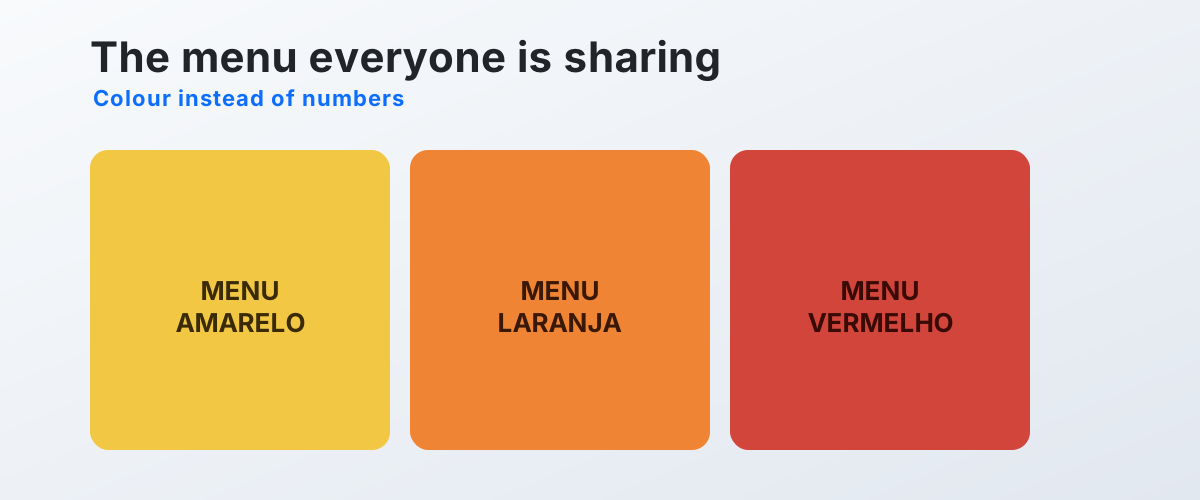
A clip has been circulating showing a specials board from a restaurant in Portugal. No “Menu 1, Menu 2, Menu 3.” Instead: Menu Amarelo (yellow), Menu Laranja (orange), Menu Vermelho (red) — each a complete fixed set of starter, main and dessert at one price, printed as a block of color rather than a numbered list. The caption asked whether it was the best-designed menu in the world. It’s a fair question, and it’s worth answering properly rather than just admiring the photo.
What a number does that a color doesn’t
Call a set menu “Menu 1,” and you’ve said something about it whether you meant to or not: it’s the first one, the entry-level one, the one you pick if you’re not going all-in. “Menu 3” reads as the upgrade. A numbered list is a ladder, and nobody wants to be seen picking the bottom rung — which either pushes guests toward the priciest option to avoid feeling cheap, or toward the cheapest because the ladder makes them self-conscious about spending. Either way, the number is doing psychological work you didn’t ask it to do.
A color does none of that. Yellow isn’t “worse” than red. They’re just different — different moods, different combinations, different occasions. Swapping the ladder for a palette lets a guest choose based on what they actually want to eat, not on where the option sits in a hierarchy. It’s the same reframing behind why a wine list organized by style (“light and crisp,” “bold and structured”) outsells one organized by price, and why the fixed-price meal itself — no à la carte decision-making, no dollar figure next to every dish — already does a lot of this work before color ever enters the picture. A 2007 study run at Cornell’s teaching restaurant, the CIA’s St. Andrew’s Café, found that removing the explicit ”$” and “dollars” from a menu increased average spend by over 8% — visible price cues appear to activate a small, real “pain of paying” that a guest doesn’t consciously notice but reliably responds to. A menu that hides the ladder and mutes the price is stacking two separate psychological effects, not one.
None of this needs a marketing department to engineer. The Portuguese board wasn’t produced by a behavioral science consultancy — it’s a chalk-and-paint specials board, doing this by instinct. That’s the real headline: good menu psychology is often just good taste, arrived at without anyone naming the mechanism.
Four other restaurants that solved the same problem differently
Alinea (Chicago) sells tickets, not reservations. Co-owner Nick Kokonas built a system — later spun out as the reservation platform Tock — where a seat is bought upfront like a theater ticket, non-refundable, sometimes at a dynamic price depending on demand for that date and time. It sounds like a small operational change. It removes the entire psychology of the no-show (there’s no show to no to — you already paid) and it turns “going to dinner” into “going to an event you already committed to,” which changes how a guest anticipates and values the meal before they’ve eaten a bite. Alinea’s own reporting after the switch showed profit up 38%.
Omakase removes the menu entirely. No categories, no prices per course, often no printed list at all — you tell the chef your budget and any restrictions, and the rest is trust. This is the opposite of the Portuguese board’s approach (color still gives structure) but it’s solving the identical underlying problem: too many independent decisions exhausts a guest before the meal even starts. The paradox-of-choice research behind this is well established — past a certain number of options, more choice measurably makes people less satisfied with whatever they pick, not more.
The French bistro chalkboard plat du jour. One dish, maybe two, hand-written, changes daily. No menu at all beats a menu with too many options for the same reason omakase does — and it does double duty as a freshness signal: a board that’s rewritten every morning implies a kitchen that’s shopping every morning, whether or not that’s literally true.
Every genuinely great tasting menu is really a queue, not a catalog. Course order is fixed, portions are calibrated to build toward a finish rather than fill a stomach, and the “choice” a guest makes is really just committing to the ride. It borrows the same logic as the fixed-price board: remove the decision, and you remove the friction that comes with it.
The part that’s hard to see from a photo
Here’s what a viral 15-second clip of a beautiful color-coded board can’t show you: what it takes to run that board correctly every single day. A fixed menu that changes daily still needs each of its three or four versions costed accurately, its allergens declared correctly per dish — not per “the yellow one,” per actual ingredient — and its content pushed to the board, the printed insert and the till at the same time, in whichever language the kitchen, the front of house and the guest each need. A restaurant that reprints a laminated board from a spreadsheet every morning is one missed line away from an allergen declaration that doesn’t match what’s actually in the pan.
That’s the unglamorous half of great menu design: the psychology gets the credit, but the plumbing underneath — recipe costing, allergen tracking, same-day publishing to every channel from one source of truth — is what lets a kitchen run a menu this disciplined without it becoming a daily liability. It’s exactly what CalcMenu’s menus and recipes and allergen modules are built to carry, so the color on the board can stay the fun part.
Want to run a fixed menu this disciplined without the daily spreadsheet risk? Book a free 15-minute call with our team — no commitment: Schedule a call.
Sources
- Cornell Chronicle — Diners spend more when menus don’t use dollar signs
- Robb Report — Nick Kokonas Is Leaving Tock, the Reservation Platform He Founded
Explore CalcMenu's recipe management software for restaurants, hotels & catering to see how it applies to your kitchen.
Related sectors
Comments
Comments coming soon.