
The Japanese sando is having a global moment — and it works just as well sweet as it does salty
From a 1935 geisha's breakfast shortcut to a viral 7-Eleven launch in the US, Japan's sando has become one of food service's most versatile trends. The same milk-bread format carries a fried pork cutlet and a cream-and-fruit dessert equally well — here's the history, and what makes it travel.
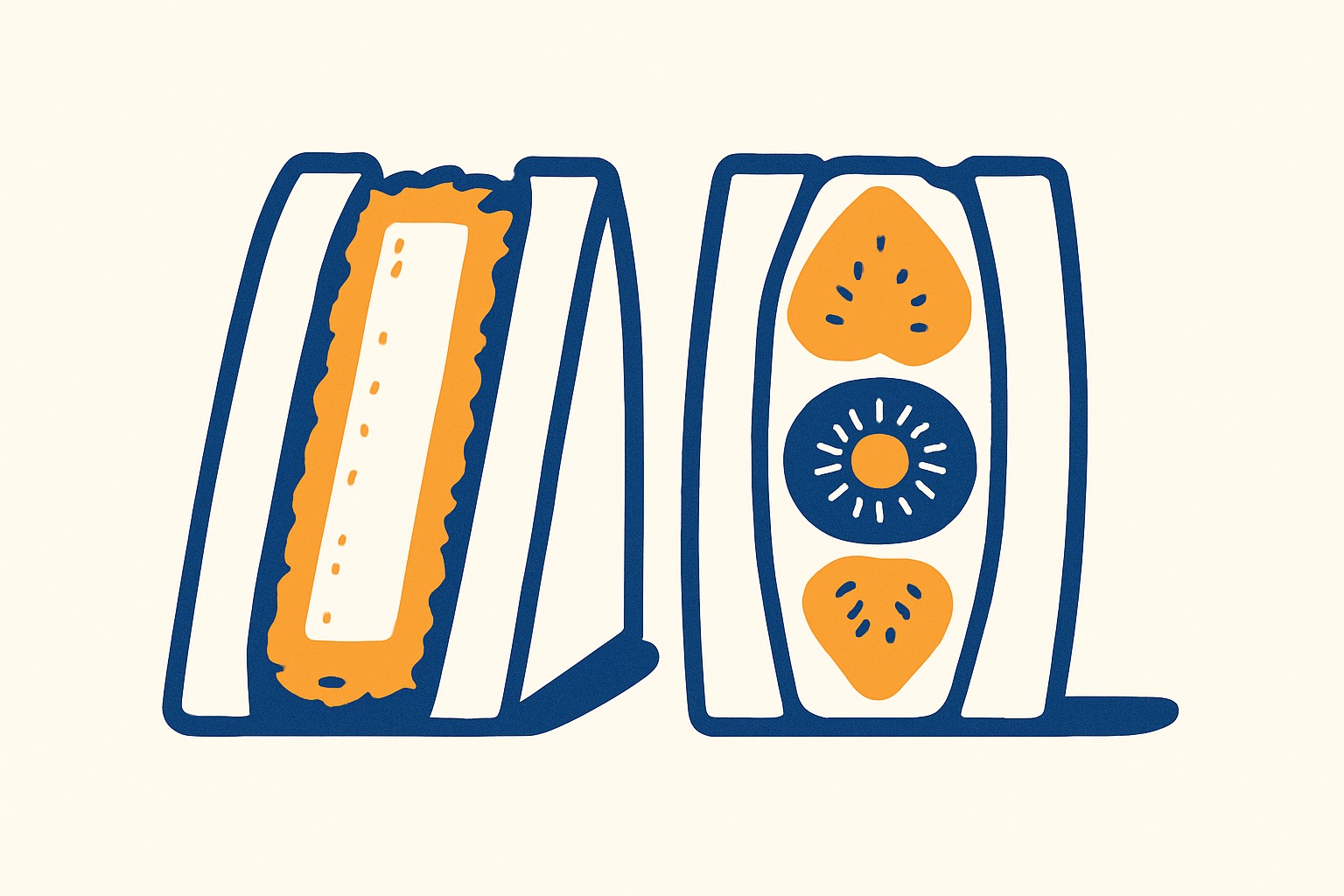
One sandwich format, two completely different menus
On December 3, 2025, 7-Eleven announced from its Irving, Texas headquarters that it was bringing its “Japanese-Style Egg Salad Sandwich” to US stores nationwide. That’s a convenience-store chain putting real marketing weight behind a sandwich that, in Japan, already sells more than any other packaged sandwich on the shelf. The launch wasn’t a gamble — it was catching up to a trend that had been building on social media for years, with travelers posting videos of flying to Japan partly to eat a $3 egg sandwich from a konbini fridge.
That sandwich is a sando: crustless, precisely cut, built on soft milk bread. What makes the sando format unusual isn’t just the egg version — it’s that the exact same construction method produces Japan’s most popular savory snack (tamago sando), one of its most respected street-food exports (katsu sando), and one of its most visually striking desserts (fruit sando). Most sandwich formats pick a lane. The sando works sweet and salty with equal conviction, and that versatility is a big part of why it’s traveling so well right now.
Salty: the egg sandwich that conquered 50,000 convenience stores
Japan has more than 50,000 konbini, dominated by three chains — 7-Eleven, Lawson and FamilyMart — and the single best-selling store-bought sandwich across all of them is the tamago sando: triangles of soft, faintly sweet shokupan milk bread around a rich egg salad bound with Kewpie mayonnaise, Japan’s egg-yolk-only mayo prized for its umami depth. The three chains don’t make it identically, and Japanese food writers treat the differences the way beer critics treat regional breweries: 7-Eleven’s is the largest, heaviest and most expensive of the three at 340 calories; Lawson’s uses a specially milled bread roughly 30% thicker than its rivals’, and its version got a name-check on Anthony Bourdain’s Parts Unknown; FamilyMart’s is the thinnest and cheapest, with the least protein but more than double the sodium of the others. Three companies, one format, three genuinely different products — sold from a refrigerated case, at convenience-store margins, at a scale most restaurant sandwiches never reach.
 Same format, three genuinely different products: Japan’s three biggest konbini chains each make their own version of the tamago sando, and food writers compare the differences the way beer critics compare regional breweries.
Salty: katsu sando, invented so a geisha wouldn’t smudge her lipstick
The fried pork cutlet at the center of katsu sando has its own separate origin. Tonkatsu — a breaded, deep-fried pork cutlet — first appeared on a Tokyo menu in 1899 at Rengatei, a Western-style restaurant in Ginza still serving today, where it was adapted from French côtelette de veau. It took another 36 years for someone to put it between bread. In 1935, at a tonkatsu restaurant called Isen in Ueno — a hanamachi district where geishas lived and worked — the manager was eating breakfast one morning and had the idea of sandwiching a cutlet between bread for easy eating, the same logic behind a sushi roll. Because Isen’s regular clientele were geishas on their way to work, the restaurant had small, crustless bread specially made so the sandwich wouldn’t smear their lipstick. A practical fix for one restaurant’s specific customers became, ninety years later, a dish served in fine-dining tasting menus and food-cart windows from Portland to London.
Sweet: fruit sando came from luxury fruit shops, not bakeries
The sweet side of the format has an entirely different lineage. Sembikiya, which opened Japan’s first fruit parlor in 1868, built its reputation on “Western” luxury foods — mango-infused curry, strawberry milk, and fruit desserts sold to a clientele that could afford them. Fruit itself was a luxury good in Japan through the Taishō era (1912–1926), popular as a formal gift, and fruit shops across Tokyo and Kyoto opened attached parlors serving parfaits, tarts and, eventually, sandwiches: crustless milk bread, whipped cream, and whole or halved pieces of seasonal fruit — strawberry, muscat grape, kiwi, mikan, peach, melon — arranged so that when the sandwich is sliced in half, the cross-section reveals a deliberate pattern. That cross-section is exactly what makes fruit sando so suited to the current moment: it was engineered as a visual object a full century before anyone had a phone to photograph it with.
 The deliberate cross-section pattern is the whole point of a fruit sando — a visual technique developed in Japan’s fruit parlors nearly a century before smartphone cameras existed.
Why the same construction works in both directions
Three things make the sando format unusually portable between savory and sweet, which is rare for any single sandwich construction:
- The bread is neutral by design. Shokupan is soft, faintly sweet, and deliberately mild — built to support a filling rather than compete with it, unlike a baguette or a bagel, both of which have a strong enough character that they push every filling in one direction.
- The crustless, precisely cut format reads as a small, complete object either way. A katsu sando cut into two rectangles and a fruit sando cut into two triangles both photograph the same way — a clean cross-section, no crumbs, no drips. That single visual grammar is why both versions travel identically well on social media.
- Neither version requires cooking à la minute. Egg salad, breaded-and-fried cutlet, and whipped cream with fruit are all things a kitchen can prep ahead and assemble to order — the sando’s economics were built around a convenience store’s operating model, not a chef’s.
Is this a döner kebab, or a Dubai chocolate?
Every food trend eventually splits into two categories: the ones that peak and fade within a year or two, and the ones that quietly become permanent menu infrastructure. Japanese cuisine as a whole has already made that jump once in Western markets — conveyor-belt sushi arrived in London in 1997 and never really left. The sando looks like it’s following the same trajectory rather than a shorter one. It isn’t riding a single viral ingredient the way Dubai chocolate rode pistachio and knafeh; it’s riding an entire construction method that already has three independent, decades-old use cases behind it in its home market, plus a convenience-store supply chain proving it can be produced at genuine volume. Los Angeles’ Konbi built a cult following on convenience-store-style sandos and has since shifted to a reservation-only format; Japanese minimarket concepts have opened multiple locations in New York over the past year; and 7-Eleven’s US rollout is a chain betting on sustained demand, not a limited-time promotion. None of that guarantees permanence — but it’s a different shape of bet than most single-item food trends make.
What this means for a kitchen adding a sando to the menu
A sando line is genuinely one of the more approachable trend additions available right now, for reasons that map directly onto kitchen operations rather than just flavor:
- Batch prep, portion-controlled assembly. Egg salad, cutlet breading, and fruit-and-cream filling can all be prepped in batches and portioned to a fixed weight, which is exactly the kind of standardization that keeps food cost predictable across shifts.
- A small, controllable allergen set — but not a zero one. Nearly every version of the sando touches egg (mayonnaise or egg salad), gluten (shokupan) and dairy (cream, or the mayo’s base). That’s a short list to document accurately, but it needs to be documented on every variant, since the savory and sweet versions carry different allergens in different concentrations.
- High photographability, low equipment cost. Unlike a lot of visually driven trend dishes, a sando line doesn’t require new kitchen equipment — a fryer for katsu, a mixer for whipped cream, and a bread slicer cover most of it — which lowers the cost of testing it before committing to a permanent menu slot.
How CalcMenu keeps a sando line’s numbers as tight as its cross-section
The whole appeal of a sando is precision — a clean, consistent cut every time. That same discipline needs to extend to the food cost and allergen data behind it, especially once a savory and a sweet version are both running on the same prep line.
- Recipe costing that separates every variant — a katsu sando and a fruit sando look related on the menu but have almost nothing in common on the ingredient side; costing them as if they were interchangeable hides real margin differences.
- Allergen tracking that follows egg, gluten and dairy through every version, so a substitution in one variant (a different mayo, a dairy-free cream) doesn’t silently break the allergen data on the others.
- Portioning and standardization that keeps a fixed fill weight consistent whether the kitchen is running ten sandos a day or two hundred, which is exactly the discipline the format was built around in the first place.
CalcMenu can’t tell you whether the sando trend lands closer to sushi’s three-decade run or a Dubai-chocolate-style spike. It can make sure that whichever version ends up on your menu is costed, allergen-documented, and portioned as precisely as the sandwich itself looks.
Related reading
- Bubble tea, fried chicken, Dubai chocolate: how long do food trends actually last in Europe?
- Hawaii’s plantation kitchens invented poke bowls, saimin, and Spam musubi using the same Japanese onigiri technique that shaped the sando
- Profitability #6 — Portioning and standardization: same plate, same cost, every time
- The hot dog took 50 years to become American. The Korean taco truck did it in one Twitter feed.
Thinking about adding a sando line to your menu? Book a free 15-minute call with our team — no commitment: Schedule a call.
Sources
- 7-Eleven, Inc. Introduces Japanese-Style Egg Salad Sandwich to U.S. Stores – PR Newswire
- Japan’s viral 7-Eleven egg salad sandwich launches in the U.S. – CBC News
- Japanese Konbini Egg Sandwich 7-Eleven, FamilyMart, Lawson – No Recipes
- What Makes Japanese 7-Eleven’s Egg Salad Sandwiches Downright Legendary – Foodie
- Katsu-sando – Wikipedia
- Tonkatsu – Wikipedia
- From geishas to the world: Katsu sando, then and now – SBS Food
- The Trendy Origins Of Japan’s Famous Fruit Sando – Food Republic
- Sweeten Your Springtime With Japan’s Fruit Sandwiches – Atlas Obscura
- Sando—the cult sandwich from Japan – Kikkoman
- Konbi – Yelp
Explore CalcMenu's recipe management software for restaurants, hotels & catering to see how it applies to your kitchen.
Related sectors
Comments
Comments coming soon.