
One clause in the FDA Food Code lets a kitchen skip temperature checks on prepped food entirely — replacing the thermometer with nothing but an accurately written label
Most food-safety rules for prepped food revolve around temperature: keep it cold, keep it hot, check it regularly. A specific US FDA Food Code provision — Time as a Public Health Control — allows an establishment to legally skip temperature monitoring altogether and control safety with time alone, provided every batch is marked with the exact time it must be sold, served or discarded. The entire legal compliance burden shifts onto one thing: the label being right, every single time.
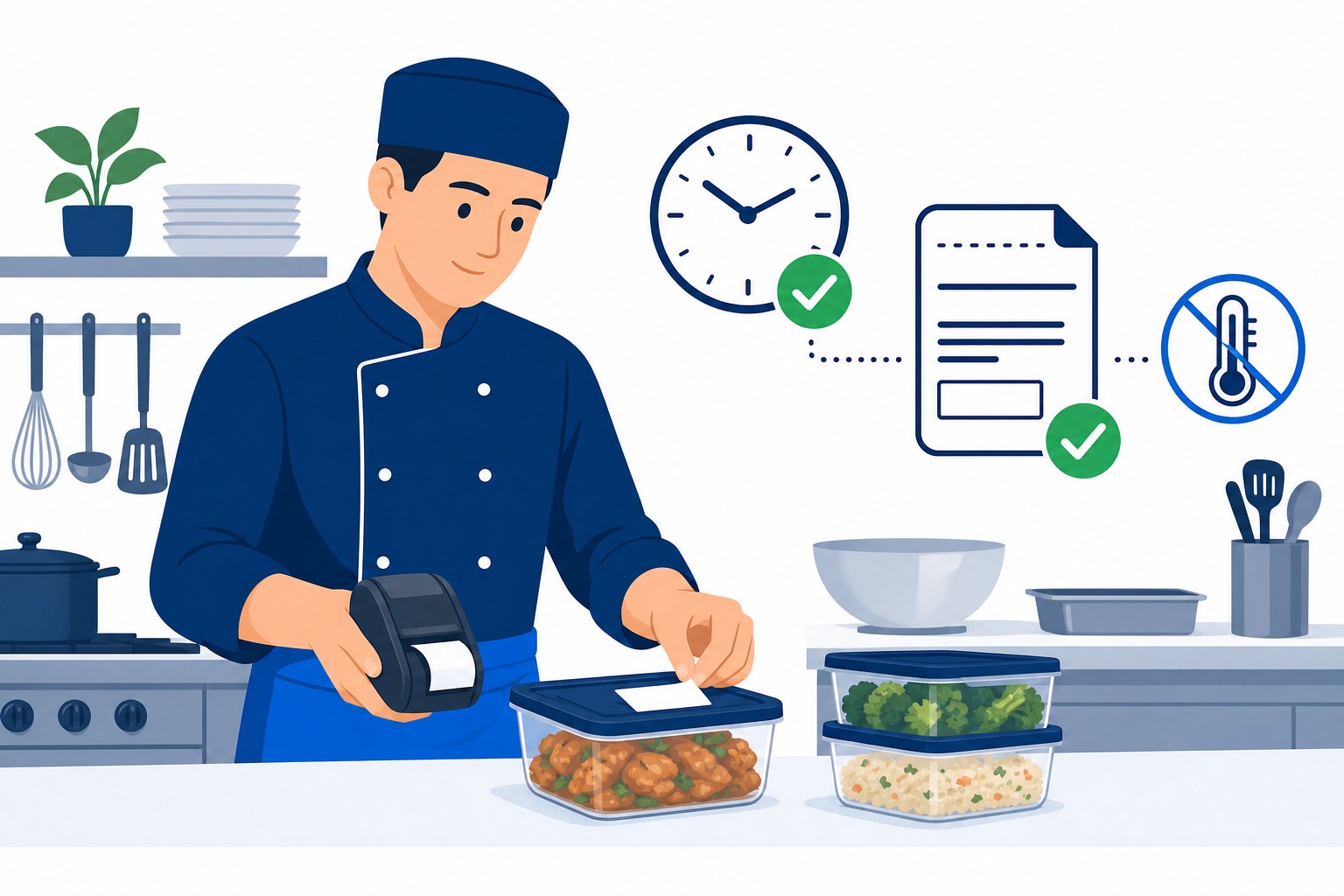
The default rule is temperature. There’s a lesser-known exception.
This is a US-specific rule — food-safety frameworks vary significantly by country, and this exact provision has no direct equivalent elsewhere. The EU’s HACCP-based framework (Regulation (EC) 852/2004), the UK’s own post-Brexit rules, Switzerland’s food law, and Australia’s FSANZ code are each built differently, without an identical fixed-hour time-only allowance. With that scope in mind: most food-safety frameworks for prepped, ready-to-eat food are built around temperature control — keep cold food below a threshold, keep hot food above one, and document it regularly. The FDA Food Code — the model code most US state and local health departments adopt, first published in 1993 and updated periodically since — calls this category of food “TCS” (Time/Temperature Control for Safety), a class of items that support rapid bacterial growth if left in the temperature “danger zone” too long.
Time as a Public Health Control: the alternative most kitchens don’t use
Buried in the Food Code (section 3-501.19) is a genuinely different option: Time as a Public Health Control (TPHC). Under a written procedure approved by the local regulatory authority, an establishment can control a TCS food using time alone, with no temperature monitoring required at all during that period. The food must be marked, at the moment it’s prepped or pulled from temperature control, with either the time it was removed or the exact time by which it must be sold, served, or thrown away — commonly a 4-hour maximum, or up to 6 hours under a stricter set of conditions (starting cold, at or below 41°F/5°C, and never exceeding 70°F/21°C during the window). Once that clock runs out, the food is discarded, full stop, regardless of how it looks or smells.
Why this is a bigger deal than it sounds
The practical effect is striking: an entire category of food-safety compliance shifts from a continuous physical measurement — checking and logging temperature — to a single act performed once, at the start, when the food is prepped. That single act is writing the correct time on the container. There’s no second chance to catch an error later the way a missed temperature check might still get caught on the next round. If the label is wrong, illegible, or simply missing, the safety control behind it doesn’t exist — even though the food might be sitting at a perfectly safe temperature the entire time.
Where this actually breaks down in a real kitchen
This is exactly where manual labeling under time pressure tends to fail. A prep cook doing mental math mid-shift, a piece of tape that’s peeled off, a marker that’s run dry, a handwriting scrawl nobody can read at hour three of a rush — none of these are hypothetical failure modes, they’re the ordinary, daily reality of any kitchen still labeling prepped food by hand. Under TPHC specifically, that’s not a minor inconvenience; it’s the entire compliance mechanism failing silently, with nothing else standing behind it.
What this means for how prepped food gets labeled
Whether or not a kitchen formally operates under a TPHC procedure, the underlying lesson applies to any prep-labeling discipline: the label is not paperwork attached to the safety control, it is the safety control.
- Time labels need to be calculated, not estimated — a discard time that’s mentally approximated under pressure is exactly the failure mode this provision depends on not happening.
- Legibility and consistency matter as much as accuracy — a correct time nobody can read is functionally the same as no label at all.
- The record needs to survive an inspection, not just a shift — an inspector checking TPHC compliance is checking whether every batch, every day, was marked correctly, not just today’s.
Where BlazeIQ Labels fits
BlazeIQ Labels removes the exact point of failure this depends on: it calculates the use-by or discard time automatically — from CalcMenu recipe data, or from a simple time-and-date rule — and prints it to a thermal label in one tap, on a Bluetooth or network printer. No mental math under pressure, no handwriting to misread, no tape that’s peeled off silently. The base app is free; compliance modules for cold chain, freeze/thaw and staff tracking activate on request.
Running a kitchen that relies on accurate prep labeling? Book a free 15-minute call with our team — no commitment: Schedule a call.
Sources
- FDA Food Code 2022 — Full Document
- Time as a Public Health Control for Cut Tomatoes — FDA
- Fact Sheet: Time As A Public Health Control — Tennessee Department of Health
- Time as a Public Health Control (TPHC) Guidelines — UC Berkeley EH&S
Explore CalcMenu's recipe management software for restaurants, hotels & catering to see how it applies to your kitchen.
Related sectors
Comments
Comments coming soon.