
Ask three chefs the same question: what 'my kitchen doesn't need labels' actually costs
The most common objection to prep labeling is also the easiest to test: ask three experienced chefs on the same team the same shelf-life question and compare the answers. What that test usually reveals — and what handwritten labels actually cost once you count the minutes and the downside risk, not just the sticker price of a system.
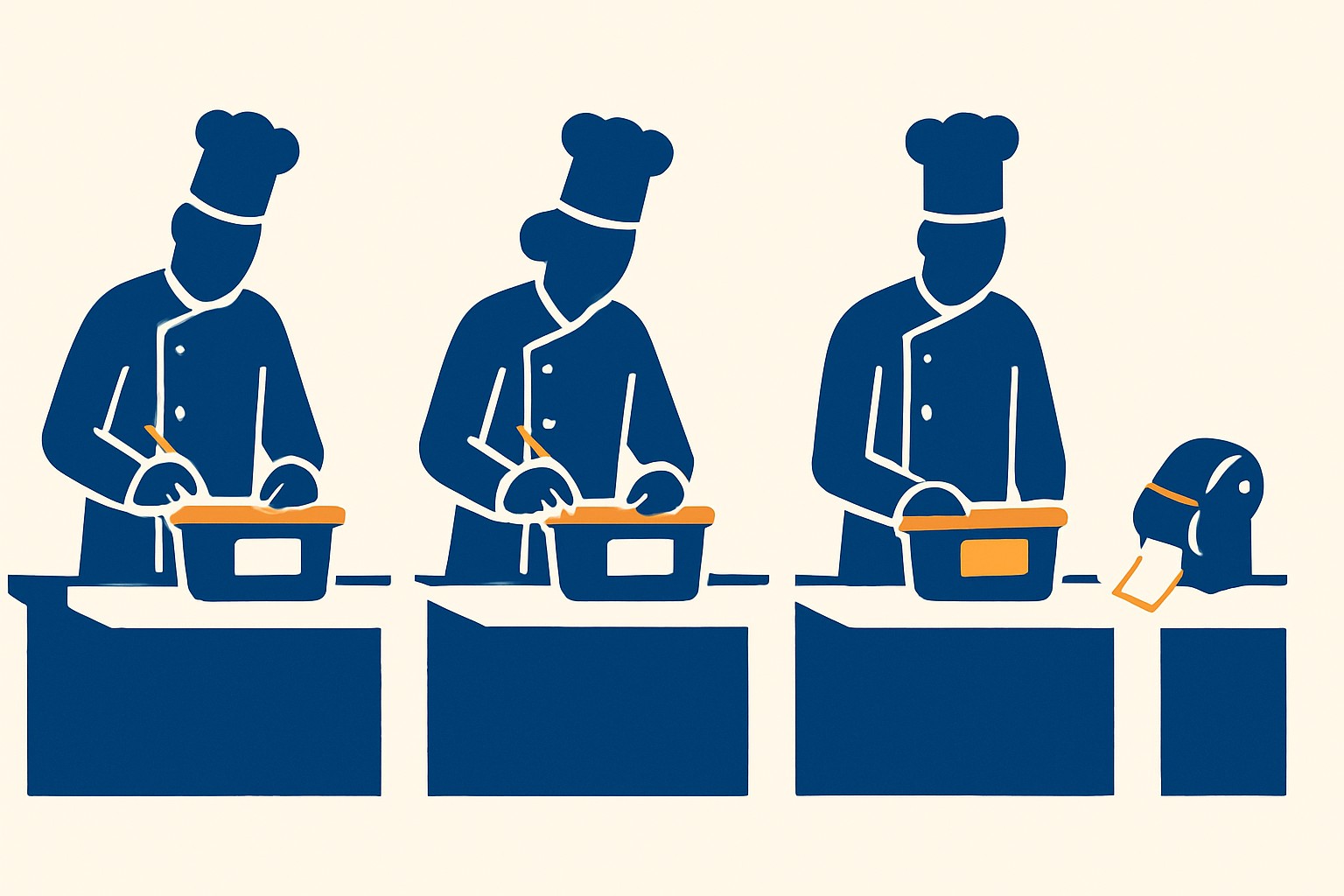
“My chefs are experienced enough not to need this”
It’s one of the most common objections a kitchen-labeling pitch runs into, and it usually comes from a genuinely well-run operation: an executive chef who trusts their brigade, doesn’t want another gadget between the cutting board and the walk-in, and sees date labeling as a solved problem — a marker, a roll of tape, and years of experience.
The objection deserves a real answer, not a brochure. So here’s a test any kitchen manager can run in the next five minutes, before spending anything on anything.
The three-chef test
Ask three chefs on your team — separately, so they can’t confer — the same question:
“How many days can you hold diced cooked chicken in a covered container at 4°C before it must be discarded?”
Swap in any TCS (time/temperature-control-for-safety) item your kitchen actually preps. Write down all three answers before comparing them.
In a kitchen with a single documented standard that every shift actually follows, the three answers match. In most kitchens — including very good ones — they don’t. Not because any of the three chefs is wrong to be confident. Each of them is applying real experience, correctly, to what they individually learned, at whatever property or brigade they trained under, updated by whatever they’ve personally seen go bad or not go bad since. That’s exactly the problem: “experienced” describes an individual’s judgment. It doesn’t describe a shared, auditable standard — and a hotel kitchen with multiple nationalities on staff, seasonal hiring, and a rotating commis roster is precisely the environment where individual judgment and documented standard drift apart fastest.
Why the answers scatter — and why that’s not a training problem you can just talk your way out of
The best available data on this comes from the FDA’s own recall records. An analysis of FDA Recall Enterprise System data covering 1,471 major food allergen recalls (FY2013–2019) found that among the recalls with a known root cause, 71.1% traced back to labeling-associated errors — not contamination, not a supplier failure, the label itself. Digging further, 76.8% of those were attributed to inadequate label controls, split roughly between inadequate label content controls (63.5%) and inadequate label management controls (36.5%) — in plain terms, either the wrong information ended up on the label, or the right information wasn’t consistently applied, checked, or updated across the operation.
That’s the mechanism the three-chef test exposes in miniature. A label is either a system output — the same input always produces the same, correct output, regardless of who’s on the pass that day — or it’s a memory test that three different, individually experienced people will pass differently. Kitchens don’t get to choose which one an inspector, an internal brand auditor, or a plaintiff’s lawyer treats it as after something goes wrong. They only get to choose which one it actually is beforehand.
“It’s just hundreds of euros for something we don’t need” — running the actual numbers
This is the part worth doing arithmetic on, because the objection is really a cost comparison, and most of the time only one side of it gets counted.
The time side. Hand-writing a legible prep label — checking a reference chart or doing the date math, writing it clearly enough to survive a shift, sticking it down — runs somewhere in the range of 15–20 seconds per label under real kitchen conditions, closer to 20+ when it’s busy and the writer is doing the math from memory. A mid-size hotel kitchen running multiple outlets easily produces 150–300 prep labels a day. At even the low end of that range, that’s 40–75 minutes of skilled kitchen labor spent every single day writing dates by hand — done, notably, by the same experienced staff the objection says shouldn’t need to think about it in the first place.
The downside side. A peer-reviewed cost analysis of restaurant foodborne-illness outbreaks estimated total cost — lost revenue, legal fees, fines, and higher insurance — at roughly $4,000 for a small, five-person outbreak with no lawsuits, rising to $1.9–2.6 million for a 250-person outbreak once litigation and reputational damage are in the mix. Individual settlements for a single affected guest commonly run $10,000–$50,000 for moderate cases and can exceed $100,000 for severe ones. Separately, regulatory mislabeling penalties in jurisdictions like the US typically run $25–$1,000 per violation, rising to a $10,000 maximum and potential criminal exposure for repeat or fraudulent violations — smaller numbers individually, but they compound with an inspection failure or a brand-standards audit finding, neither of which stays private for long. We’ve written before about what an inspection-readiness failure actually looks like in practice, and — for hotel groups with a US-headquartered parent specifically — what happens when that failure ends up litigated at home instead of where the incident occurred.
 Minutes of daily labor on one side, a low-probability but high-severity tail risk on the other — that’s the real comparison, not “hundreds of euros vs. zero.”
Set those two sides next to each other and the “hundreds of euros” framing inverts. The cost of a labeling system isn’t competing against zero — it’s competing against 40–75 minutes of daily labor cost on one side, and a low-probability but high-severity tail risk measured in tens of thousands to millions on the other. A system that removes the labor cost and closes the consistency gap the three-chef test exposes isn’t an add-on to a kitchen that’s already good. It’s what keeps a good kitchen’s outcomes matching its reputation on the one day it’s tested.
What actually changes when the label stops being handwritten
None of this requires distrusting your chefs — it requires not asking their memory to do a system’s job. BlazeIQ Labels calculates the use-by or discard date automatically from the recipe or a time-and-date rule, and prints it to a thermal label in one tap. The date is never estimated under pressure, never illegible, and — critically for the three-chef test — never different depending on which experienced person happened to be the one writing it that day. The base app is free to try; cold-chain, freeze/thaw and staff-tracking compliance modules activate on request for kitchens that need the fuller audit trail.
The record doesn’t live on the sticker — it lives in a log book
Here’s the detail that matters most, and it’s easy to miss: the label itself is not the record. A prep label gets thrown away with the container the moment the food is used — that’s normal, expected, and fine. What survives is a separate entry in a digital log book, written the instant the label is printed, independent of whatever happens to the physical sticker afterward.
The app won’t let a print happen without a named staff member selected first, and every label carries a lot number, a batch number, and a QR code alongside the use-by date. But none of that has to be recovered from a bin to be useful: each print event is also written automatically to a log — which item, which staff member, which printer or station, and the exact timestamp — queued locally and synced the moment the connection allows, so a spotty kitchen wifi doesn’t silently swallow the record either. Ask for the history of any item, any staff member, or any station, weeks later, and it’s a query, not a search through the trash.
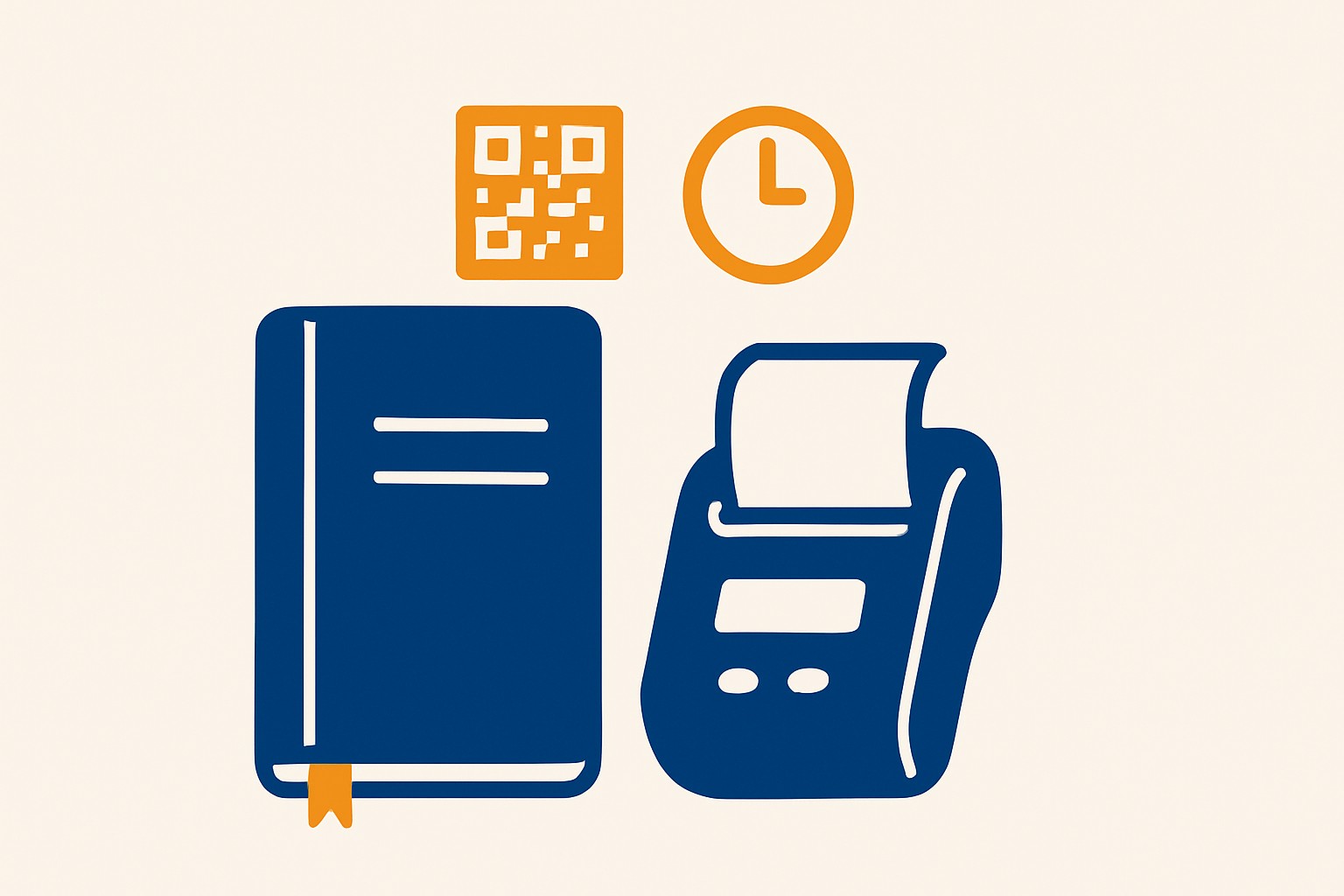 The label and the record are two different things — one gets thrown away with the container, the other doesn’t.
That single design detail cuts both ways, which is exactly what makes it useful rather than merely strict:
- When something does go wrong, root cause moves from days to minutes. Instead of asking the team who remembers prepping a specific dish on a specific evening, you query the log: which staff member printed that item, at what time, at which station, under which lot number. Documentation speed is the single biggest lever in how a food-safety incident actually resolves — a per-person, per-print record is that speed built in, not reconstructed afterward from memory.
- When nothing went wrong, it’s the fastest way to prove that, too. The same log that would catch a genuine lapse clears a kitchen just as quickly when a complaint turns out to be unfounded — the right label, the right person, the right time, no ambiguity and no multi-day internal investigation required to establish it.
It also closes a specific gap the paper era can’t. A countersigned SOP binder can be filled in by whoever was nearest the clipboard, after the fact; a print log can’t, because it’s a byproduct of the print action itself, not a separate administrative step someone has to remember to do.
Try it before you decide anything
Run the three-chef test on your own team this week. If all three answers match, you already have what a labeling system would give you — a genuinely documented, uniformly applied standard — and you don’t need us. If they don’t match, that gap is the actual product, not the sticker on a label.
Curious what a consistent answer looks like across your whole kitchen? Book a free 15-minute call with our team — no commitment: Schedule a call.
Sources
- Most Major Food Allergen Recalls Caused by Preventable Labeling Errors, Study Finds — Food Safety Magazine (FDA Recall Enterprise System data, FY2013–2019)
- Estimated Cost to a Restaurant of a Foodborne Illness Outbreak — PMC / National Institutes of Health
- A Foodborne Illness Outbreak Could Cost a Restaurant Millions, Study Suggests — Johns Hopkins Bloomberg School of Public Health
- Food Poisoning Settlement Amounts: $5K–$500K+ — IC Legal
- California Health & Safety Code § 114087 HS – Mislabeling of Food
Related reading
- One clause in the FDA Food Code lets a kitchen skip temperature checks on prepped food entirely — replacing the thermometer with nothing but an accurately written label
- From clipboard to compliance: digital SOPs in hotel kitchens
- Operated abroad, answerable at home: US legal exposure for global hospitality groups
- Abu Dhabi’s food safety authority is closing restaurants at a steady clip in 2026
Explore CalcMenu's recipe management software for restaurants, hotels & catering to see how it applies to your kitchen.
Related sectors
Comments
Comments coming soon.