
Your grandparents didn't have a zero-waste kitchen because they were virtuous. They had one because a rasher of bacon cost real money and there was no other choice.
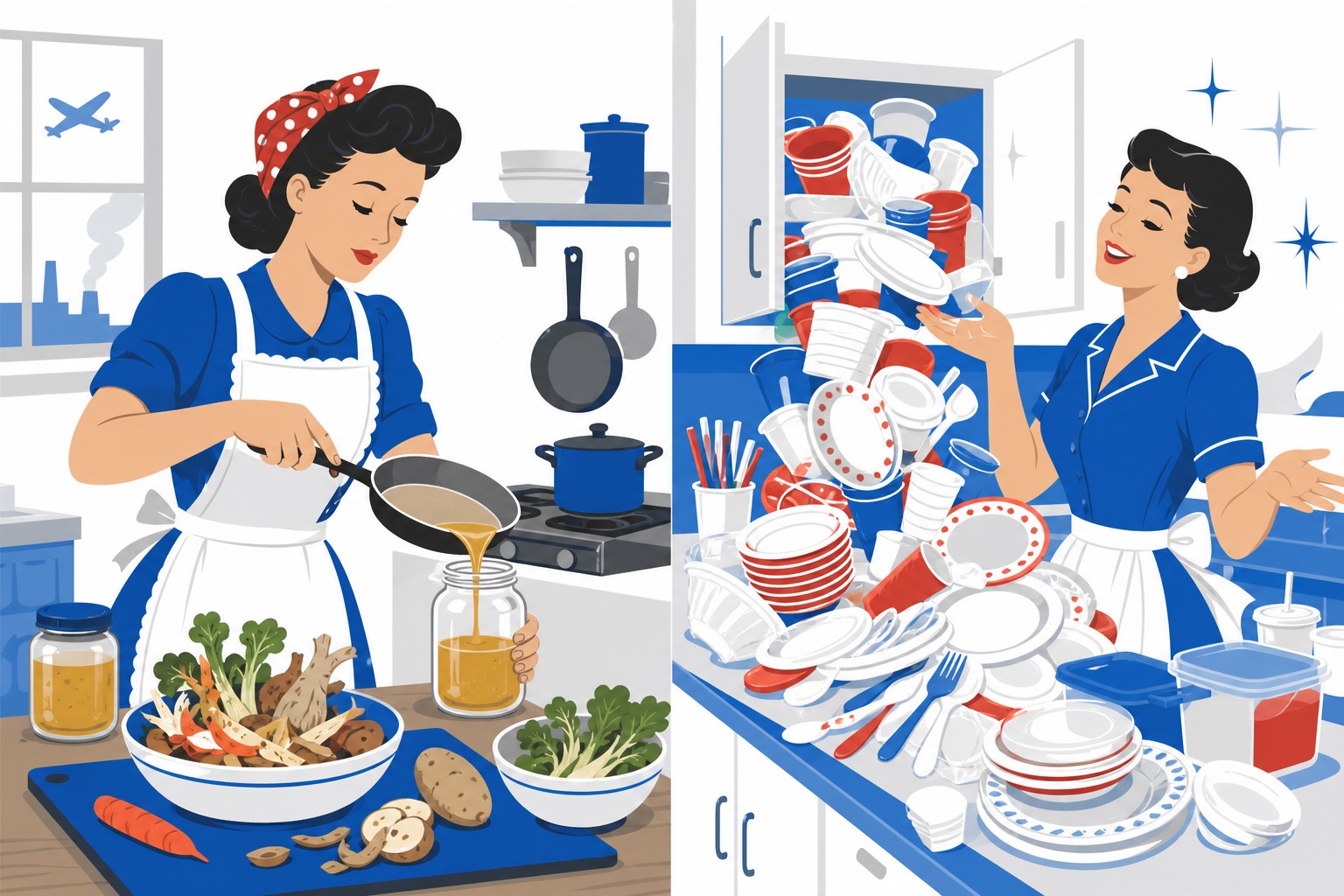
Wartime rationing turned "use it up, wear it out, make it do, or do without" into standard kitchen practice across Europe and North America. Then a 1955 LIFE magazine spread called 'Throwaway Living' celebrated the opposite as the height of modern life — and zero waste spent 50 years looking like nostalgia before cost pressure and regulation brought it back as standard operating procedure.
Zero waste isn’t a new idea. It’s a very old one that got expensively unlearned
If you’d asked a European or North American household in 1943 how they felt about food waste, “zero waste” wouldn’t have registered as a lifestyle choice — it would have sounded like a strange way of describing simply cooking dinner. Bones went into stock. Fat was rendered and saved. Peelings, bruised produce, stale bread — all of it had a next use, because the alternative wasn’t landfill guilt, it was going without. That mentality didn’t survive the century intact. It was deliberately replaced, celebrated as progress at the time, and is now being rebuilt from scratch — this time by regulation and cost pressure rather than by scarcity.
The wartime kitchen ran on a real zero-waste discipline
The U.S. home-front slogan “Use it up, wear it out, make it do, or do without” wasn’t a suggestion — it was the operating logic of a rationed economy. Households saved used cooking fats specifically because they contained glycerin, a raw material for explosives; the U.S. War Production Board’s collection drives recovered roughly 600 million pounds of kitchen fat over the course of the war. Britain ran the same logic under the Ministry of Food’s “make do and mend” campaign, teaching housewives to extend the life of every material good, food included, because imports were being sunk in the Atlantic.
Switzerland took a distinct but parallel path: the Plan Wahlen (the “Anbauschlacht,” or cultivation battle), launched in November 1940 under agricultural expert Friedrich Traugott Wahlen, converted grassland and pasture to calorie-dense crops — potatoes and vegetables yield up to ten times more calories per hectare than livestock farming. Between 1940 and 1945, Swiss food self-sufficiency rose from 52% to 70%, grain production doubled, potato production tripled, and vegetable production quadrupled — protecting both the resident population and roughly 300,000 wartime refugees from serious hardship. None of this was framed as an environmental programme. It was framed as survival, and it worked because waste, at every level of the food chain, was treated as a cost the country could no longer absorb.
Rationing didn’t end when the fighting stopped
Here’s the detail that surprises people: the discipline outlasted the war by years. Britain kept meat and other food rationing in place until 4 July 1954 — nine years after victory in Europe, longer than almost any other combatant nation, because the UK’s postwar economy was slower to recover and a larger share of its reconstruction spending went elsewhere. West Germany went the opposite direction almost overnight: on 21 June 1948, Ludwig Erhard unilaterally ended price controls and rationing the same day the new Deutsche Mark was introduced — shop windows that had sat empty were reportedly stocked with goods within days, as merchants who’d been hoarding stock finally trusted the currency enough to sell it. That abrupt shift became the opening chapter of the Wirtschaftswunder, West Germany’s postwar economic miracle.
1955: the year “throwing it away” was marketed as the future
The cultural pivot has an unusually precise date. In August 1955, LIFE magazine ran a feature titled “Throwaway Living”, showing a family standing beneath a cascade of disposable plates, cups and cutlery, with the tagline that disposable items “cut down on household chores” — and the explicit claim that if those objects weren’t disposable, they’d represent 40 hours of scrubbing. The piece is widely credited as the origin of the term “throwaway society.” It wasn’t describing wastefulness — it was celebrating it as liberation. Disposable products arrived in a steady stream through the following decade, from the ballpoint pen (1952) to the plastic grocery bag (1965), each marketed the same way: as freedom from a chore, not as a tradeoff with a cost.
This wasn’t purely spontaneous consumer taste, either. The idea of deliberately building products to be discarded and replaced predates the war — economist Bernard London had proposed legally mandated “planned obsolescence” as a Depression-era stimulus measure back in 1932 — and by 1960, social critic Vance Packard’s The Waste Makers was explicitly accusing American industry of manufacturing discontent and waste on purpose, to keep the postwar consumption engine running. Material prosperity had removed the economic necessity for conservation; wasting food and goods became, in the language of the sociologists studying it, a form of conspicuous consumption — proof you’d made it, rather than proof you hadn’t planned properly.
Zero waste’s second act didn’t come from nostalgia — it came from a blogger and then from regulators
The modern “zero waste” movement traces to a specific, recent, well-documented starting point: Bea Johnson, a French-American who began writing about her family’s radically reduced-waste lifestyle in 2009 and published Zero Waste Home in 2013, popularizing the now-familiar 5 Rs framework (refuse, reduce, reuse, recycle, rot). It was received, at first, as a fringe lifestyle experiment — treated with roughly the skepticism you’d expect for a family fitting a year of household trash into a single jar.
What changed it from lifestyle content into operating requirement wasn’t a values shift — it was regulation catching up to a cost that had been externalized for seventy years. The EU’s Waste Framework Directive, amended in 2025, now sets binding national food waste reduction targets for 2030: a 10% cut in processing and manufacturing waste, and a 30% per-capita cut in retail and food service waste — with explicit obligations reaching into restaurants and food services directly, not just households. That’s not a marketing campaign asking kitchens to feel good about composting. It’s a compliance deadline with a percentage attached to it.
The through-line: waste was never actually free. It was just invisible for a while
Look at the arc as one continuous story rather than three unrelated eras, and the pattern is simple. Wartime scarcity made the cost of waste impossible to ignore, so households tracked it obsessively. Postwar abundance made that cost easy to externalize — cheap materials, cheap disposal, and a culture that rewarded visible consumption meant nobody in the supply chain had to look closely at what they were throwing away, so almost nobody did. What’s bringing zero-waste discipline back now isn’t nostalgia for ration books. It’s the same force that built the original discipline in the first place: the cost of waste becoming visible and unavoidable again, this time through ingredient prices, waste-hauling contracts, and binding regulatory targets rather than through convoy losses in the Atlantic.
That’s exactly the operational shift behind kitchens like Langham Hospitality Group’s group-wide upcycling programme — orange peel into marmalade, fish trimmings into a permanent menu item, Wagyu fat rendered into house tallow. None of those are new culinary tricks. They’re precisely the kind of scrap-to-ingredient thinking a 1943 kitchen took for granted, rebuilt for a kitchen that now has the yield data to make the decision deliberately instead of by necessity.
What this means for your kitchen’s numbers today
You don’t need a ration book to run the same discipline your grandparents ran by default — you need the same thing Plan Wahlen and every wartime kitchen actually had: visibility into exactly what’s coming in, what’s being used, and what’s being thrown away.
- Trim, peel and byproduct tracked at the recipe level, not folded invisibly into the cost of the primary dish, so a byproduct’s real volume and value is something you can act on.
- A real cost basis for waste, so reducing it is a measurable financial decision, not a values statement to guests.
- Consistency across every site and every shift, the same standing discipline a rationed household couldn’t afford to apply inconsistently.
CalcMenu can’t bring back potato-heavy Swiss allotments or fat-collection drives. It can make sure your kitchen’s yield, trim and waste data is precise enough that the next EU compliance deadline is a reporting exercise, not a scramble. For the operational mechanics behind that — yield factors, purchasing precision, and the three distinct waste stages in a professional kitchen — see Food waste reduction in professional kitchens.
Want to see what your own kitchen’s waste and yield data actually looks like once it’s tracked properly? Book a free 15-minute call with our team — no commitment: Schedule a call.
Related reading
- Langham turned 390kg of orange peels into a marmalade — food cost work with better marketing
- Profitability #5 — Waste is margin: the 7:1 business case for waste discipline
- A jeweler who never baked a loaf in his life invented sliced bread
Sources
- Rationing, Recycling, Reusing: WWII’s Lasting Impact on Waste Management — Waste News
- The American Home Front During World War II: Rationing, Recycling, and Victory Gardens — U.S. National Park Service
- Plan Wahlen — Wikipedia (DE)
- Jetzt mehr Selbstversorgung: Was wir vom «Plan Wahlen» und der Anbauschlacht lernen können — Bauernzeitung
- On this day in 1954: Food rationing ends after 14 years — Bodleian Library Archives and Manuscripts
- Rationing in the United Kingdom — Wikipedia
- Rising from the Ruins: The Anatomy of the Wirtschaftswunder — Explaining History
- ‘Throwaway Living’: When Tossing Out Everything Was All the Rage — TIME
- Throw-away society — Wikipedia
- Planned obsolescence — Wikipedia
- Bea Johnson — Wikipedia
- Food waste reduction targets — European Commission, Food Safety
Explore CalcMenu's recipe management software for restaurants, hotels & catering to see how it applies to your kitchen.
Related sectors
Comments
Comments coming soon.