
Bali is the only Hindu-majority place in the world's largest Muslim-majority country — which is exactly why its most famous dish is a whole roast pig
Almost 90% of Indonesians are Muslim, and pork is genuinely hard to find across most of the archipelago. Bali is the one major exception — 87% Hindu, a status that traces to a 16th-century collapse that sent Hindu nobility, priests and artisans fleeing Java for the island. Babi guling, Bali's iconic roast suckling pig, isn't a tourist-menu curiosity — it started as a religious offering, and its position on Bali's food map is a direct, edible record of why the island is different.

A genuine religious island within an Islamic-majority country
Indonesia is the world’s largest Muslim-majority nation — close to 90% of the population is Muslim. Bali is the clear exception: roughly 87% of Balinese people practice Hinduism, making it the only Hindu-majority place in the entire country. That’s not an accident of geography or a modern tourism-era quirk. It’s the direct result of a specific 16th-century collapse.
Where Bali’s Hindu majority actually comes from
Hinduism reached Bali more than a thousand years ago through contact with Indian traders, and it deepened significantly under the Majapahit Empire, a powerful Hindu-Buddhist kingdom based in Java that extended its influence to Bali in the 13th and 14th centuries — the source of much of the island’s temple architecture, artistic tradition, and caste system. The turning point came in the 16th century, when Islam spread across Java and the Majapahit Empire collapsed. Hindu nobility, priests, and artisans fled east, seeking refuge on Bali. That migration is what solidified the island as the last stronghold of Hinduism in what would become the Indonesian archipelago — a status it has held, largely unchanged, for roughly five centuries.
 Bali became the last stronghold of Hinduism in the archipelago after the Majapahit Empire’s collapse sent Hindu nobility, priests and artisans fleeing east.
Babi guling didn’t start as a tourist dish — it started as an offering
Bali’s most famous dish, babi guling — a whole suckling pig, stuffed with a paste of turmeric, galangal, lemongrass and chili, then slow-roasted on a spit until the skin cracks — traces directly to a specific Balinese Hindu ritual called Tabuh Rah, in which a pig was traditionally sacrificed as an offering to the gods, then purified and cooked. References to this kind of ritual appear in Balinese inscriptions dating back to the 10th century (the Batur Bang and Batuan inscriptions, in the Balinese calendar). Pigs are still ceremonially slaughtered today for events like odalan (temple anniversary festivals) and otonan (a child’s birthday in the Balinese calendar), always within an exorcising or purification framework, not simply as a meal. Babi guling’s everyday restaurant version — now genuinely famous internationally, including as a favorite of the late Anthony Bourdain — is a secularized descendant of a ceremonial dish, not an invented tourist novelty.
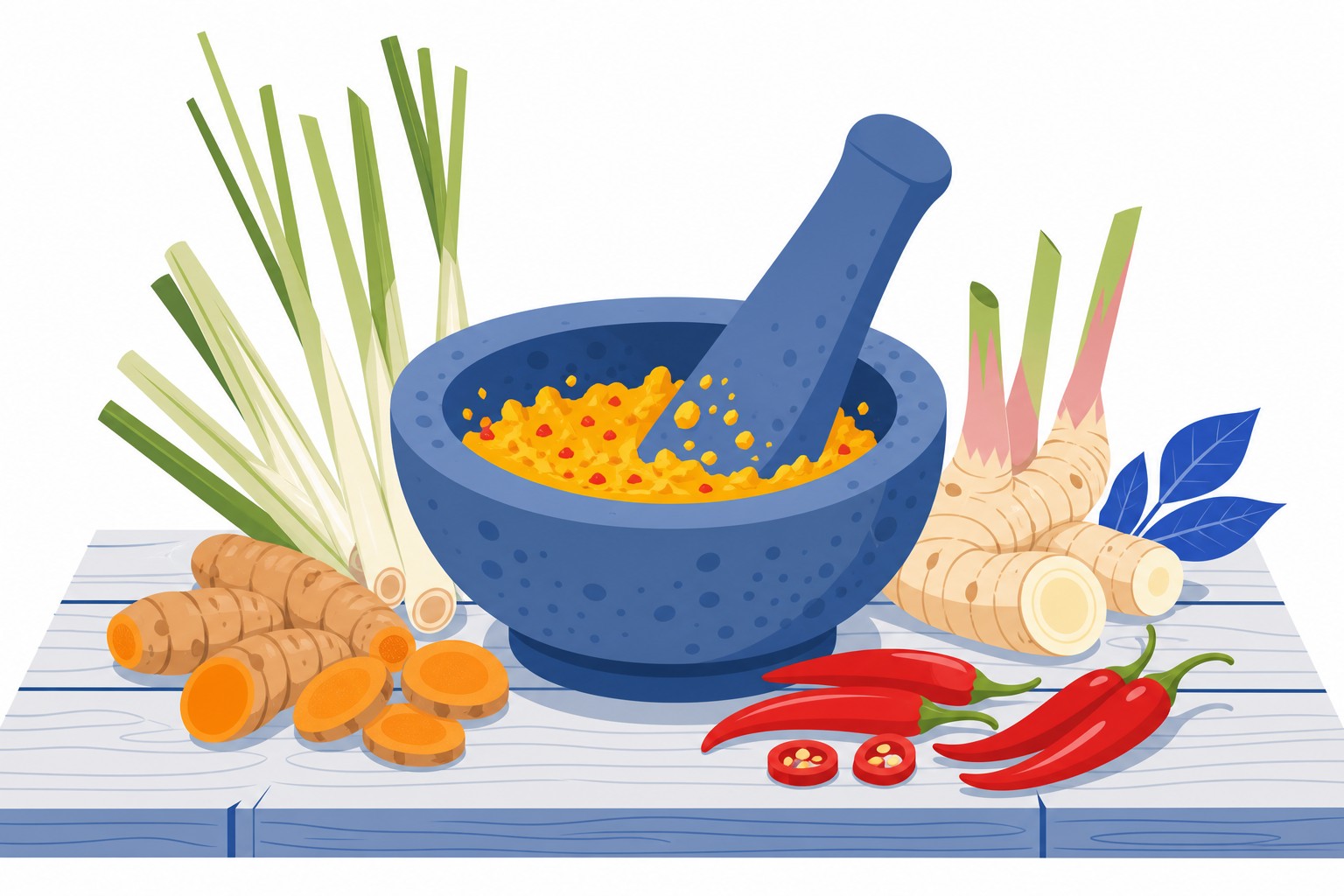 The spice paste — turmeric, galangal, lemongrass and chili — stuffed inside babi guling before it’s slow-roasted on a spit.
Why this is worth knowing rather than just eating
The instinct to ask “why does Bali eat pork when the rest of Indonesia doesn’t” already has the right shape — it’s a genuinely good question with a genuinely traceable historical answer, not a cultural inconsistency. Bali’s food map is a direct expression of a five-century-old religious and political fact: it’s the one place in the archipelago where a pre-Islamic Hindu-Buddhist tradition never had to accommodate the religious shift that reshaped food norms almost everywhere else in Indonesia.
What this means for a menu that includes regionally specific dishes
Whether it’s babi guling or any other dish tied tightly to a specific regional religious or cultural context, the operational lesson is the one this series keeps coming back to: a dish’s real history and its cost structure are separate systems, and only one of them should ever be treated loosely.
- Honest context on the menu, especially for a dish with real ceremonial origins — guests increasingly notice and appreciate the real story over a flattened one.
- Recipe precision for whole-animal dishes, where portioning, yield, and spice-paste ratios all move the true cost meaningfully.
- Regional accuracy, since treating “Indonesian food” as one undifferentiated cuisine misses exactly the kind of religious and regional variation that makes a dish like babi guling make sense in the first place.
CalcMenu can’t settle any theological question about Bali’s place in Indonesia. It can make sure a dish this specific is costed and documented with the same precision its history deserves.
Running a kitchen with regionally specific Southeast Asian dishes on the menu? Book a free 15-minute call with our team — no commitment: Schedule a call.
Related reading
- Manado was fought over by Portugal, then Spain, then the Dutch — its food carries all three layers
- In 1982, a third of every restaurant in the Netherlands served Indonesian food under a Chinese sign
Sources
- Bali — Wikipedia
- Balinese Hinduism Explained: History, Beliefs, & Traditions — Bali Holiday Secrets
- The story behind Anthony Bourdain’s best pork dish, Bali’s babi guling — South China Morning Post
- History of Babi Guling & Why Balinese Eat Pork in the World’s Largest Muslim Country
- Babi Guling — Balitra Complete Bali Travel Guide
- Blood Sacrifice in Balinese Religion — Baligram
Explore CalcMenu's recipe management software for restaurants, hotels & catering to see how it applies to your kitchen.
Related sectors
Comments
Comments coming soon.