
In 1982, a third of every restaurant in the Netherlands served Indonesian food under a Chinese sign. Nobody planned that. It's still true today that the Dutch 'national dish' conversation usually ends in Java.
Rijsttafel was invented by Dutch colonists in Java to show off at dinner parties — it's not a pre-colonial Indonesian tradition. It came home with them anyway, merged with Rotterdam's Chinese restaurant scene into a hybrid nobody designed, and by 1982 that hybrid was a third of the entire Dutch restaurant industry. The claim that Dutch food is 'all imported' undersells a genuinely unusual food-history story.
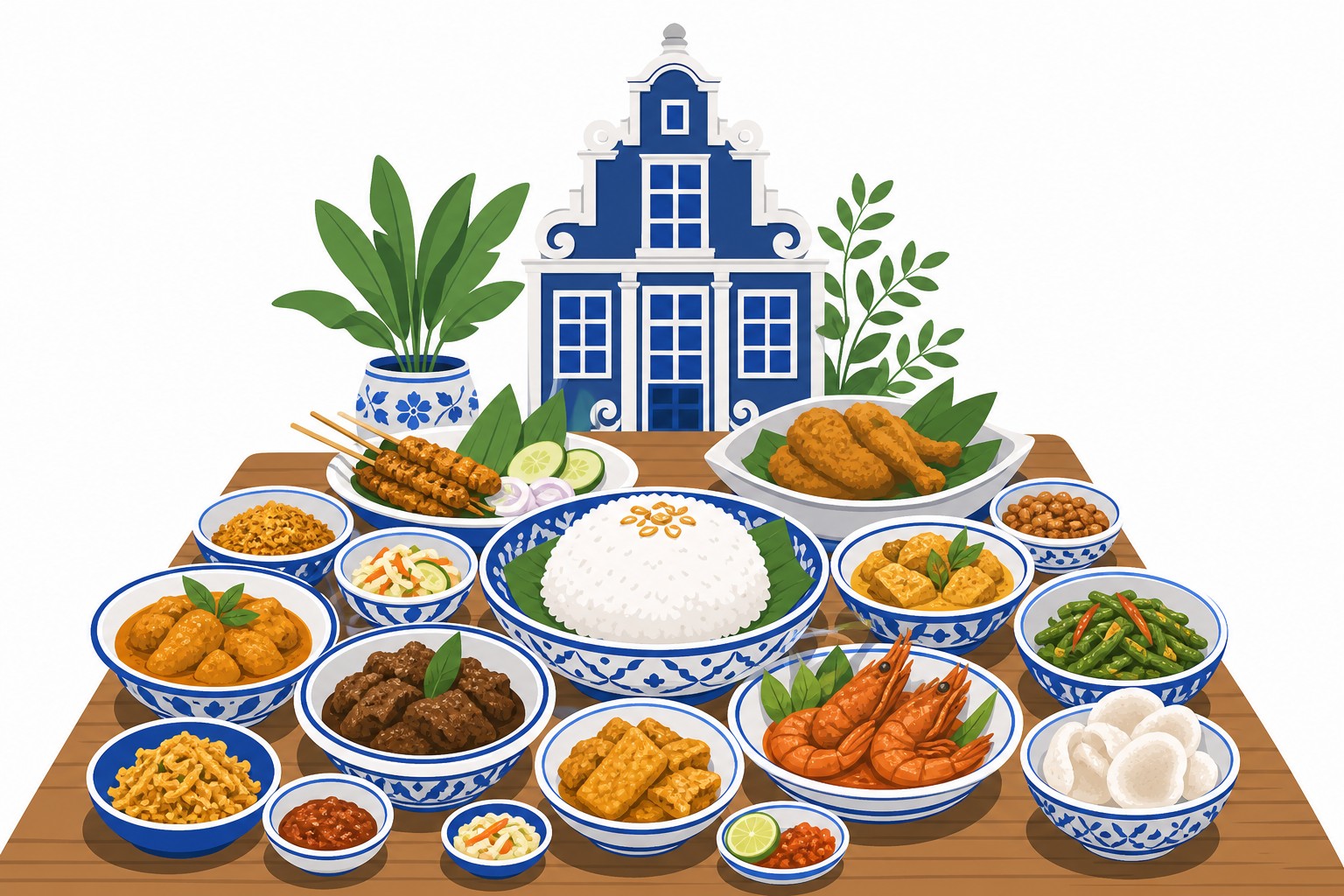
The dish that isn’t Indonesian, invented to look Indonesian, for an audience that wasn’t Indonesian
Start with the biggest misconception first: rijsttafel — the “rice table” of a dozen-plus small dishes surrounding a mound of rice — is not a traditional Indonesian way of eating. It was assembled by Dutch colonists in the Netherlands East Indies, combining Javanese, Balinese, Sumatran and other regional dishes into a single, sequenced, European-style multi-course banquet, specifically to impress dinner guests with the “exotic abundance” of the colony. No pre-colonial Indonesian household served a rijsttafel. It’s a colonial invention wearing Indonesian dishes as its components — and that distinction matters, because what happened to it next is the more interesting story.
The people who brought it home weren’t tourists — they were refugees from their own homeland
When Indonesia declared independence in 1945, an estimated 300,000 to 400,000 Indische Nederlanders — Dutch-Indonesian Eurasians, known as “Indos,” many of mixed Dutch-Indonesian heritage going back generations — were repatriated to the Netherlands between 1945 and 1965, arriving in a country most had never lived in. They brought rijsttafel with them, along with the everyday, non-ceremonial Indonesian home cooking that had nothing to do with colonial dinner theater: nasi goreng, saté, gado-gado. For the Indos, this wasn’t nostalgia tourism — it was the food of a home they’d been forced to leave, rebuilt in a country that was only nominally theirs.
Then Chinese restaurateurs did something nobody planned
Here’s the part almost no one outside the Netherlands knows. Chinese immigration to Rotterdam had started around 1900 through Dutch Steamship Company labor recruitment, and the country’s first Chinese restaurant, Chong Kok Low, opened in Rotterdam’s Katendrecht district in 1922 — initially serving the Chinese community itself. After the war, as Indonesian food’s popularity grew alongside the Indo repatriation, Chinese restaurateurs began hiring Indonesian cooks and adding dishes like nasi rames and gado-gado to their menus. The two cuisines didn’t stay separate. They merged into a genuinely new, Netherlands-specific category — the Chinees-Indisch restaurant — that belonged fully to neither China nor Indonesia.
 The Chinees-Indisch restaurant — a format invented in the Netherlands, belonging fully to neither China nor Indonesia.
The scale this reached is the real headline
By 1982, there were roughly 2,000 Chinese-Indonesian restaurants in the Netherlands — about a third of the country’s entire restaurant industry. Sixty percent of the Dutch population ate at one at least occasionally; thirty percent went at least once a month. For most of the 20th century, if a Dutch family said they were “going out for Chinese,” there was a very good chance they were eating food that was at least as Indonesian as it was Chinese, at a restaurant format invented in the Netherlands by neither Dutch, Chinese, nor Indonesian tradition alone. In February 2021, the Dutch government formally recognized Chinese-Indonesian restaurant culture as part of the national Inventory of Intangible Cultural Heritage — the same list rijsttafel itself joined in December 2015.
The “bamischijf” is the detail that makes the point
If you want the single clearest proof of how deep this runs: the bamischijf — a flat, breaded, frozen disc of bami goreng (Indonesian fried noodles) — sits in the freezer section of essentially every Dutch supermarket and every neighborhood snackbar, alongside kroket and frikandel, marketed and consumed as an entirely ordinary, unremarkable Dutch snack. Nobody buying one at a train-station snackbar is thinking about Java, colonial dinner parties, or 1940s repatriation ships. It’s just Tuesday-night food. That’s not evidence Dutch food “doesn’t exist” — it’s evidence that Indonesian food succeeded so completely at integrating into Dutch everyday life that it stopped registering as foreign at all, which is a different and more interesting outcome than most colonial food histories produce.
 The bamischijf, sitting between a kroket and a frikandel — Indonesian fried noodles, breaded and sold as an entirely unremarkable Dutch snack.
Why this is a genuinely unusual case, not just another immigrant-food story
Most of the food-migration stories this blog has covered — Vietnamese refugees building banh mi trucks in California, Hong Kong refugees inventing cha chaan teng café culture, Filipino food staying under-the-radar despite one of the world’s largest diasporas — involve a cuisine arriving with migrants and having to fight for mainstream acceptance in a new country, often over decades. The Dutch-Indonesian case inverted that path almost immediately: colonial administrators imported the format first, a repatriated population with contested belonging in their own “home” country carried the substance back under difficult circumstances, and a completely unrelated Chinese immigrant restaurant sector supplied the distribution infrastructure that made it a genuine national fixture within a generation, not several. Three separate groups, three separate motivations, one outcome nobody designed on purpose.
What this means if you’re running a menu with a colonial or migration-linked cuisine on it
Whether it’s Indonesian food in the Netherlands, Vietnamese in France, or any cuisine with a layered colonial and migration history behind it, the operational lesson is the same one this series keeps returning to: the story behind a dish and the cost structure behind a dish are two separate systems, and only one of them can be improvised.
- Recipe documentation that survives generational and cultural drift — a nasi goreng recipe passed down through three waves of migration and two restaurant traditions needs the same yield and cost precision as any other dish on the menu.
- Consistency across a fusion menu’s genuinely different cuisines, where a Chinese-Indonesian kitchen is effectively running two ingredient systems under one roof.
- Honest sourcing, especially for a menu that’s telling a real historical story to guests — the story earns more trust when the kitchen’s numbers back it up.
CalcMenu can’t settle whether rijsttafel counts as “real” Indonesian food — the Dutch themselves have been arguing about that since 1945. It can make sure your kitchen’s version of it is costed and documented with the same rigor as everything else on the menu.
Running a kitchen with a fusion or migration-linked cuisine on the menu? Book a free 15-minute call with our team — no commitment: Schedule a call.
Related reading
- Hong Kong’s cha chaan teng café cuisine, built by refugees from famine
- Filipino sailors founded the first Asian settlement in the US in 1763 — Filipino food still isn’t mainstream there
Sources
- Rijsttafel — Wikipedia
- What Is Rijsttafel? A Dish to Bridge Dutch and Indonesian Identities — Smithsonian Center for Folklife and Cultural Heritage
- Indonesian food with a colonial twist: how the feast of rijsttafel became a social tool and status symbol — South China Morning Post
- Migration and repatriation — Eurasians (Indo-Europeans) of the Netherlands Indies
- Babi Pangang or Foe Yong Hai? Chinese-Indonesian restaurants in the Netherlands — Public History Amsterdam
- The Chinese-Indonesian restaurant culture — Immaterieel Erfgoed (Dutch Intangible Cultural Heritage)
- Bamischijf — Wikipedia
Explore CalcMenu's recipe management software for restaurants, hotels & catering to see how it applies to your kitchen.
Related sectors
Comments
Comments coming soon.