
Manado was fought over by Portugal, then Spain, then the Dutch — who turned it into their 'model' colonial subject through mass conversion. Its food carries all three layers, and none of the blame usually aimed at just one of them
Manado Malay, the language of North Sulawesi's capital, was measurably shaped by 16th-century Portuguese contact — before Spain seized the Portuguese fort with local help, and long before the Dutch turned Minahasa into the most thoroughly Christianized, most literate, most "loyal" region of their entire East Indies empire. Manadonese cuisine, heavy on Chinese, Spanish, Portuguese and Dutch influence in its cakes and pastries, is the edible record of all three passes.
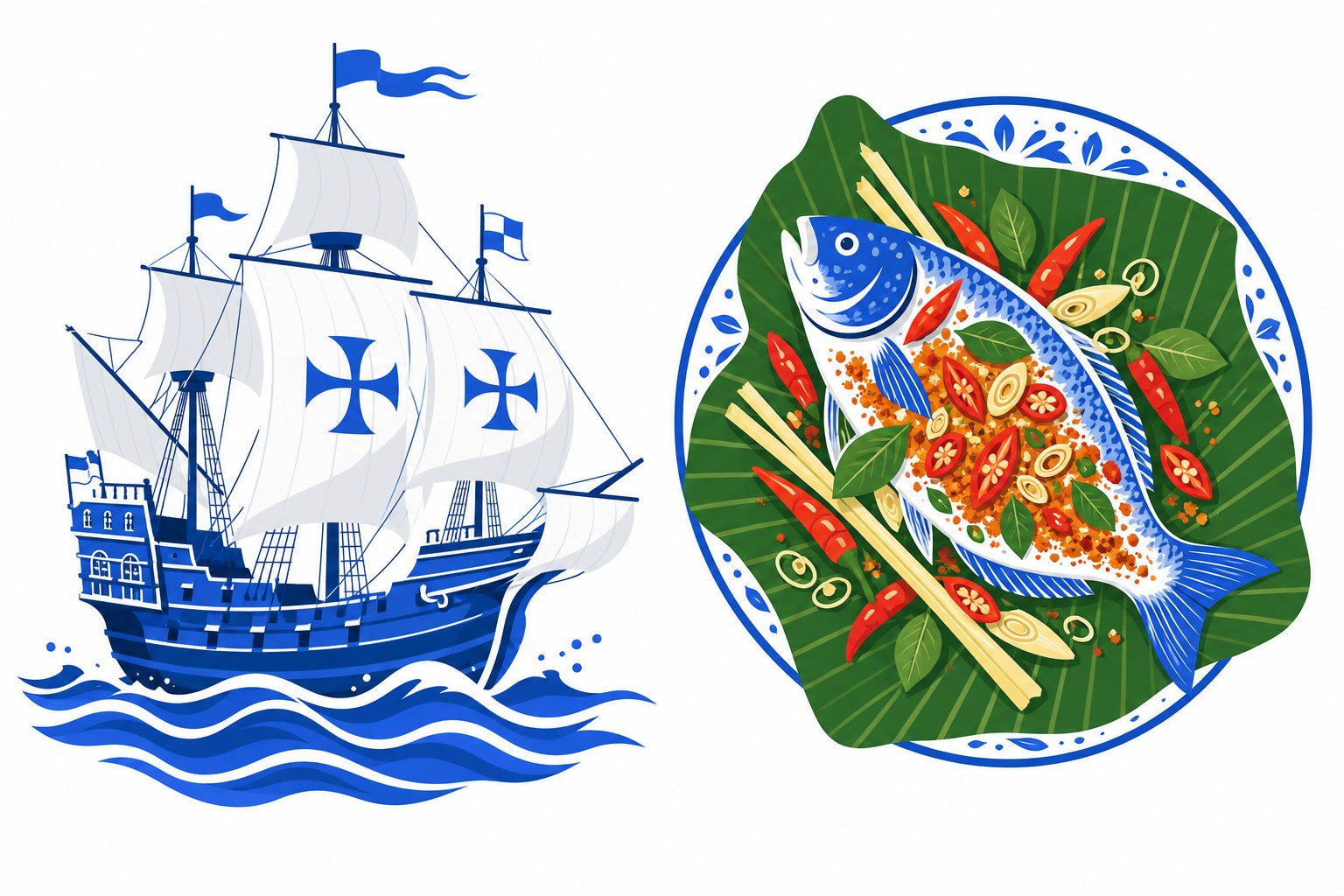
Not three tidy colonies — a century of overlapping, competing claims
North Sulawesi’s capital, Manado, has a colonial history that’s genuinely unusual even by Indonesian standards — but it wasn’t the clean “Portugal, then Spain, then the Dutch” relay it’s tempting to compress it into. Manado was never formally a Portuguese colony. For the better part of a century, Portuguese traders and missionaries, a Spanish military foothold reaching in from the Philippines, the Dutch, and the neighboring Sultanate of Ternate were all active in the region at overlapping times — with local Minahasan rulers switching allegiance between them as it suited them, not simply being handed from one European administration to the next.
Portugal traded and preached; Spain built forts; nobody had the place to themselves for long
Portuguese ships reached Manado in the mid-16th century, bringing the region’s first Catholic missionary, Father Diego Magalhaens, and establishing a trading post at Wenang — trade and mission work, not formal colonial administration. The linguistic fingerprint is still detectable today: Manado Malay, the regional lingua franca, was measurably shaped by Portuguese contact from this period. The Muslim Sultanate of Ternate, the dominant regional power, held real sway over Minahasa too, at one point signing a treaty with the Portuguese aimed against its rivals in Tidore and against Spain — a reminder that Ternate, not just the Europeans, was setting terms here.
Spain entered the same contest: in the 1550s, Spanish forces captured the Portuguese fort at nearby Amurang, with help from local Minahasan allies, and built their own fort at Manado. That wasn’t the end of Portuguese presence, though — Spain built yet another fortress near Manado in 1623, still contesting the ground seven decades later. Somewhere in this back-and-forth, one of the archipelago’s first Indo-Eurasian (mestizo) communities took root in Manado: the first King of Manado, Muntu Untu (r. c. 1630), was himself the son of a Spanish mestizo. It’s a population, and a food influence, distinct from the later, much better-documented Dutch-Indonesian “Indo” communities of Java.
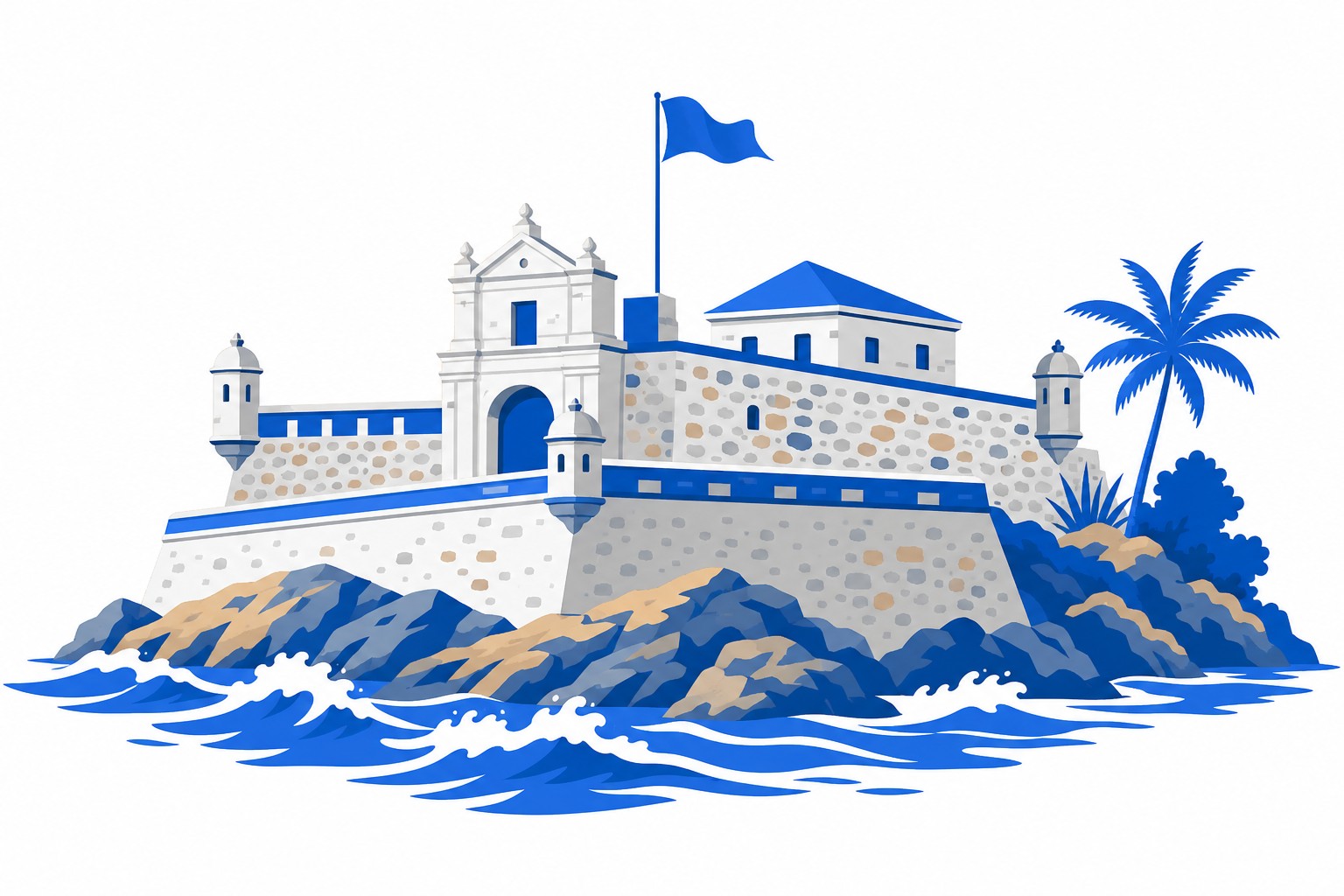 The fort at Manado — Spanish forces captured this site from Portugal in the 1550s with local Minahasan help, one round in a contest that ran for another century.
The Dutch didn’t simply “arrive” — Minahasans helped push the last Iberians out
The Dutch East India Company (VOC) had been probing the region since the early 1600s — visiting Manado Tua for rice as early as 1608, forcing an alliance on the Sultan of Ternate in 1607, and taking the island of Siau from Spanish forces in 1614. But the moment that actually ended Iberian presence in Manado was a local one: in 1655, Minahasan leaders allied with the Dutch to finally force the Portuguese out. Three years later, the VOC built Fort Amsterdam on the site of an existing Spanish fort, and it became Manado’s administrative center; the last Portuguese left the area shortly after.
Only from this point did Minahasa become something closer to a conventional colony in the administrative sense — and what happened next was still unusual. Starting in the 1820s, Calvinist missionaries from the Netherlands Missionary Society turned their attention to the region. Conversion was real, but gradual rather than instant: by 1860 — the year missionary Johann Friedrich Riedel died, having personally baptized over 9,000 Minahasans since 1831 — 57% of the population had converted. That share kept climbing for decades afterward, past 80,000 Christians by the 1880s, toward the roughly 90%+ figure the region holds today. The colonial administration responded by investing in the region in ways it didn’t elsewhere — Minahasa ended the colonial period with the highest literacy rate anywhere in the Dutch East Indies, and Minahasans were disproportionately recruited into the KNIL (colonial army) and colonial civil service across the entire archipelago, not just locally. It became, in effect, the empire’s favored, “model” colonial population — a status that came with real advantages and a genuinely complicated legacy of its own.
 57% of Minahasa had converted to Christianity by 1860, climbing toward today’s 90%+ over the following decades — the foundation of its “model colony” status under Dutch rule.
A migration wave separate from Java’s better-known one
That relationship produced its own distinct migration story to the Netherlands, separate from the much larger, better-documented wave of Dutch-Indonesian “Indo” repatriation after 1945 covered elsewhere on this blog. Minahasans, with their deep integration into the colonial civil and military apparatus, had their own significant wave of migration to the Netherlands, notably around 1957, when Indonesia’s nationalization of Dutch-owned assets upended the livelihoods of people whose careers had been built inside that colonial system.
The food carries every layer, and it’s genuinely distinctive
Manadonese cuisine reflects this entire sequence directly, and it stands out even within Indonesia’s already-diverse regional food map. It’s known for a heavy, distinctive use of spice — sometimes making up more than half a dish’s total ingredients by some accounts — built around fresh seafood, exotic proteins like paniki (spiced fruit bat) and cakalang fufu (smoked skipjack tuna), and dishes seasoned in rica-rica or woku spice blends. Layered on top of the indigenous and Chinese-trade foundation is a genuinely distinctive European-influenced pastry and cake tradition — a direct, edible trace of the Portuguese, Spanish and Dutch periods, each of which left a mark on Manadonese baking that the rest of Indonesia’s cuisine doesn’t share.
Why this history resists the simple version
It would be easy to tell this as a story with one villain, or as three colonizers politely taking turns — but the actual history involved Portuguese traders and missionaries, a Spanish military foothold reaching in from the Philippines, the Sultanate of Ternate asserting its own regional authority, and Minahasan rulers who switched allies more than once when it served them: helping Spain take a fort from Portugal in the 1550s, then a century later helping the Dutch finally push the last Portuguese out. Minahasans later rose into the colonial administration’s own upper ranks rather than only being subject to it. None of that erases the real costs of any of these periods, including the Dutch one that followed. It does mean the honest version of Manado’s history isn’t a clean relay race between three colonizers — it’s a genuinely tangled, contested sequence worth understanding as such.
What this means for a menu built on a layered regional cuisine
Manadonese food’s intensity and distinctiveness come specifically from that layered history — which makes it a genuinely demanding cuisine to cost and document consistently.
- Spice-ratio precision, since Manadonese cooking’s defining trait is spice as a majority ingredient by weight, not a background note.
- Sourcing for genuinely unusual proteins, where availability and price volatility are real planning factors.
- Recipe documentation that reflects real regional variation, rather than treating “Indonesian food” as one undifferentiated cuisine.
CalcMenu can’t settle which layer of Manado’s tangled history shaped a given dish the most. It can make sure whichever version is on your menu is costed with the same precision the dish’s own history deserves.
Running a kitchen with a genuinely regional Southeast Asian cuisine on the menu? Book a free 15-minute call with our team — no commitment: Schedule a call.
Related reading
- In 1982, a third of every restaurant in the Netherlands served Indonesian food under a Chinese sign
- Freddie Mercury was born on Zanzibar — the ‘Spice Island’ whose centuries of Omani, Indian, African and Arab trade connections are still traceable in a bowl of pilau today
Sources
- Manado — Wikipedia
- Manado Malay — Grokipedia
- Minahasa people — Wikipedia
- Minahassa, a summarized history — Dirk Teeuwen
- Christian Conversions and Dutch Colonialism in Minahasa in the Nineteenth Century
- Minahasa (North Sulawesi): The Success Story of Dutch Colonialism in Indonesia — CEI, Maria Johanna Schouten
- Minahasan cuisine — Wikipedia
- Zanzibar Swahili Cuisine: A Guide to the Island’s Best Dishes — Pongwe
Explore CalcMenu's recipe management software for restaurants, hotels & catering to see how it applies to your kitchen.
Related sectors
Comments
Comments coming soon.