
One Menu Plan, Every Counter: How a Retail Chain Runs In-Store Restaurants Without Paper
A large retail chain plans menus centrally but lets each in-store restaurant forecast its own quantities, print station posters sized to its own layout, and publish a menu page in its own language. Here's how one menu plan becomes dozens of different, correct outputs.
The Same Menu, a Different Restaurant Every Time
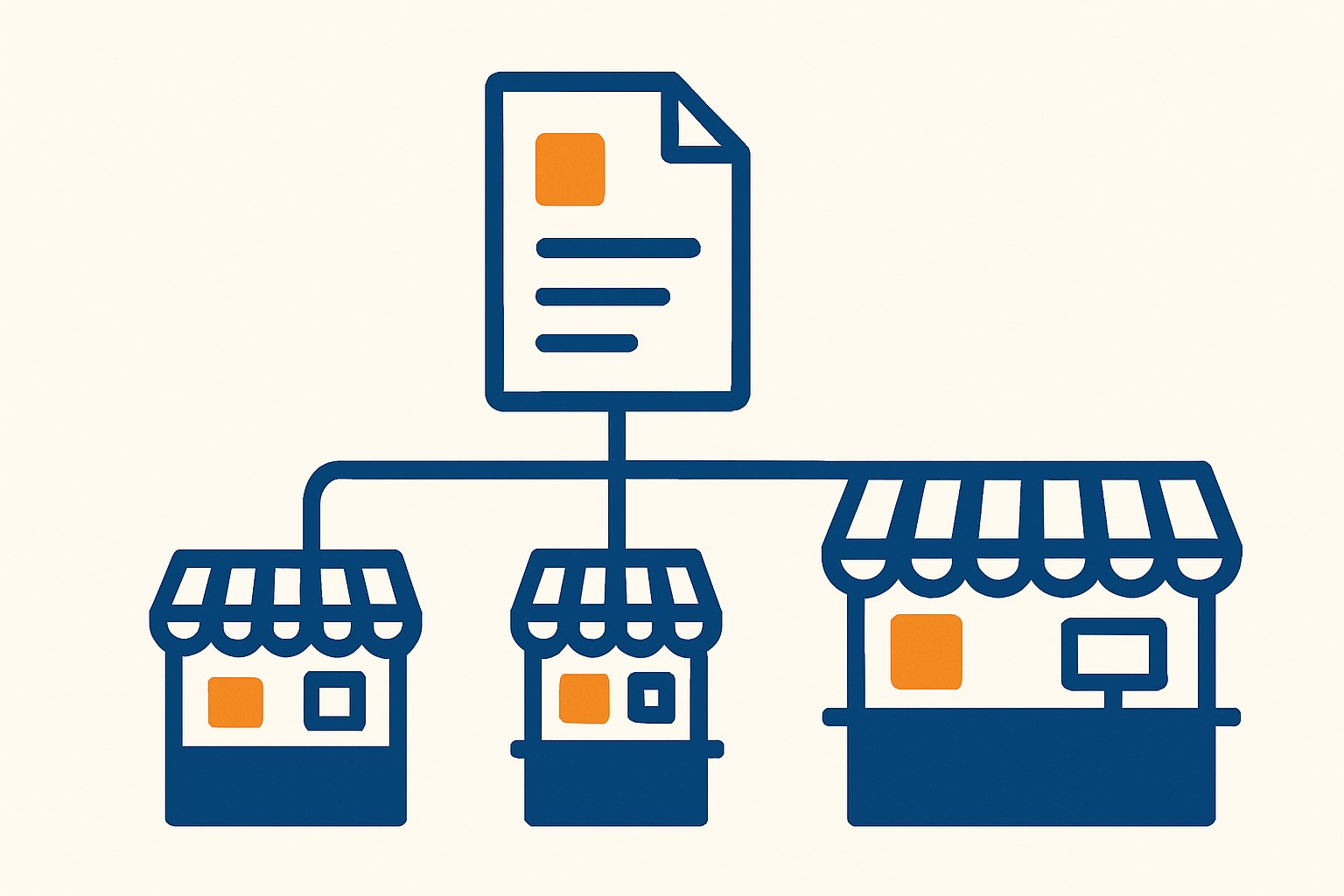
A large retail chain with a restaurant in dozens of its stores runs into a problem that is easy to describe and hard to solve: head office plans one menu, but no two restaurants serving it are the same. A flagship store might run a hot kitchen, a grill, a salad bar and a dessert station. A smaller branch might only have room for two of those. Same brand, same season, same central menu plan — very different day-to-day reality on the floor.
Handled with spreadsheets and shared folders, that gap turns into exactly the kind of drift described in our piece on keeping numbers aligned across every outlet: one branch prints last month’s dish list, another improvises because nobody sent the update, and head office loses visibility into what is actually being offered where.
A Central Plan That Still Leaves Room for Local Judgment
The starting point is a single menu plan, built once at head office and shared with every restaurant in the chain. But a menu plan is not the same thing as a production forecast, and this is where the chain’s setup earns its keep: the plan defines what’s on offer; each restaurant manager decides how much of it to make.
Every branch manager knows their own customers — the office crowd that floods in at lunch on a Tuesday, the weekend footfall that skews toward families, the dish that always sells out by 1pm at that specific location and nowhere else. CalcMenu’s central menu and recipe database carries the plan to every site, but the quantity forecast for each dish stays a local call, entered by the person with the best information to make it. Head office keeps the recipe, the costing and the standard consistent; the branch keeps the judgment call that no spreadsheet from head office could make as well as they can.
The Menu Adapts to the Stations a Restaurant Actually Has
Not every restaurant has the same stations, and CalcMenu doesn’t pretend otherwise. A branch with a full hot kitchen, grill, salad bar and dessert counter offers the full central menu. A branch with only a hot kitchen and a salad bar offers a smaller, entirely valid subset of it — never a stale approximation cobbled together locally. The choice each customer sees reflects what that specific restaurant can actually produce, not a generic list that overpromises at the smaller sites and undersells the bigger ones.
That same station structure is what makes the next step — printed posters — line up correctly at every single location, regardless of format.
A Poster for Every Station, Generated From the Plan
Each station gets its own poster, generated straight from the menu plan and hung right where customers order: the dishes on offer at that counter, correctly translated, correctly priced, with the right allergen information attached. Nobody is retyping a dish list into a page layout tool at branch level, and nobody is manually reconciling a printed poster against whatever the kitchen actually decided to serve that week.
When a recipe changes at head office — a supplier substitution, a reformulated sauce, an updated allergen — the next poster print reflects it. The same logic that keeps HACCP and allergen data consistent across sites applies here: the poster a customer reads at the grill station is generated from the same data as the recipe the kitchen is actually working from, not a separate document someone updates from memory.
The Web Menu: Specific to the Restaurant, Specific to the Language
The chain’s website shows a menu page for each restaurant — not one generic corporate menu page repeated everywhere with a store finder bolted on. Each store’s page shows exactly what that store’s stations serve, and it renders in the language appropriate to that store’s customers. A chain operating across language regions can publish the identical central plan as a French menu in one region and a German or Italian menu in another, correctly, without a translator manually re-keying it into the website each time a dish changes.
That’s the same multilingual recipe layer that drives the printed posters, published a second time as a digital menu channel — one update at head office, reflected everywhere a customer might look, on screen and on paper, in whichever language fits the store.
Every Recipe, Everywhere, Without a Binder in Sight
Every restaurant’s kitchen team has electronic access to the full recipe catalogue — not a photocopied binder handed down from the previous manager, not a folder of PDFs that quietly stops getting updated after the first few weeks. A recipe changed at head office is a recipe changed everywhere at once, on the device the kitchen is already using.
The saving isn’t just paper, though that adds up across dozens of sites printing and reprinting recipe sheets. It’s that a kitchen team is never working from a version of a recipe that’s a week, a month, or a season out of date — the same guarantee that keeps food cost, allergen data and HACCP records aligned across every site in a multi-outlet operation.
One Plan, Correctly Different Everywhere It Lands
None of this depends on every restaurant behaving the same way. The whole point is that a single, centrally managed menu plan can produce a correctly different result at every site: a different quantity forecast because a different manager knows their own customers, a different station layout because not every branch has the same footprint, a different poster and a different-language web page because the plan was built once and adapted everywhere it’s used — instead of copy-pasted and quietly drifting out of sync.
Running Something Similar?
If you operate a retail chain with restaurants of different sizes and different station setups across your stores, this pattern — one central plan, correct local output everywhere — tends to translate directly to your situation. Book a 15-minute call with Marc and we’ll walk through how it would map onto your specific store formats.
Related reading: The Recipe on the Scale: One Less Device at Every Supermarket Station
Explore CalcMenu's recipe management software for restaurants, hotels & catering to see how it applies to your kitchen.
Related sectors
Comments
Comments coming soon.