
The Recipe on the Scale: One Less Device at Every Supermarket Station
A large retail chain connected its butcher, deli and bakery scales directly to CalcMenu, so the recipe the staff member needs shows up on the scale's own screen — no tablet, no phone, no laminated sheet taped to the wall.
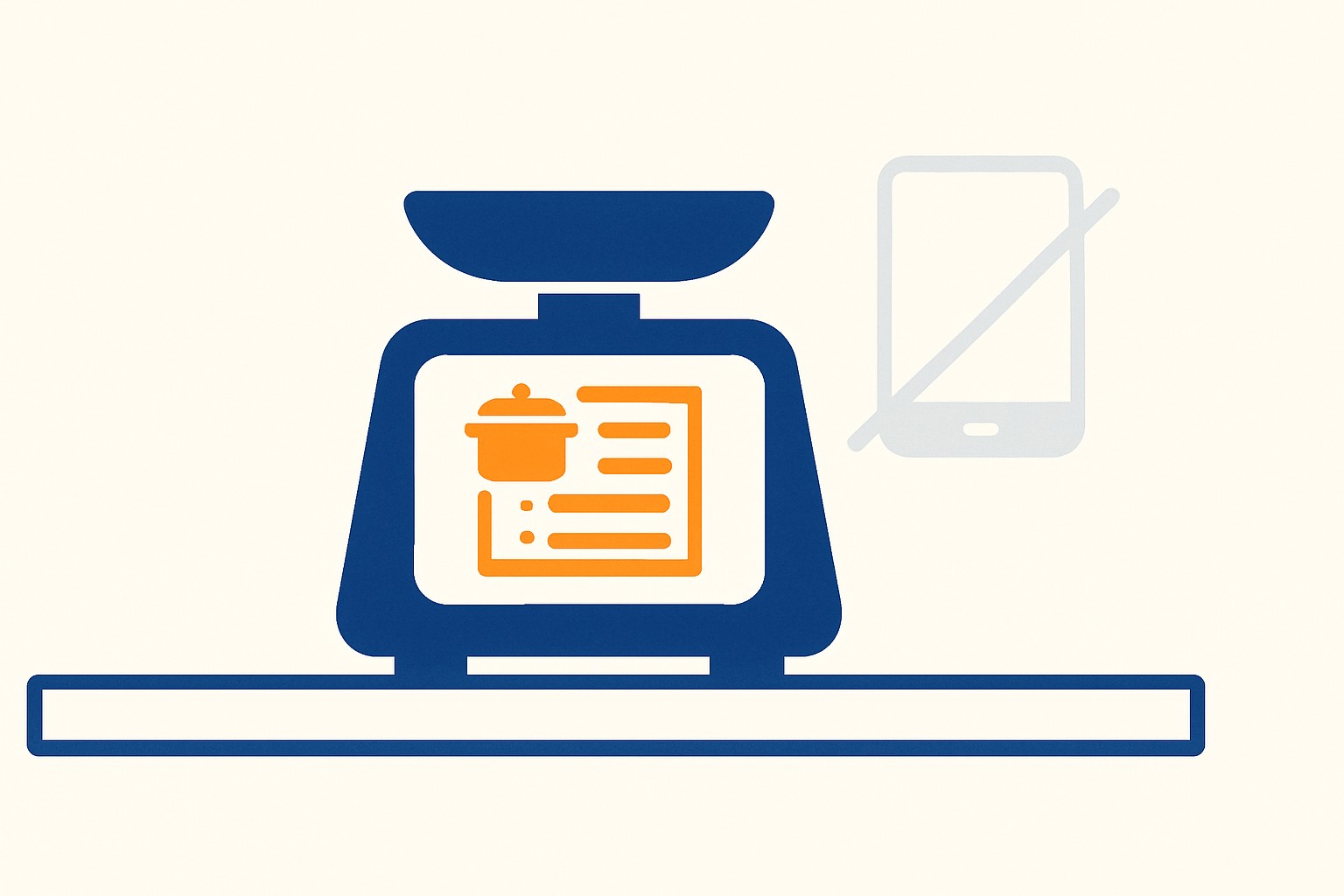
Every Station Already Has a Scale. Why Add a Second Screen?
Walk past the butcher counter, the deli, or the fresh-prep station in a large supermarket and there’s already a scale sitting there, doing the one job it was bought for: weighing product and pricing it. Ask that same staff member to follow a recipe — a marinade ratio, a sausage mix, a portion spec for a pre-packed cut — and a second device usually has to show up: a tablet mounted nearby, a phone passed around, or, more often than either, a laminated sheet taped to the wall that’s been there long enough that nobody’s sure it’s still correct.
That’s one more device to buy, mount, clean, charge and keep updated, at every station, in every store. It’s also one more place a recipe can quietly go stale, exactly the drift we’ve written about in the context of keeping data consistent across sites — except here it’s not a printed poster falling behind, it’s a laminated card nobody remembers to reprint.
The Same Screen, a Second Job
A large retail chain solved this by connecting its scales directly to CalcMenu’s recipe database, the same scale-to-label pathway already used to print weight, price-per-kilo and allergen information at the counter — extended one step further. Instead of adding a screen, the chain put the recipe on the screen that was already there.
A staff member at the butcher counter selects the item being prepared, and the scale shows the recipe for it: ingredient ratios, the marinade or seasoning mix, the target portion weight, the allergen list — the same data that already drives the printed label, now also driving what the person doing the work sees while they’re doing it. No separate app to open, no laminated sheet to hunt down, no second device competing for space on a counter that’s usually already tight.
Built for the Butcher Counter, Useful at Every Other Station
The butcher counter is the clearest case — recipes there are frequently weight-driven (a sausage mix expressed as a ratio per kilo, a marinade dosed to the weight of the cut), which is exactly what a connected scale is already positioned to handle. But the same setup applies anywhere a supermarket has a scale and a recipe to follow: the deli counter portioning a salad or a pâté, the bakery weighing out a dough or a filling, the fresh-prep station assembling a ready meal to a fixed recipe. Any station with a scale already has the hardware; connecting it to CalcMenu is what turns that scale into a recipe display as well as a pricing tool.
One Recipe Change, Reflected at the Scale Immediately
The advantage isn’t just fewer devices — it’s that the recipe shown at the scale is never out of date. When a recipe changes at head office — a supplier substitution, an adjusted seasoning ratio, an updated allergen — that change reaches the scale the same way it reaches the printed label: instantly, without anyone at the store having to update a laminated sheet or push a new file to a tablet. It’s the same principle behind keeping HACCP and allergen data aligned across every site: one source of truth, reflected everywhere it’s read, including at the point where the work actually happens.
Fewer Devices, Not More
It’s worth being explicit about what this isn’t: it’s not another screen to add to an already crowded counter, another login for staff to remember, or another piece of hardware for IT to provision and support across dozens of stores. It’s the device that was already doing the weighing, doing one more job it’s well placed to do — because the recipe and the weight it’s checking against come from the same data in the first place.
Have a Counter Full of Scales Already?
If your stations already run on scales for pricing and labelling, connecting them to show the recipe as well is a small, largely hardware-free step — worth a conversation if laminated sheets or a spare tablet are still doing that job today. Book a 15-minute call with Marc and we’ll look at what your existing scales can already do.
Related reading: One Menu Plan, Every Counter: How a Retail Chain Runs In-Store Restaurants Without Paper
Explore CalcMenu's recipe management software for restaurants, hotels & catering to see how it applies to your kitchen.
Related sectors
Comments
Comments coming soon.