
Japan's national school lunch began in 1946 as donated skim milk children hated the smell of — the system it grew into now wastes food at about a quarter of the rate an American school cafeteria does
In the winter of 1946, occupied Japan's first school lunches were funded by a wartime relief agency and consisted of little more than tomato stew and a powdered milk many children disliked. Eight decades and two separate national laws later, more than 10 million Japanese schoolchildren serve, eat and clean up a full hot lunch every day, with a food waste rate of roughly 7% against about 30% in American school cafeterias.
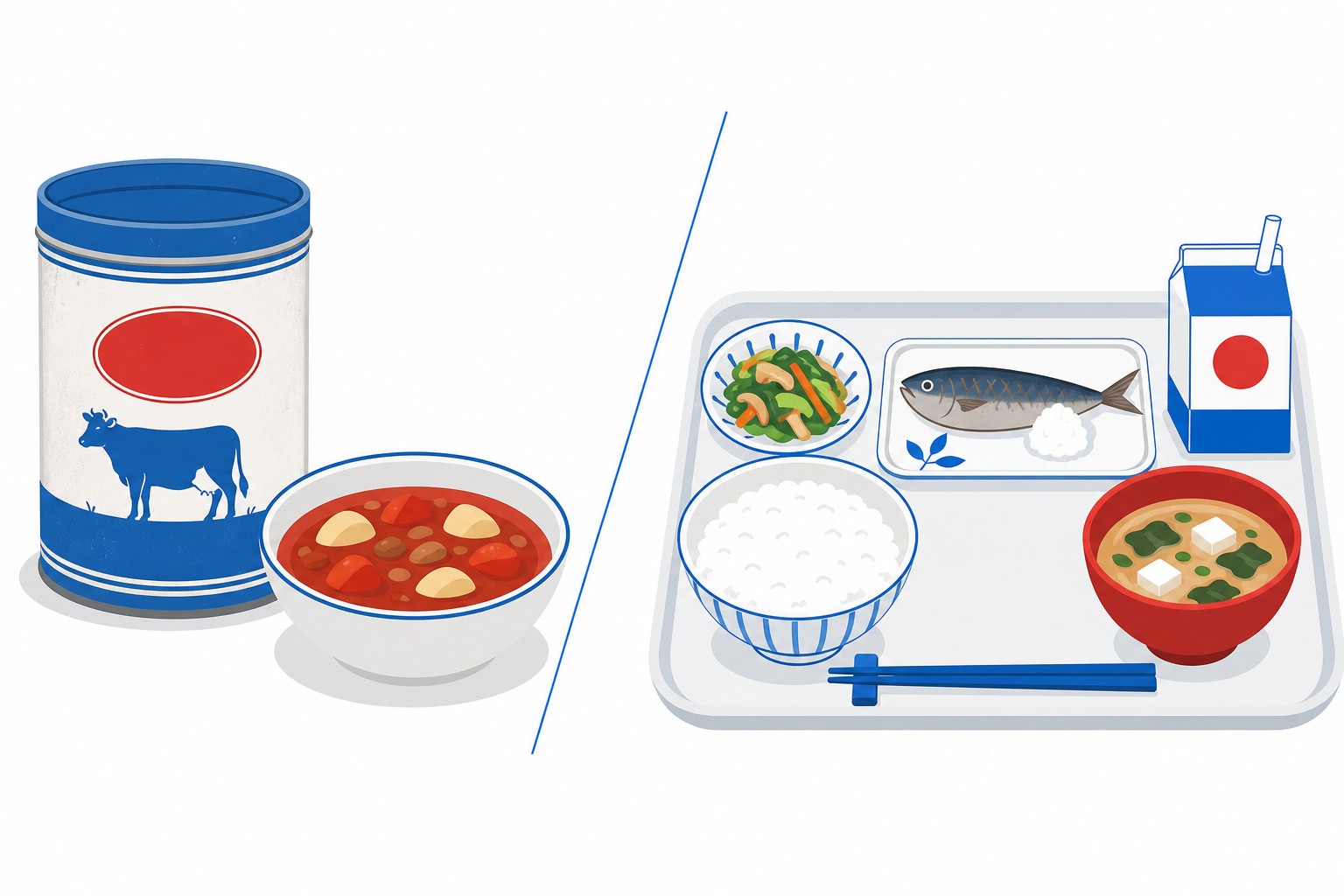
A wartime relief agency, not a ministry, funded Japan’s first school lunch
On Christmas Eve, 1946, school lunches began for 250,000 children across Tokyo, Kanagawa and Chiba, backed by the occupying GHQ administration and funded by a donation from LARA — the Licensed Agencies for Relief in Asia, a US-based charity coalition, not any branch of the Japanese government. The first standard menu was tomato stew and powdered skim milk. The milk in particular became infamous: it didn’t dissolve cleanly, it scorched easily when heated in a pan, and it left a distinctive smell once it cooled that generations of Japanese schoolchildren who lived through it still describe unfavorably. It was also, for children in a country still recovering from wartime devastation, often the most reliable meal of their week. By 1947 the program had expanded nationwide to roughly 3 million children, still dependent on powdered non-fat milk donated from America.
Two more donor agencies kept it alive before Japan made it law
The emergency aid kept arriving from multiple directions at once. UNICEF donated shipments of powdered milk from 1949 to 1950, and the United States donated wheat flour from 1950 to 1951 — flour that helped establish bread, an odd staple for a rice-growing nation, as a recurring kyūshoku item for decades afterward. What makes Japan’s version of this story different from most postwar emergency-feeding programs: rather than winding down once the immediate crisis passed, or drifting on as an informal habit, it was formally codified. The National School Lunch Program Act, passed in 1954, turned a donor-dependent relief measure into permanent domestic law — while the country was still substantially reliant on foreign-donated ingredients to run it.
From donated calories to legally mandated food literacy
Half a century later, Japan legislated the program a second time, and this time the target wasn’t calories — it was education. The Basic Act on Shokuiku, passed in 2005, was the first Japanese law to regulate diet and eating habits at all, introduced in response to rising rates of eating disorders among young people. The law is explicit about what it considers school food education to be: “the basis of a human life which is fundamental to intellectual education, moral education, and physical education.” Two years later, in April 2007, Japan formalized a licensed nutrition-teacher role, eiyō kyōyu — “teachers of food” — though placement still varies by region and not every school has one on staff.
The lunch itself is run largely by ten-year-olds, on purpose
Walk into a Japanese public elementary school at lunchtime and the adults are barely involved. A rotating student group called the kyūshoku-toban — the lunch duty team — dons white aprons, caps and masks, collects the food carts from the school kitchen, and portions and serves the meal to their own classmates. Everyone present, teachers included, eats the same dish at the same time; most public elementary schools don’t allow packed lunches from home at all. Afterward, the same students clean the classroom, wash their milk cartons for recycling and sort the trash themselves. The underlying philosophy has a name — mottainai, roughly “nothing should go to waste” — and children are expected to finish what they’re served, not have it cleared for them.
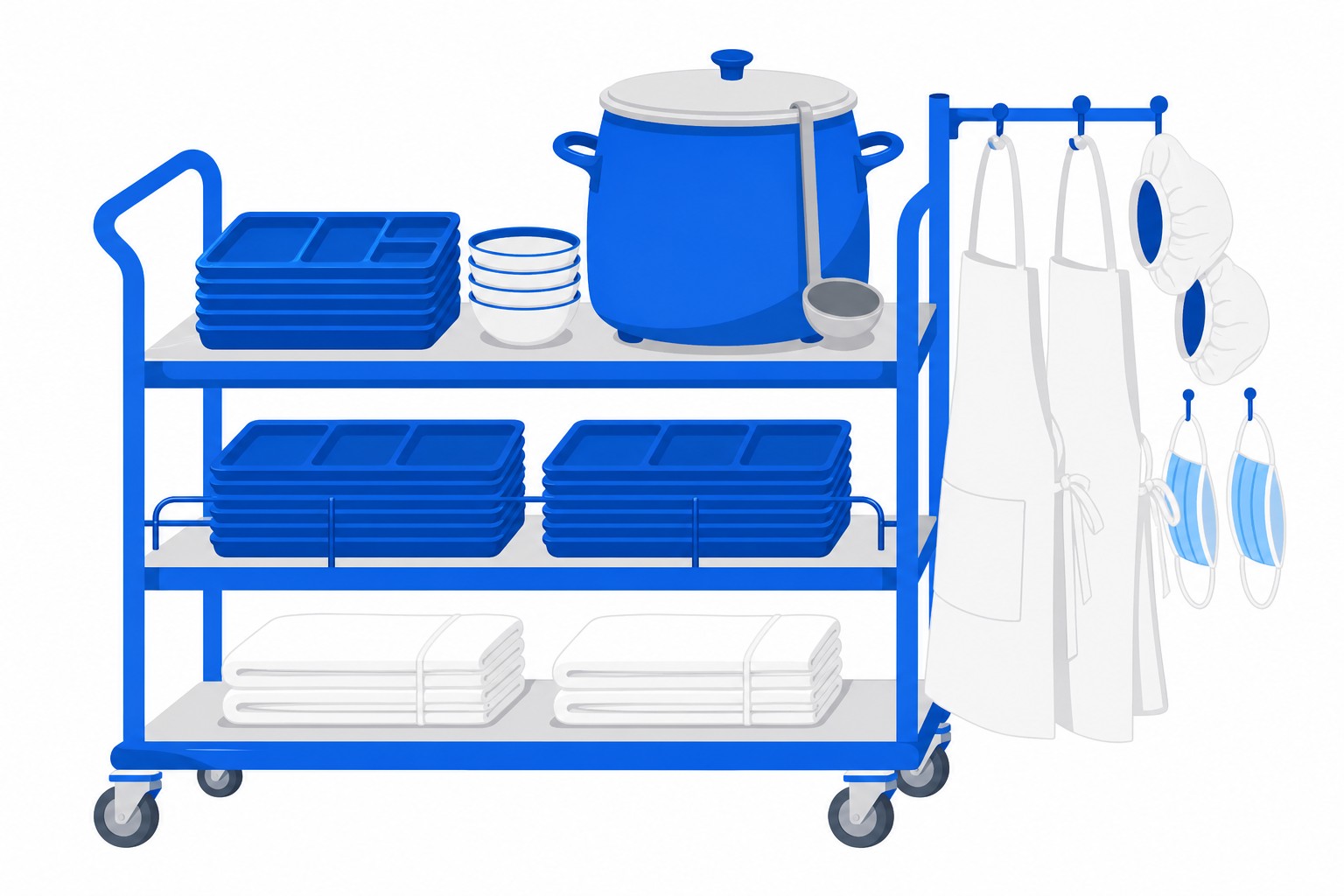 The kyūshoku-toban — a rotating student duty team — dons aprons, caps and masks to serve their own classmates lunch, with no adults doing the serving.
The number this whole system was quietly built toward
That discipline shows up as a measurable, comparable operational result. Japan’s school lunch food waste rate runs at roughly 7%, against approximately 30% in American school cafeterias — a gap that’s about student behavior, standardized portioning, and a food-education law working exactly as designed, not a one-off cultural anecdote. It also isn’t expensive to run: the average cost lands around ¥300 per meal (about ¥4,700 a month for an elementary student), with guardians billed only for ingredients while government funding covers labor and facilities.
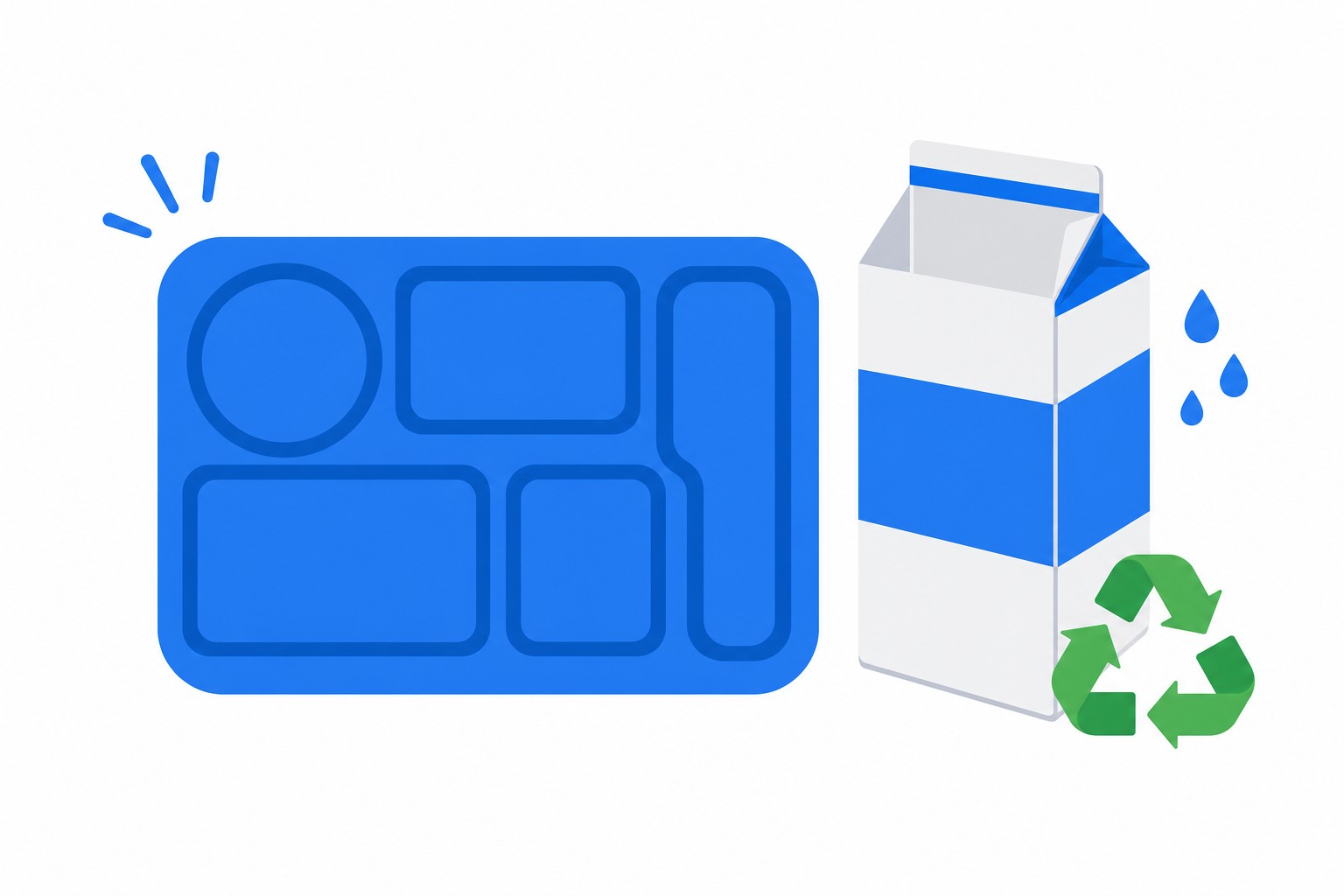 Mottainai in practice: students are expected to finish what they’re served, and even wash their own milk cartons for recycling afterward.
Why this belongs next to the rest of this series’ institutional-feeding stories
Most of the crisis-feeding programs this series has covered share the same shape: an emergency creates them, and either the emergency ends and they wind down, or they survive informally, unlegislated, running on institutional memory rather than statute. Japan’s kyūshoku system is the exception on both counts. It was legislated twice, fifty-one years apart, by two laws with entirely different goals — one to guarantee the meal itself, the other to guarantee what children learn from eating it — and both statutes are still active today, governing a program feeding more than 10 million children every school day.
How CalcMenu supports the discipline Japan proves is achievable
Japan’s food-waste number isn’t a cultural quirk that can’t travel — it’s the downstream result of consistent portioning, standardized menus and food-literate service, all things a kitchen can build into its own systems regardless of country.
- Waste tracking that reflects reality, not estimates — so a kitchen knows its actual plate-waste rate instead of assuming it.
- Standardized recipes and portions across every site, so “everyone gets the same meal” means the same quality and nutrition, not just the same menu name.
- Nutrition data built into every recipe, so food-education-level transparency doesn’t require a dedicated licensed specialist at every single location.
CalcMenu can’t hand your kitchen fifty-one years of legislative discipline. It can make the data that discipline depends on — waste, portions, nutrition — visible from day one.
Want your kitchen’s waste and portioning data as disciplined as Japan’s school lunch program? Book a free 15-minute call with our team — no commitment: Schedule a call.
Related reading
- University dining: allergens, diets and waste on campus
- Your grandparents didn’t have a zero-waste kitchen because they were virtuous. They had one because a rasher of bacon cost real money and there was no other choice.
Sources
- Feeding the Nation: How Japan’s School Lunches Changed Through the Twentieth Century — Nippon.com
- A brief history of the evolution of Japanese school lunches — Japan Today
- School Lunch Program in Japan — National Institute for Educational Policy Research (NIER)
- The History, Current Status, and Future Directions of the School Lunch Program in Japan — ResearchGate
- Basic Act on Shokuiku (Food and Nutrition Education) — Japanese Law Translation, Ministry of Justice
- Shokuiku – How Japan Leverages School Meals as a ‘Living Textbook’ for Lifelong Healthy Eating — Global Child Nutrition Foundation
Explore CalcMenu's recipe management software for restaurants, hotels & catering to see how it applies to your kitchen.
Related sectors
Comments
Comments coming soon.