
The Turkish hammam isn't an independent tradition — it's a direct descendant of the Roman bath. The Finnish sauna is the one that owes Rome nothing.
Baden-Baden is built on the ruins of a Roman garrison bath. The hot-cold contrast every modern spa circuit uses was formalized by a 19th-century Bavarian priest, not inherited from antiquity. And the hammam most people assume is a separate Islamic invention is actually a Roman bath adapted by Seljuk Turks — the sauna is the real outlier.
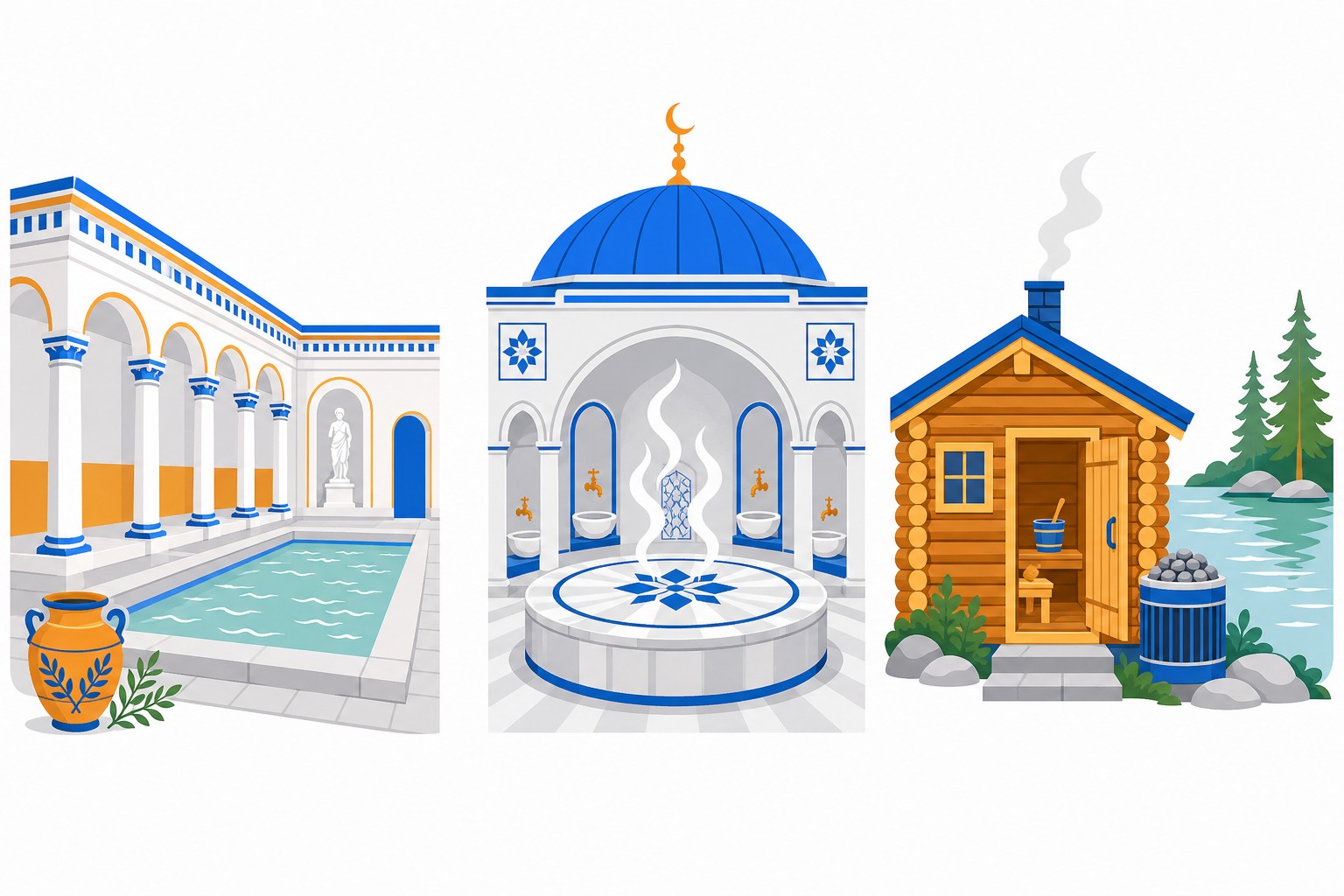
The modern spa circuit feels ancient. Most of it isn’t, and the parts that are ancient don’t share one origin
Walk into almost any European wellness resort today and you’ll find the same format: a hot room, a cold plunge, a steam room, maybe a scrub treatment. It reads as one continuous, timeless ritual. It isn’t. It’s a 19th–20th century assembly of at least three genuinely separate historical lineages — one of which is 2,000 years older than the others and directly related to a second, while the third owes nothing to either.
The shared root: Roman thermae, engineered for a sequence
The Roman bath complex wasn’t a single room — it was a deliberate progression. Bathers moved through the tepidarium (a warm room to acclimate), the caldarium (a hot, humid room with a heated pool, warmed from below by a hypocaust — a network of pillars and flues circulating hot air under the floor), and finally the frigidarium (a cold plunge to close the pores and finish). The largest complexes, like the Baths of Caracalla (built 212–216 CE, covering 10–12 hectares), weren’t just bathing facilities — they included libraries, gardens, shops, and massage rooms, functioning as a genuine civic social hub where bathers discussed politics and business before dinner. This sequence — warm, then hot, then cold — is the direct ancestor of the modern spa circuit, and it’s also the shared root of two of the three traditions covered here.
Germany and Austria: not inspired by Rome, physically built on it
This isn’t a case of cultural influence traveling across centuries — in Baden-Baden, it’s literal, physical continuity. The Romans founded the town at a former Celtic settlement, naming it Civitas Aurelia Aquensis, and stationed garrisons there from the 2nd century BCE onward specifically to treat war injuries in the hot springs. The remains of the soldiers’ baths, with their original heating and water systems, sit directly beneath the modern Friedrichsbad — one of Germany’s most famous thermal baths is quite literally stacked on top of a Roman military hospital. Austria’s Bad Gastein followed a different but parallel arc: its radon-rich thermal water drew bathers for centuries before the Badeschloss formally opened to spa guests in 1791, part of the broader 18th–19th century aristocratic revival of “taking the waters” across the German-speaking world — the era that gave these towns their “Bad” prefix, a formal designation still legally regulated today.
The hot-cold contrast ritual is 19th-century, not ancient
Here’s the detail that surprises most people: the alternating hot-then-cold sequence that defines every modern spa circuit wasn’t inherited unbroken from Rome — it was formalized in the 1840s by a Bavarian Catholic priest. Sebastian Kneipp contracted tuberculosis in 1847, found a book on cold-water therapy by Johann Sigmund Hahn, and began bathing repeatedly in the ice-cold Danube in winter before rushing home to warm up — a treatment he credited with curing himself of what was then often a fatal disease. He built an entire hydrotherapy system around it in Bad Wörishofen, publishing My Water Cure in 1886, and the “Kneipp Cure” — hydrotherapy plus botanical medicine, exercise, nutrition and balance — became genuinely influential across German and Austrian spa culture. UNESCO added Kneipp’s teachings to its Intangible Cultural Heritage list in 2015. The Kneipp brand still exists today. When a modern wellness resort tells guests to alternate hot and cold for circulation, that instruction traces to a 19th-century priest curing himself in a river, not to an unbroken ancient practice.
Italy: continuity that predates Rome entirely
Italy’s terme tradition runs even further back than the Roman layer most visitors assume is the origin. Chianciano Terme’s recorded history starts in the 5th century BCE, when the Etruscans built a temple to their god of health beside the Silene springs — centuries before Rome absorbed the site. Rome then validated rather than invented the tradition: the poet Horace visited on his own physician’s advice in the 1st century BCE, and Roman-era votive statuettes have been found near Montecatini Terme’s current spring, alongside the first written record of that spa from 1201. The thread from Etruscan temple to Roman endorsement to medieval record to today’s still-operating spa town is close to unbroken.
The Turkish hammam: a Roman cousin, not an independent invention
This is the correction most people don’t expect: the hammam is not a separate Islamic-world invention parallel to the Roman bath — it’s a direct descendant of it. Following the 7th–8th century Arab expansion, Islamic societies adapted the existing Roman-Byzantine bathhouse model, and the Seljuk Turks later carried the format east, blending it with Central Asian and Iranian bathing customs and Islamic religious requirements around cleanliness before prayer. What actually makes a hammam different from the building it descended from is specific and structural: Roman baths used standing pools; hammams use running water poured over the body, because standing water was considered unclean. There’s no cold-plunge centerpiece — the ritual centers on the göbek taşı (“belly stone”), a heated marble platform in the hot room, combined with scrub and massage rather than a hot-to-cold progression. Most of Istanbul’s surviving hammams date from the 15th–18th centuries, including works by the Ottoman architect Mimar Sinan, and many were built as part of mosque complexes — genuinely dual-purpose spaces for physical cleanliness and religious preparation, not simply leisure.
The Finnish sauna: the one tradition that owes nothing to any of this
Every lineage above traces back to the Mediterranean. The sauna doesn’t. Finnish sauna bathing is believed to date back as far as 7,000 BCE, developing as earth pits dug into hillsides and covered with animal skins — heated rocks over a fire, with the flames allowed to die down before bathing, a technology that evolved independently of Rome, the Levant, or Central Asia entirely. By the Middle Ages, saunas had become wooden cabins heated by a stove, typically built beside a lake specifically so bathers could take a cold plunge immediately after. The heat itself is structurally different too — dry heat punctuated by löyly, steam released by throwing water on heated stones, rather than the moist ambient heat of a Roman caldarium or a hammam’s steam room. Finnish sauna culture was added to UNESCO’s Intangible Cultural Heritage list in December 2020. It’s the only one of the four traditions in this piece that isn’t, in some direct or adapted form, a descendant of the Roman bath.
What this means for the resort you’re actually running
If your wellness resort offers a hot room, a cold plunge, a steam session and a scrub treatment in sequence, you’re not offering one ancient ritual — you’re offering a curated assembly of at least three unrelated histories: Roman-derived circuit bathing (Germany, Austria, Italy), a 19th-century hydrotherapy method (Kneipp’s hot-cold contrast), a Roman-Islamic hybrid (the hammam steam-and-scrub format), and an entirely independent dry-heat tradition (Finnish sauna). None of that makes the experience less legitimate — it makes it a genuinely interesting, checkable story instead of a vague “ancient wellness ritual” claim that doesn’t hold up to a guest who’s actually curious.
How CalcMenu keeps a multi-outlet wellness resort’s numbers as precise as its history
Whether your resort’s format traces to Rome, Bavaria, Istanbul or a Finnish hillside, the F&B operation behind it deserves the same rigor as the treatments themselves.
- Recipe and menu consistency across every outlet — main restaurant, spa bar, room service — the same discipline this series keeps coming back to for multi-site hospitality groups.
- Allergen and dietary data that travels with the guest, not just the treatment booking, especially for wellness guests on detox or specific diets.
- Real food cost and margin visibility, independent of which outlet or which century a dish’s format actually traces back to.
CalcMenu can’t settle whether your spa’s hot-cold circuit is more Kneipp or more Roman. It can make sure the food and beverage side of your resort is costed and documented with the same precision.
Running the F&B side of a spa or thermal resort? Book a free 15-minute call with our team — no commitment: Schedule a call.
Related reading
- CalcMenu for thermal cure establishments
- CalcMenu for spa & wellness resorts
- A jeweler who never baked a loaf in his life invented sliced bread
Sources
- Thermae — Britannica
- Roman Bathing Culture: Socializing and Hygiene in the Ancient World — The Archaeologist
- Thermal Springs of Baden-Baden — Roman Healing Waters
- Urban Nature Bad Gastein — History
- Sebastian Kneipp — Wikipedia
- Chianciano Terme — Wikipedia
- Spa history: Montecatini Terme — Great Spa Towns of Europe
- Hammam — Wikipedia
- History of Turkish Baths — Turkish-Baths.com
- Finnish sauna — Wikipedia
- Sauna culture in Finland — UNESCO Intangible Cultural Heritage
Explore CalcMenu's recipe management software for restaurants, hotels & catering to see how it applies to your kitchen.
Related sectors
Comments
Comments coming soon.