
In 1964, a Swiss hospital-catering association got fed up with trays that fit nobody's oven — the container system it invented that afternoon still runs almost every professional kitchen in Europe
Every stainless steel tray, insert and container in a European commercial kitchen almost certainly follows the same system: Gastronorm. It wasn't invented by an equipment manufacturer chasing a patent — it was agreed on in 1964 by Swiss hospital-catering and hotel associations tired of trays that fit nobody's oven or fridge. Six decades later it's the near-universal standard across Europe, and the reason a hotel pan bought in Zürich still fits an oven bought in Lisbon.
The container nobody thinks about, in every kitchen that matters
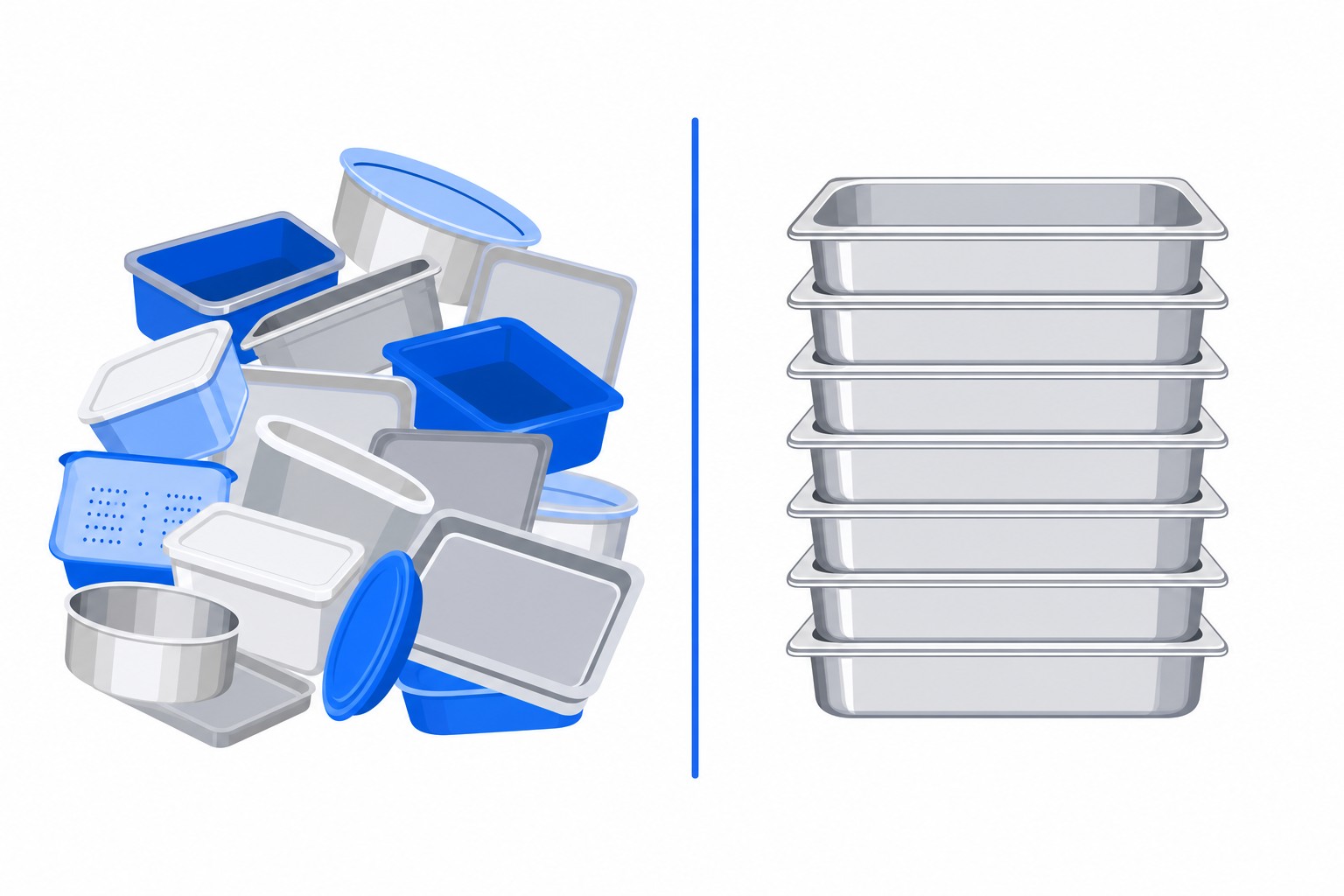
Walk into almost any professional kitchen in Europe — a hotel, a hospital, a school canteen, a catering hall — and you’ll find stacks of identical rectangular stainless steel trays sliding into ovens, fridges, bain-maries and service counters, all interchangeable, all from whichever manufacturer happened to be cheapest that year. Nobody on the line usually asks why they’re that exact size. The answer is a single afternoon in Switzerland, six decades ago.
The actual problem: nothing fit anything
Before 1964, professional kitchens ran on a genuinely chaotic mix of container shapes and sizes, with no coordination between manufacturers. Trays from one supplier didn’t match the fridge shelving from another; oven racks wasted corner space because nothing was cut to match anything else; planning storage or transport meant working around whatever oddly-shaped containers happened to be on hand. It wasn’t a minor annoyance — it was wasted space and unnecessarily complicated workflows built into the physical layout of every kitchen.
Two Swiss associations, one grid, one afternoon
On 17 November 1964, the Swiss Association for Hospital, Home and Community Catering (SVG) and the Swiss Hotel Association agreed on a single base module: a container measuring 530 × 325 mm, now known as GN 1/1. It’s worth noting who was in the room: this wasn’t a restaurant-industry-only fix — institutional and hospital catering was one of the two founding parties, not a later adopter of something built for hotels. The goal was explicit: every other container size in a kitchen should derive from this one grid, so nothing wasted a corner and everything from every manufacturer could work together.
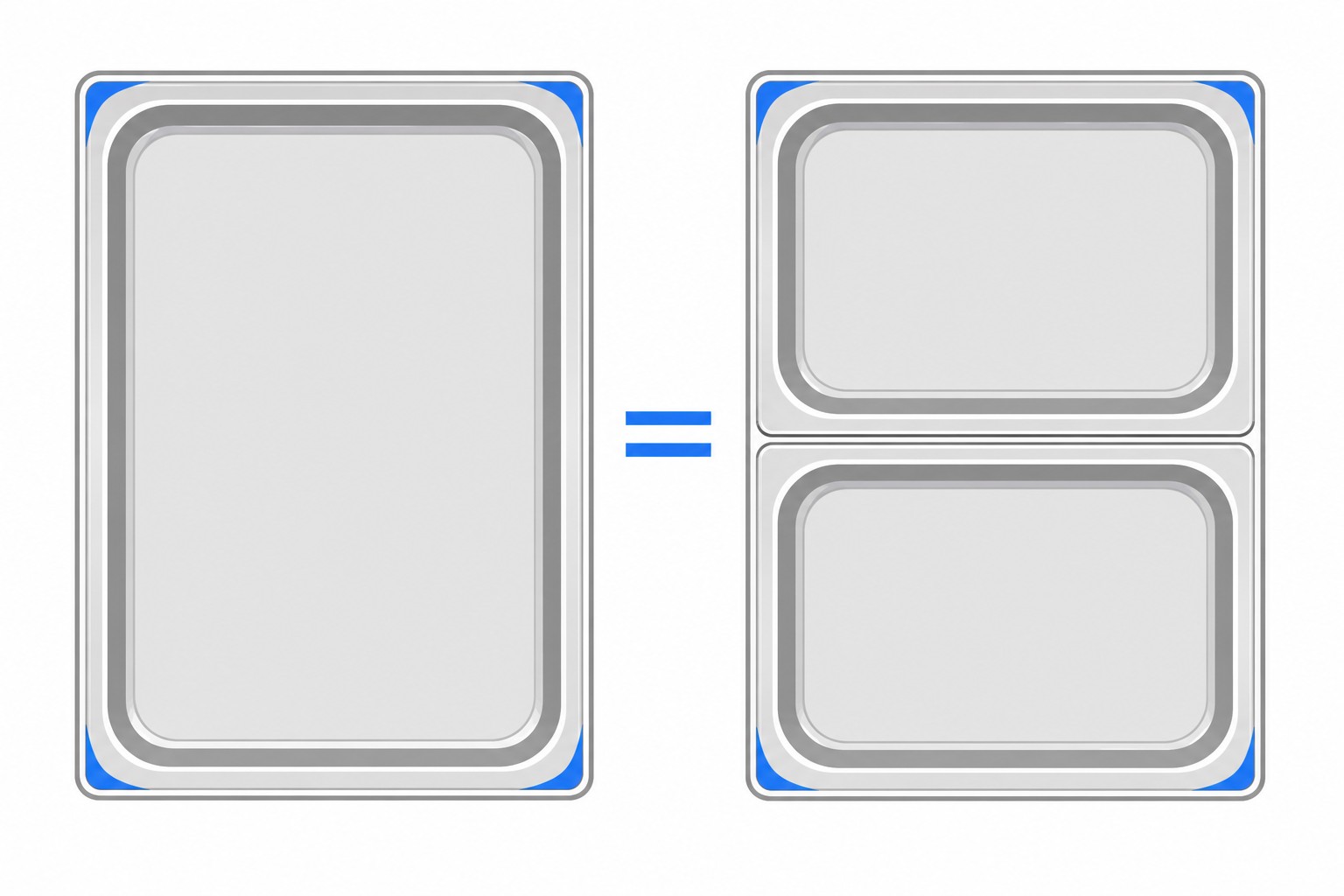 The entire system is one grid: a GN 1/1 tray’s footprint splits exactly into two GN 1/2s, or three GN 1/3s, with standard depths of 20, 40, 65, 100, 150 and 200mm layered on top.
The elegant part: it’s all just fractions of one rectangle
Every other Gastronorm size — GN 1/2, 1/3, 1/4, 1/6, 1/9, or the double-width GN 2/1 — is a mathematical fraction or multiple of that same 530 × 325mm rectangle, combined with standard depths of 20, 40, 65, 100, 150 and 200mm. The practical result: a GN 1/1 tray’s exact footprint can be replaced with two GN 1/2s, or a mix of smaller containers, and it all still fits the same oven rack, the same fridge shelf, the same bain-marie well, regardless of which brand made which piece. It’s a genuinely elegant solution to what had been a purely logistical mess.
Standardized on paper decades after it had already won
Gastronorm wasn’t formally written into international standards until well after it had already taken over European kitchens. Germany’s DIN 66075, in the 1970s, was the first to formally specify the equipment cutout dimensions that let ovens and fridges from any manufacturer accept the containers. It took until 15 December 1993 for the European Committee for Standardization to adopt it officially as EN 631-1, covering “materials and articles in contact with foodstuffs — catering containers — dimensions of containers.” By the time the paperwork caught up, the system had already, in the words of one industry account, made its “triumphal march through Europe and to large parts of the world.” Reportedly, not everyone welcomed it at first — some chefs are said to have pushed back on the very idea that professional cooking could or should be standardized down to the container. The logistics argument won anyway.
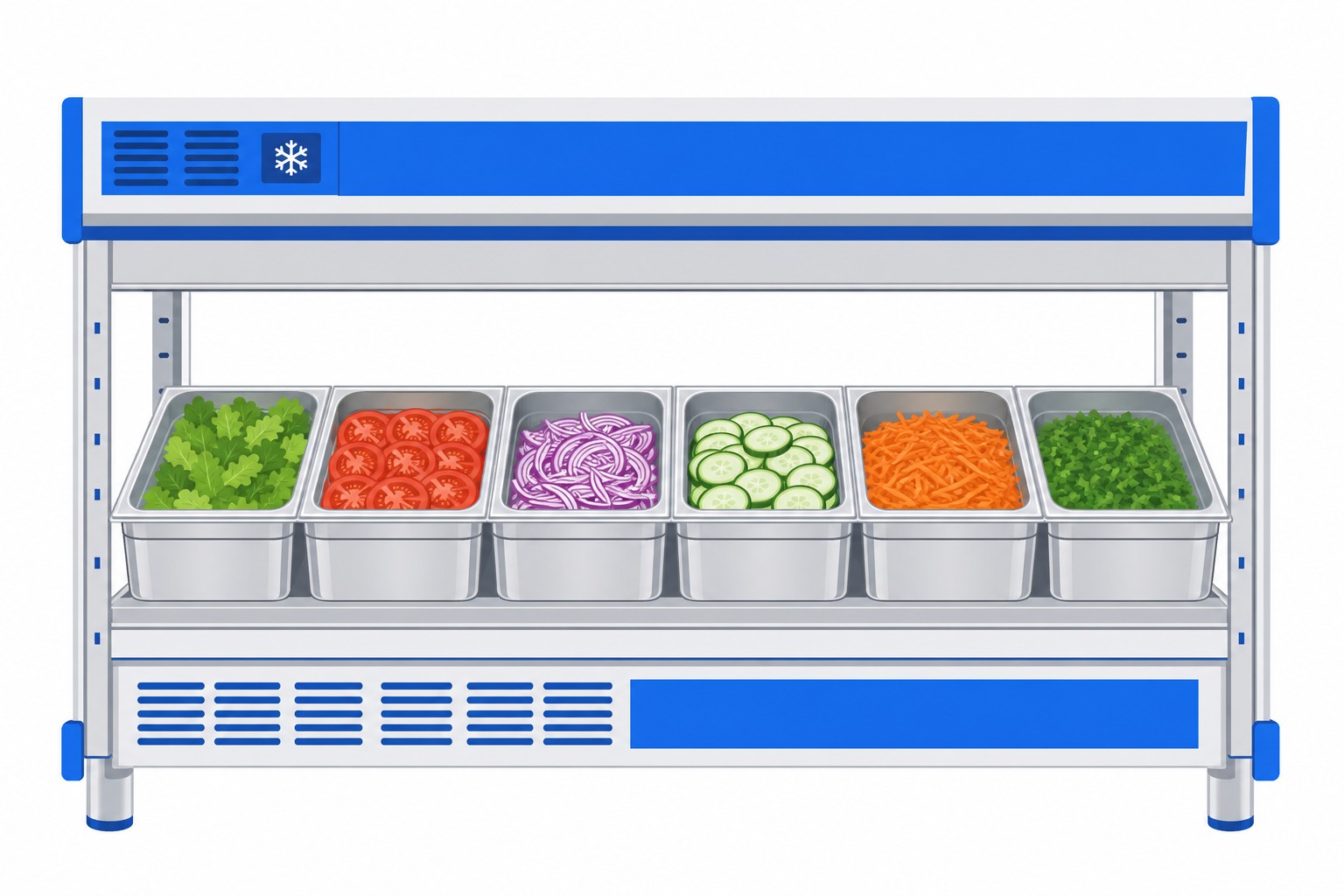 The entire point: equipment from completely different manufacturers — ovens, fridges, bain-maries, service counters — all accept the same containers, with no wasted space.
Where it stops: North America runs a different grid entirely
Gastronorm’s reach has a hard edge at the US and Canadian border. American commercial kitchens use their own, incompatible system — the hotel pan — sized in inches rather than metric: a US Full Size Pan measures 12 × 20 inches (305 × 508mm), genuinely different dimensions from the GN 1/1’s 530 × 325mm. Depths are numbered differently too (100, 200, 400, 600, 800, roughly inches × 100 rather than millimeters). Both systems use the same fractional logic internally — but a European Gastronorm tray and an American hotel pan are not interchangeable, and importing kitchen equipment across that divide means the containers, ovens and fridges genuinely don’t fit each other.
Why a 1964 tray standard belongs in a series about kitchen costing
Gastronorm is a genuinely mundane piece of equipment history, but the underlying logic — one standardized unit that every recipe, every portion and every storage decision gets measured against — is exactly the discipline a kitchen needs for its numbers, not just its shelving.
- Standardization compounds — the same instinct that made one tray size fit every oven in Europe is what makes one recipe format fit every location in a multi-site kitchen.
- Physical constraints shape recipe planning — portion sizes, batch quantities and storage logistics are all still bounded by container geometry, six decades on.
- “Nobody asks why” is a sign a standard actually worked — the best operational systems become invisible, which is itself worth remembering when introducing a new one.
CalcMenu didn’t invent the container your food sits in. It can make sure the recipe, portion and cost behind whatever’s in that GN 1/1 stays consistent everywhere it’s used.
Running a multi-site kitchen where consistency actually matters? Book a free 15-minute call with our team — no commitment: Schedule a call.
Related reading
- A Swiss cheese cartel invented fondue as the country’s ‘national dish’ in the 1930s to offload a surplus
- Switzerland’s favorite ‘exotic’ dish is curried rice with tinned pineapple, invented by a hotelier who spotted the name on a London menu
- Your grandparents didn’t have a zero-waste kitchen because they were virtuous. They had one because a rasher of bacon cost real money and there was no other choice.
Sources
- Gastronorm — Wikipedia
- BPRO Gastronorm container blog series episode 1: History and sizes
- Gastronorm - Something you need to know — Sunnex Products
- The Complete Guide to Gastronorm Sizes — Araven
Explore CalcMenu's recipe management software for restaurants, hotels & catering to see how it applies to your kitchen.
Related sectors
Comments
Comments coming soon.