
The Manila galleon connected Mexico and the Philippines for 250 years, trading chili for coconut wine and corn for mangoes. Its single richest heist, in 1587, was the biggest prize of the entire trade — and somehow no film has ever told the story
Chili, corn, tomato and chocolate sailed west from Mexico and rewired Filipino cooking. Mango, rice and coconut wine sailed east — and the Filipino sailors who carried that coconut-wine knowledge to Mexico's Pacific coast may have helped shape the distillation techniques behind tequila and mezcal. In between, one English privateer pulled off the richest single robbery in the trade's 250-year run. Every part of this is documented. None of it has been a movie.
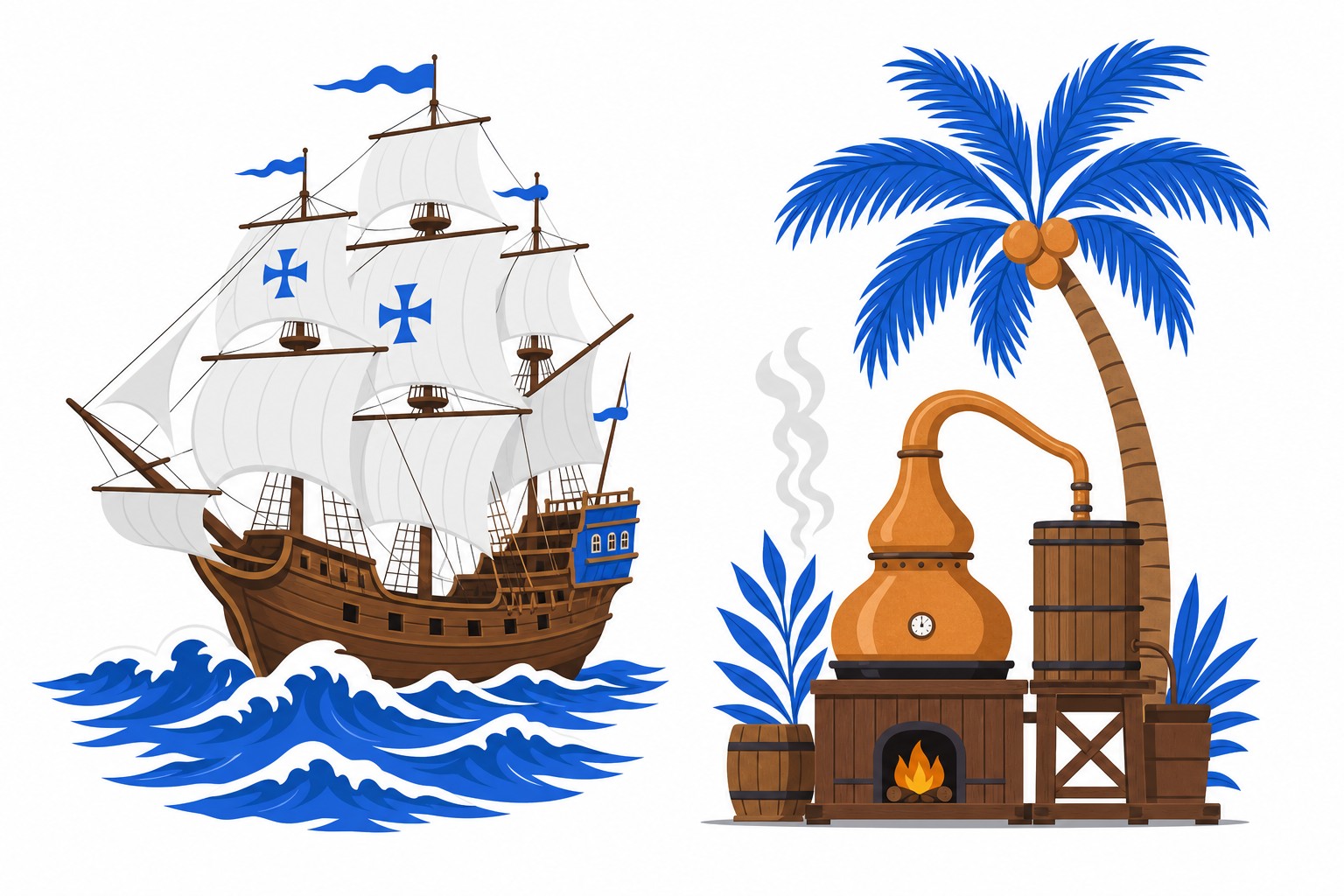
Two ports, one ship a year, two hundred and fifty years
Between 1565 and 1815, a Spanish galleon left the port of Cavite near Manila roughly once a year, rode the summer monsoon across the Pacific, and landed six months later in Acapulco, Mexico — then turned around and did it again. It’s often described as the longest continuously operating trade route in world history. I’ve already written about one of its stranger side effects: in 1763, a group of Filipino crew deserted a Manila galleon in the Gulf of Mexico and built the first Asian settlement in what’s now the United States. That desertion wasn’t an isolated event — it was one visible trace of a much larger, two-way food exchange between Mexico and the Philippines that most people have never heard the full version of.
 The galleon route ran Manila to Acapulco and back, roughly once a year, for two and a half centuries — the ships stopped, the exchange they carried didn’t.
What sailed east: the ingredients that rewired Filipino cooking
The cargo heading from Mexico to Manila is the half of this story most food writers already know: chili peppers, corn, tomatoes, chocolate, potatoes, peanuts, pineapple, and avocado all crossed the Pacific for the first time on these ships. None of these were in Philippine cooking before the galleon trade. Afterward, they became foundational — chili in particular is now inseparable from the idea of Filipino and broader Southeast Asian food, and it arrived by exactly this route, not from anywhere closer to home.
What sailed west: the half of the story that’s genuinely surprising
The cargo heading the other direction is less commonly told, and it’s more interesting. Manila-bound galleons returning to Acapulco carried mangoes, rice, and tuba — coconut palm wine, named from the Visayan word for the sap it’s made from. Filipino sailors, indentured laborers, and free migrants who crossed on these ships settled along Mexico’s Pacific coast, especially the state of Colima, and planted what are documented as Mexico’s first coconut palms. They brought the knowledge of how to tap and ferment the sap with them. By the 17th century, tuba was being produced commercially in Colima, Jalisco, and Guerrero; by the 18th century it was one of the most widely consumed drinks along the entire Mexican Pacific coast.
Here’s the part worth sitting with: researchers studying 17th-century colonial accounts of Colima have found that the distillation equipment described there — hollow tree trunks connected to copper kettles heated over wood fires — matches traditional Filipino stills for lambanog, a distilled coconut spirit, almost exactly. The argument some historians make is that this imported fermentation and distillation knowledge helped shape the techniques that later produced mezcal and tequila on Mexico’s Pacific coast. There’s an even smaller, stranger trace still in daily use: the word palapa — the thatched-roof beach structure found across Mexican and Central American resorts today — is the same word used in the Bicol region of the Philippines for coconut fronds.
 Tuba stills like this one, documented in 17th-century Colima, match traditional Filipino lambanog distillation equipment closely enough that some historians trace tequila’s technique back through this exact trade route.
The richest single heist in the trade’s entire history
The dramatic version of this story is real, and it’s a genuine 16th-century adventure story that happens to be true. On 4 November 1587, English privateer Thomas Cavendish — sailing to become only the third person in history to circumnavigate the globe — spotted the galleon Santa Ana off the coast of Baja California. The Santa Ana was sailing without cannons, to make room for more cargo. After several hours of chase and heavy damage, her captain Tomás de Alzola initially refused to surrender; his own navigator, Alonso de Valladolid, pleaded with him to strike his colours and save the crew’s lives rather than go down with the ship. Alzola gave in. Cavendish’s men loaded roughly 37 kilograms of gold plus silks, spices, and wine — a haul some Mexican sources put at 2,000,000 pesos, around 50 tonnes of silver equivalent. It remains, by most accounts, the single largest loss any galleon suffered in the trade’s 250-year run. Cavendish was knighted by Elizabeth I on his return to England.
That’s a genuinely cinematic scene — the captain who wouldn’t surrender, the navigator who talked him down, an entire year’s fortune changing hands in an afternoon. And as far as any searchable record shows, no film — Hollywood or otherwise — has actually told this specific story. Pirate movies have recycled the general shape of a treasure-galleon capture for a century without ever going back to the real one that set the benchmark for what a galleon heist actually looked like.
Two cuisines, one route, both directions verified
Put the two halves together and the Manila galleon looks less like a single trade route and more like a two-way culinary transplant that happened to run through the same two ports for two and a half centuries: Mexican ingredients rewrote Filipino cooking, and Filipino distillation knowledge plausibly helped shape one of Mexico’s most famous spirits. Both directions are separately documented; neither is the more commonly told half of the story on its own.
What this means if tequila, mezcal, or Filipino-Mexican fusion is on your menu
If your bar program or kitchen touches either side of this exchange — a tequila or mezcal cocktail list, a Filipino-Mexican fusion menu, or simply a heritage angle worth telling guests — the operational point is the same one this series keeps returning to: a good historical story is only as strong as the sourcing and documentation standing behind the dish or the pour.
- Provenance documentation for spirits and specialty ingredients, especially where a heritage story is part of what you’re selling to the guest.
- Recipe consistency across a fusion menu that’s genuinely drawing on two distinct culinary traditions, not blending them into something generic.
- Cost visibility on imported or specialty items — coconut products, specific chili varieties, imported spirits — where sourcing volatility is real.
CalcMenu can’t settle whether tuba actually shaped tequila as we know it today — that’s a live historical argument. It can make sure whatever you’re pouring or plating in its honor is costed and documented with the same rigor as the story you’re telling about it.
Running a bar or kitchen program with a real heritage story behind it? Book a free 15-minute call with our team — no commitment: Schedule a call.
Related reading
- Filipino sailors founded the first Asian settlement in the US in 1763 — deserters from this same galleon trade
- In 1982, a third of every restaurant in the Netherlands served Indonesian food under a Chinese sign
Sources
- Manila galleon — Wikipedia
- How the mango, coconut found their way to Mexico — Inquirer Kitchen
- The Chili in everyone’s kitchen and the Manila Galleon Trade — Dang’s Notes
- Filipino sailors dock in Mexico … and help invent tequila? — The Conversation
- How Filipino Sailors—and Coconuts—Helped Create Mexico’s National Drink — SAPIENS
- Is This Mexico’s Oldest Spirit? — Atlas Obscura
- Tubâ — Wikipedia
- Thomas Cavendish — Wikipedia
- Santa Ana: A pirate encounter and the hunt for lost treasure — Mexico News Daily
Explore CalcMenu's recipe management software for restaurants, hotels & catering to see how it applies to your kitchen.
Related sectors
Comments
Comments coming soon.