
Filipino sailors founded the first Asian settlement in what's now the United States in 1763 — thirteen years before the country existed. Filipino food still isn't mainstream there.
The Philippines has one of the largest, oldest, and most economically vital diasporas on Earth — 11.2 million overseas workers sending home over $35 billion a year, a presence in America that predates the United States itself. Filipino restaurants are still just 1% of America's Asian restaurants. The gap between those two facts is a genuinely interesting story, and it's finally closing.
A diaspora older than the country it eventually settled in
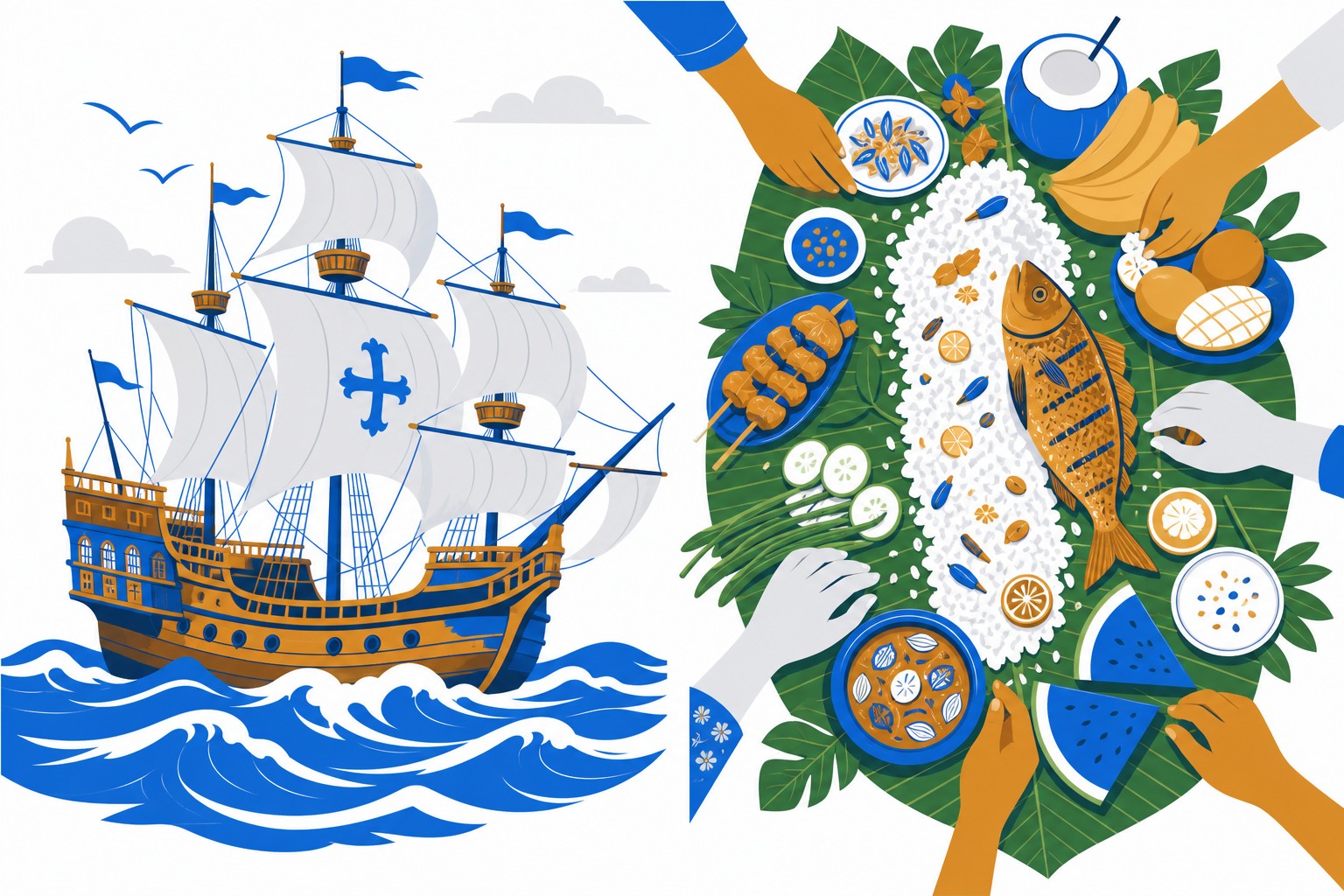
In 1763, a group of Filipino sailors — conscripted or indentured crew on the Spanish Manila galleons running the Manila–Acapulco trade route — deserted their ships in the Gulf of Mexico and walked into the marshlands of what’s now St. Bernard Parish, Louisiana. They built a stilt-house fishing village called St. Malo, in a style historians describe as “true Manila style, with immense hat-shaped eaves and balconies,” and it’s widely credited as the first permanent Asian settlement in what would become the United States. That’s thirteen years before the Declaration of Independence. Their descendants, the so-called Manilamen, later fought as privateers under Andrew Jackson at the Battle of New Orleans in 1815. Filipino presence in America isn’t a 20th-century immigration story. It’s older than the country itself.
 St. Malo, Louisiana — the Manila-style stilt village Filipino sailors built after deserting the galleon trade, thirteen years before the United States existed.
The modern version of that story is even bigger
Today, roughly 11.2 million Filipinos work outside the Philippines — Overseas Filipino Workers, or OFWs — sending home a combined $35.6 billion in cash remittances in 2025 alone, historically equivalent to around 7% of the entire national GDP. The United States receives the largest single share (nearly 40% of inflows), followed by Singapore, Saudi Arabia, Japan, and the UK. Proportionally, this is one of the largest sustained diasporas of any nation on Earth, embedded in economies on every continent, for well over a century in some places and going back two and a half centuries in Louisiana specifically.
And yet, the food didn’t travel the way the people did
Here’s the part that should be surprising and isn’t, once you look at the numbers: Filipino restaurants make up about 1% of all Asian restaurants in the United States, according to a 2023 Pew Research Center analysis of roughly 787,000 U.S. restaurants — even though Filipino-Americans account for close to 40% of the Asian-American population. Compare that to the restaurant breakdown Pew found: Chinese food accounts for 39% of Asian restaurants, Japanese 28%, Thai 11%, Indian 7%. Thai-Americans are a small fraction of the Filipino-American population in the U.S., yet Thai restaurants outnumber Filipino ones by more than ten to one. Population and remittance flow clearly aren’t the variable that predicts culinary visibility.
The “next big thing” that’s been “next” for over twenty years
This gap hasn’t gone unnoticed by the food world — it’s become something of a running joke. Andrew Zimmern called Filipino food “the next big thing” on Today in 2012. Anthony Bourdain made the same prediction in 2017. It kept not quite happening at scale, which eventually became its own story: Genevieve Villamora, who ran the James Beard–winning Washington D.C. restaurant Bad Saint until its 2019 closure, put it bluntly: “It’s like, the next new thing, the next new thing… We’ve been the next new thing for over 20 years, you know? When do we just get to be part of the American culinary landscape?”
Why, then — and it’s not one clean answer
Ask people who’ve studied this and you get several compounding factors, not one villain. Filipino cuisine is genuinely harder to reduce to a single “signature dish” the way pad thai or pho or sushi anchor their cuisines for an unfamiliar diner — it’s a five-century blend of indigenous Austronesian technique, Chinese trade influence, three centuries of Spanish colonization, and fifty years of American colonial administration, and that diversity, while the actual strength of the cuisine, makes for a much harder single-sentence pitch. There’s also a documented perception problem — some diners and even some Filipino-American chefs have described a lingering self-consciousness that “our food is too brown, it’s all soy sauce,” a framing problem more than a flavor problem. And structurally, fine-dining investment lagged: the kind of white-tablecloth Chinese, Japanese, and Thai restaurants that shaped Western perceptions of “elevated” Asian cuisine for decades simply had far fewer well-capitalized Filipino equivalents until recently.
What’s actually changing, right now
That’s the part worth ending on, because it’s real and it’s recent. Kasama in Chicago became the first Michelin-starred Filipino restaurant. Filipino chefs and restaurants pulled in at least five James Beard Award nominations in 2023 alone, on top of Tom Cunanan’s 2019 win at Bad Saint. Kamayan — the traditional communal feast eaten by hand off banana leaves — has moved from a home tradition into a genuine restaurant format, from Jeepney in New York outward. None of this is a rebrand of old food for new audiences; it’s a younger generation of Filipino-American chefs telling the actual, complicated, multi-colonial story instead of simplifying it — which, twenty years into being called “the next big thing,” might be exactly what finally makes it stick.
 Modern Filipino fine dining — the format driving the recent Michelin and James Beard recognition, decades after “next big thing” first got attached to the cuisine.
What this means if you’re building a Filipino or Filipino-influenced menu today
Whether you’re opening a Filipino restaurant abroad, adding Filipino dishes to an existing menu, or running hospitality operations that touch the Philippine market directly, the operational lesson from this history is specific: the diversity that made this cuisine hard to market is the same diversity that makes it operationally demanding. A regional adobo in Bicol (coconut milk, chili) and a Pampanga adobo (soy-forward, closer to the Chinese-trade lineage) aren’t variations on a recipe — they’re closer to different recipes that happen to share a name, each with its own ingredient sourcing, yield, and cost profile.
- Recipe-level precision for regional variants, not one generic “Filipino” recipe card standing in for a cuisine with genuine regional splits.
- Consistent costing across multi-site operations, especially where a signature dish depends on imported or hard-to-source ingredients (patis, calamansi, specific vinegars) with volatile pricing.
- Documentation that travels with the chef, so a dish’s authenticity and its food cost aren’t only in one person’s head.
CalcMenu can’t settle whether the “real” adobo is the Bicol version or the Pampanga one — that argument predates the recipe card by a few centuries. It can make sure whichever version you’re serving is costed and documented with the same rigor as the rest of your menu.
Running a kitchen with Filipino dishes on the menu — or expanding into the Philippine market? Book a free 15-minute call with our team — no commitment: Schedule a call.
Related reading
- Hawaii’s segregated plantation labor camps — filled partly by the same Filipino sakada wave — invented poke bowls, saimin and Spam musubi anyway
- Filipino food never became the food world’s “next big thing” — but Jollibee, San Miguel and Dole went global anyway
- Hong Kong’s cha chaan teng café cuisine, built by refugees from famine
- A food truck outside a Silicon Valley factory became a 500-truck company
- The vegetables empires were built on: onion and garlic across cuisines and time
Sources
- The First Asian American Settlement Was Established by Filipino Fishermen — HISTORY
- Saint Malo, Louisiana — Wikipedia
- Overseas Filipino Cash Remittances — Bangko Sentral ng Pilipinas
- OFW remittances hit record $35.6B — BusinessWorld
- Most Asian restaurants serve Chinese, Japanese or Thai food in the US — Pew Research Center
- Indian and Filipino restaurants underrepresented in the Asian food scene — NBC News
- Andrew Zimmern: Filipino food is the ‘next big thing’ — TODAY
- Filipino food the ‘next best thing’ said Anthony Bourdain — South China Morning Post
- Filipino cuisine is in the spotlight, but don’t call it a trend — NPR
- Filipino cuisine gets a nod in one of the U.S.’s highest culinary honors — NBC News
Explore CalcMenu's recipe management software for restaurants, hotels & catering to see how it applies to your kitchen.
Related sectors
Comments
Comments coming soon.