
A 12th-century monastery's octopus tax surplus became Spain's biggest single-dish food festival — the same religious order shaped the region's wine terraces and its strangest delicacy too
In one small stretch of inland Galicia, Cistercian and Benedictine monasteries didn't just influence local food — they built three completely different food traditions through three completely different mechanisms: centuries of labor terracing vineyard cliffs for sacramental wine, taxation of river fishing rights that turned a parasitic fish into a delicacy, and tribute redistribution that invented an entire dish and profession from surplus octopus. All three still define the region today.
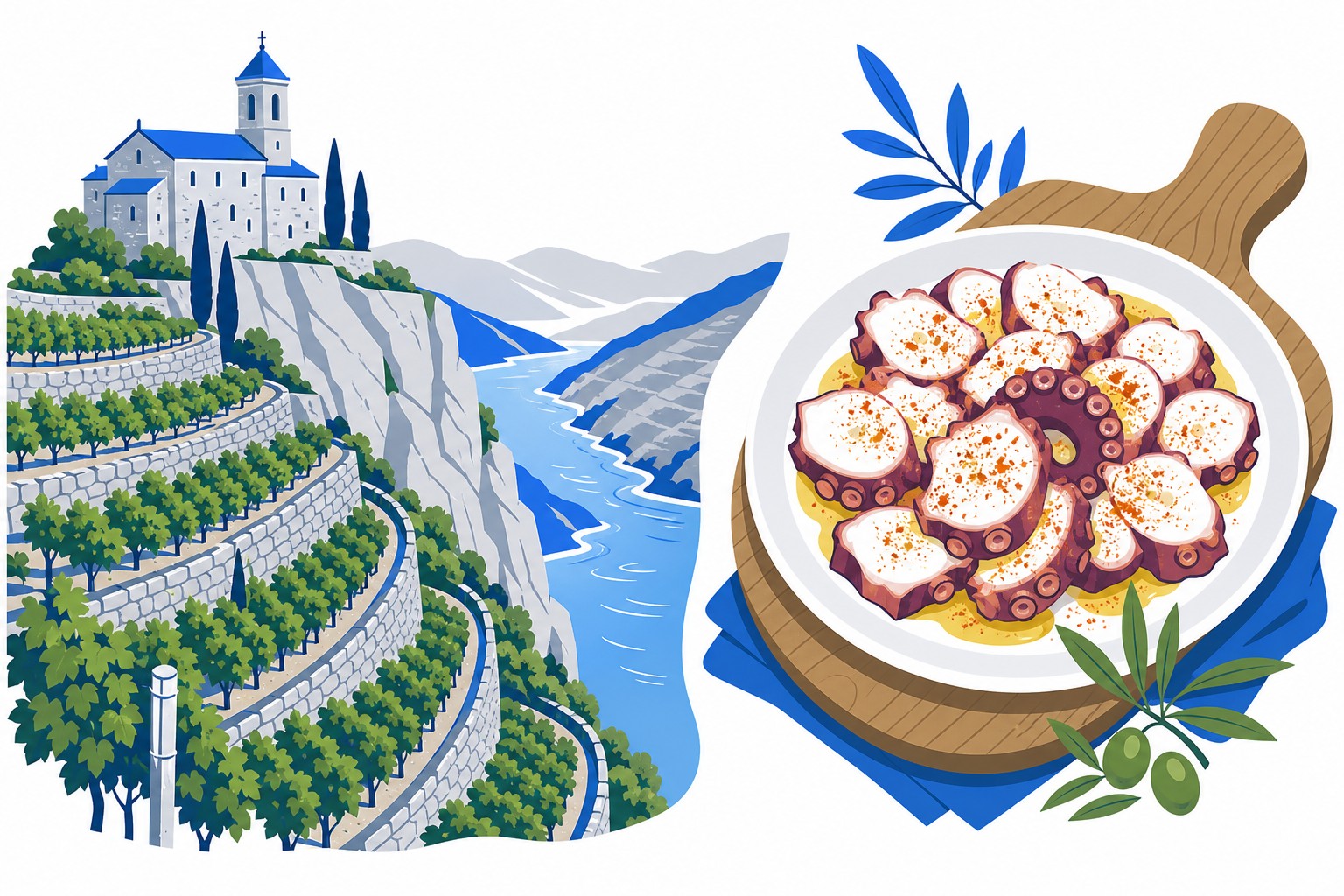
One small corner of Galicia, three unrelated food traditions, one shared cause
Ribeira Sacra — “sacred riverbank” — is the stretch of inland Galicia where the Sil and Miño rivers cut deep canyons through the Lugo and Ourense provinces. It’s known today mostly for wine: vineyards terraced into slopes so steep the region is classified internationally as “heroic viticulture,” some of it still harvested by hand or by boat. But the same institution that shaped those vineyards — Cistercian and Benedictine monasteries, active here from roughly the 6th to 12th centuries — also shaped two other foods that have nothing to do with wine and nothing to do with each other: a fish most people find repulsive on sight, and what’s become one of Spain’s biggest single-dish food festivals. Three traditions, three completely different monastic mechanisms.
Mechanism one: labor, applied to an impossible landscape
Rome cut the first terraces — socalcos — into these canyon walls to grow vines, shipping wine back to Rome by river. But it was Benedictine and Cistercian monks, arriving from the 8th and 9th centuries onward, who expanded and preserved that terracing for sacramental wine production, with monasteries like Santo Estevo de Ribas de Sil (founded in the 7th century) at the center of the effort. Over 80 Romanesque monasteries, churches and hermitages still watch over the canyon today. The terraces they built are so extreme that mechanized harvesting is often impossible — this is pure invested labor, sustained by a religious institution with the multi-generational patience to keep at it for centuries. That extremity produced its own dedicated profession: the barqueiro (boatman), who ferried harvested grape baskets by boat — fitted with a shelf called a pousa to hold them — across the river to wineries on the opposite bank, since many plots were reachable no other way. Boats and cliffside rail systems are still used on the steepest parcels today, though the dedicated boatman trade itself has largely disappeared.
Mechanism two: taxation, applied to a fish nobody would choose to eat
The Miño river has its own ancient technology: pesqueiras, stone weirs built directly into the riverbed to trap migrating lamprey, an eel-like, jawless, parasitic fish that is, by most modern reactions, genuinely off-putting to look at. Some pesqueiras date to Roman construction; reliable documentation appears in medieval records, where lamprey and the pesqueiras themselves show up as a recognized form of tax payment. Around Arbo, on the Miño, the pesqueiras were direct property of the Cistercian Monastery of Melón, which rented fishing rights to local residents. Lamprey became a genuine regional delicacy — not because it’s an easy sell, but because a monastery had a direct financial stake in the fish being caught, taxed, and eaten.
 Pesqueiras on the Miño river — stone traps of Roman origin that medieval monasteries owned outright and rented out, turning lamprey fishing into a taxed, regulated trade.
Mechanism three: tribute redistribution, which is how a whole profession got invented
This is the best-documented and most direct case. The Cistercian monastery of Santa María de Oseira, founded in 1140 in Cea (Ourense, Ribeira Sacra’s home province), received octopus as tribute from its coastal sharecroppers — a landlocked monastery collecting seafood rent from tenants working the coast. Rather than let the surplus go to waste, the monks began redistributing it to parishioners at local markets and fairs, to eat and to sell. That redistribution created both the dish — octopus boiled and served on a wooden plate with olive oil, paprika and coarse salt — and an entire profession: the pulpeiras and pulpeiros, traveling octopus cooks who worked the fair circuit with portable cauldrons. A monthly fair, originally held in Cea under a concession granted by King Sancho IV in 1286, moved to nearby O Carballiño in the 17th century. The tradition there is now the Festa do Pulpo: a single Sunday in August that draws over 100,000 visitors for one dish.
 Pulpo á feira’s origin: octopus tribute a landlocked monastery couldn’t use itself, redistributed to parishioners — which is also how the traveling pulpeira profession got started.
Why this is more interesting than any one dish on its own
It would be easy to tell each of these as an isolated food-history curiosity — a wine region, an unusual fish, a famous festival dish. What’s genuinely striking is that all three trace back to the same small cluster of monasteries, in the same corner of Galicia, operating three unrelated economic levers at once: direct labor investment in the vineyard terraces, ownership and taxation of a natural resource (the pesqueiras), and redistribution of tribute income (the octopus). A single religious institution, in other words, ran what today would be described as three completely different lines of business — and all three still define the region’s food identity, thanks to a wine bottle label using Galician spelling nobody outside the region would think to double-check.
What this means for a menu built on heritage-ingredient stories
Whether it’s a recovered heritage grape, a regionally specific fish, or a dish with a genuinely documented monastic origin, the operational lesson is one this series returns to often: a real, verifiable provenance story is worth using precisely, and it doesn’t excuse loose costing.
- Provenance adds real value only when it’s accurate — guests increasingly notice when a “monastery-origin” or “ancient tradition” story is vague marketing rather than a documented fact.
- Recipe precision for whole-animal and regionally sourced dishes, where portioning and sourcing costs move the true margin more than a generic recipe line ever shows.
- Seasonal and regional sourcing volatility, since dishes this tied to a specific river, terrace or festival calendar carry real supply and price swings a flat annual cost estimate won’t catch.
CalcMenu can’t rent you a pesqueira or terrace a hillside. It can make sure a dish this specific is costed with the same precision its six centuries of history deserve.
Running a menu built around regionally specific or heritage-ingredient dishes? Book a free 15-minute call with our team — no commitment: Schedule a call.
Related reading
- A Galician grape survived on just 18 hectares before a decade of university research turned it into Ribeira Sacra’s first single-varietal white wine
- A Seville brewery has trained over 17,000 young chefs and waiters since 1995 — with an 80% job-placement rate
- Tapas has at least three King Alfonso origin legends — and the real explanation is a lot less romantic
- Pintxos have an exact, documented birthplace and decade — a 1930s San Sebastián bar, not a medieval legend
- In 1982, a third of every restaurant in the Netherlands served Indonesian food under a Chinese sign
Sources
- Ribeira Sacra (DO) — Wikipedia
- Ribeira Sacra, The Heroic Wine Region — Foods and Wines from Spain (ICEX)
- Pesqueiras — Concello de Arbo
- Festa da Lamprea in Arbo — Turismo de Galicia
- Pulpeir@s History — Festa do Pulpo de O Carballiño
- The Fair and the Octopus — Turismo de Ourense
Explore CalcMenu's recipe management software for restaurants, hotels & catering to see how it applies to your kitchen.
Related sectors
Comments
Comments coming soon.