
A Galician grape survived on just 18 hectares before a decade of university research turned it into Ribeira Sacra's first single-varietal white wine — and it's the same vine grown 200km away under a completely different name
Blanco Lexítimo nearly disappeared from Galicia entirely, reduced to scattered old plots totaling roughly 18 hectares. A ten-year research project by two universities and Spain's national research council confirmed what growers suspected: it's a genuinely distinct, high-potential white grape — and also, under a different regional name, the same vine grown across the border in Asturias and León. One winery has now bottled the appellation's first single-varietal example.
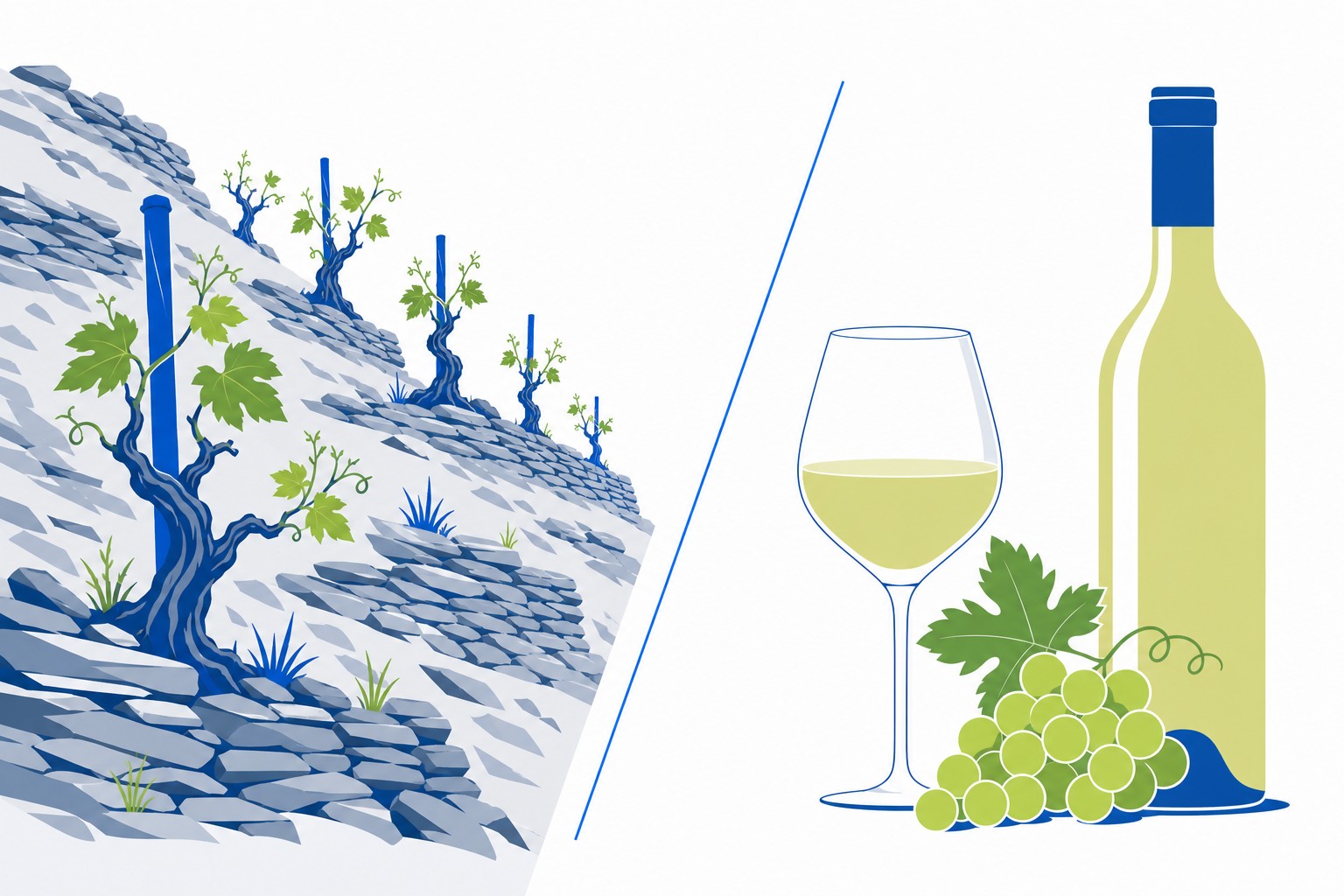
A grape reduced to scattered pockets, not a single vineyard
Blanco Lexítimo — sometimes written Branco Lexítimo — is a historically minor white grape that survived in Galicia only in isolated old plots, never as a dominant regional variety. Its largest surviving concentration, roughly 6 hectares, sits in the Betanzos area; smaller pockets remain in Barbanza (about 3 hectares, where locals call it “Raposo”), Terras do Navia (about 4 hectares, locally “Branco País”), and just 2 hectares in Ribeira Sacra itself. Total Galician plantings run to roughly 18 hectares — a rounding error next to the region’s dominant varieties.
The same grape, a different name, across a provincial border
Ampelographic research turned up something the isolated regional names had obscured: Blanco Lexítimo is the same vine grown as Albarín Blanco in neighboring Asturias (roughly 40 hectares) and León (roughly 90 hectares) — a genuine regional-synonym pattern, one grape carrying several unrelated local names depending on which valley it grew up in. It’s a pattern with real precedent in Iberian viticulture, where phylloxera-era chaos and poor record-keeping left plenty of varieties known by whatever name a given village happened to use.
 A decade of agronomic and aromatic research, led by CSIC’s Misión Biológica de Galicia and the University of Santiago de Compostela, characterized Blanco Lexítimo’s real potential before any winery released a varietal wine from it.
A ten-year research project decided whether reviving it was worth the effort
Starting around 2018, the Fundación Juana de Vega, CSIC’s research station EVEGA (Misión Biológica de Galicia / ICVV-CSIC) and the University of Santiago de Compostela ran a multi-year field study to answer a practical question: was Blanco Lexítimo actually worth commercial replanting, or just a historical curiosity? A 2018–2023 trial planted it alongside Godello, Albariño, Loureira and Treixadura on a single experimental plot — San Vitorio, in Ribeira Sacra, at 500 meters elevation — to compare them under identical conditions. The results were genuinely favorable: Blanco Lexítimo produced 2.09 kilos of fruit per plant, behind only Godello (2.76 kg) and ahead of Albariño, Loureira and Treixadura; it ripens on a shorter cycle than Loureira while reaching sugar and acid levels comparable to Albariño even when picked on the same date; and it proved very rich in glycosylated aromatic precursors — the terpene and norisoprenoid compounds responsible for aromatic intensity — positioning it between Loureira (Galicia’s most aromatically expressive variety) and Albariño. Sensory panels across multiple vintages described it consistently as fruity, tropical and floral.
The first bottle: Ribeira Sacra’s own Blanco Lexítimo
Following that research, the winery Ponte da Boga planted Blanco Lexítimo on its own slate-soil plot on the banks of the Miño river, in the northernmost stretch of Ribeira Sacra, and released what’s described as the appellation’s first single-varietal Blanco Lexítimo wine. The winemaking is straightforward: cold skin maceration, fermentation split between steel tanks and oak barrels, then five months aging on the lees. The resulting wine is pale yellowish-green, with intense citrus and white-flower aromas layered with stone fruit and a subtle toasted, smoky note; on the palate it leans toward lime, orange and apricot, at roughly 14% alcohol.
 Blanco Lexítimo’s aromatic profile — fruity, tropical and floral — comes from unusually high concentrations of the same glycosylated compounds that make Loureira, Galicia’s most aromatic variety, so expressive.
Why this is more than one winery’s marketing story
Heritage-grape revivals are common enough in wine marketing that skepticism is reasonable by default — plenty of “ancient variety” stories are thin on actual verification. This one is different in kind: the agronomic and aromatic case for Blanco Lexítimo was built by two universities and a national research council running a multi-year, multi-variety field trial before a single commercial bottle existed, not after. The synonym discovery (Albarín Blanco) is a separate, independently verifiable ampelographic fact, not part of the marketing pitch at all. Whether Blanco Lexítimo becomes a genuinely significant Galician white or stays a niche, single-producer curiosity is still an open question — but the “worth reviving” case itself is unusually well-documented for this category of story.
What this means for a wine list built on heritage or recovered varieties
Recovered and ultra-local grape varieties are an increasingly common wine-list story, and the operational lesson is a familiar one on this blog: a documented provenance story is worth telling accurately, and a small-production heritage wine carries real sourcing risk a mainstream varietal doesn’t.
- Verify before you market — a research-backed revival story (like this one) is a genuinely different claim than an undocumented “ancient variety” pitch, and guests increasingly know the difference.
- Supply volatility on tiny-production wines — 18 hectares total, across multiple growers and several different local names, means allocation and vintage availability need active management, not a “standing order” assumption.
- Accurate menu/list copy, since a recovered-variety story loses credibility fast if the details (which region, which research, which producer) don’t hold up to a guest who looks it up.
CalcMenu can’t replant a hillside or run a decade-long varietal trial. It can make sure whatever’s on your wine list is costed and tracked with the same rigor its backstory deserves.
Building a wine list around heritage or recovered regional varieties? Book a free 15-minute call with our team — no commitment: Schedule a call.
Related reading
- A Cistercian monastery’s octopus tribute surplus became Spain’s biggest single-dish food festival — the same order shaped Galicia’s wine terraces and its strangest delicacy too
- Tapas has at least three King Alfonso origin legends — and the real explanation is a lot less romantic
- A Seville brewery has trained over 17,000 young chefs and waiters since 1995 — with an 80% job-placement rate
Sources
- B. Blanco Lexítimo — Adega Ponte da Boga
- Branco Lexítimo, la variedad que se adaptó a las condiciones de la viticultura de montaña — Campo Galego
- Blanco Lexítimo y Capricho de Sousón, 2 vinos tributo a uvas autóctonas — Tecnovino
- Ponte da Boga leads the way and presents “B” — Corporación Hijos de Rivera
- VIOR — Misión Biológica de Galicia, grapevine transfer projects
Explore CalcMenu's recipe management software for restaurants, hotels & catering to see how it applies to your kitchen.
Related sectors
Comments
Comments coming soon.