
Tapas has at least three different King Alfonso origin legends attached to it — and the most likely real explanation is a lot less romantic than any of them
One legend says a 13th-century king invented tapas on doctor's orders. Another says a 19th-century king got a slice of sausage on his sherry glass to keep the sand out. Both stories are told as history in Spain today. The far more mundane, better-supported explanation: tavern keepers covered drinks with bread, ham or cheese to keep dust and flies out of the glass in the Andalusian heat — a genuinely practical habit that slowly became a dish.
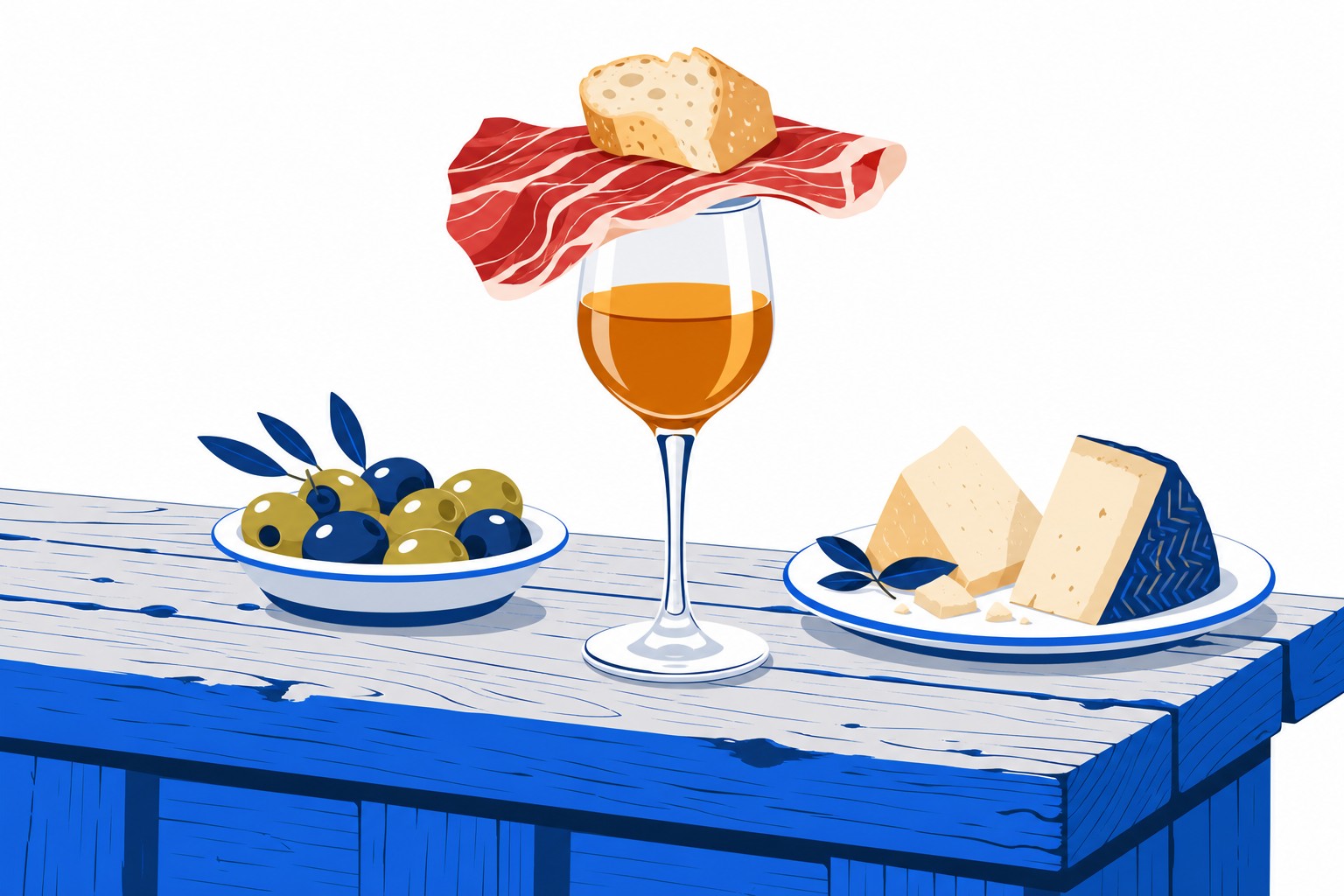
A dish named after the verb “to cover”
Tapas takes its name directly from the Spanish verb tapar — to cover, or to put a lid on. That etymology is the one solid, uncontested fact in an origin story that otherwise comes with at least three competing legends, several of them starring different Spanish kings named Alfonso, all told as settled history depending on which region — or which bar — is doing the telling.
Legend one: a 13th-century king’s doctor’s orders
The oldest version dates to the 1200s. King Alfonso X of Castile, according to this telling, was ill and had been prescribed small sips of wine throughout the day by his doctors. To keep the alcohol from going to his head on an empty stomach, he paired each sip with a small bite of food. Once recovered, he supposedly decreed that every tavern in Castile must serve a small portion of food alongside every glass of wine — explicitly to prevent public drunkenness.
Legend two: a 19th-century king and a gust of sand
A completely separate, much later legend attaches to King Alfonso XIII. In this version, the king was drinking sherry at an inn when a waiter noticed sand blowing up off the ground and, to protect the king’s drink, laid a slice of sausage over the top of the glass — which the king then ate. Several taverns across Cádiz and Seville each claim to be the actual site of this event, which is itself a good sign the story has been retrofitted onto more than one real location rather than reliably describing one.
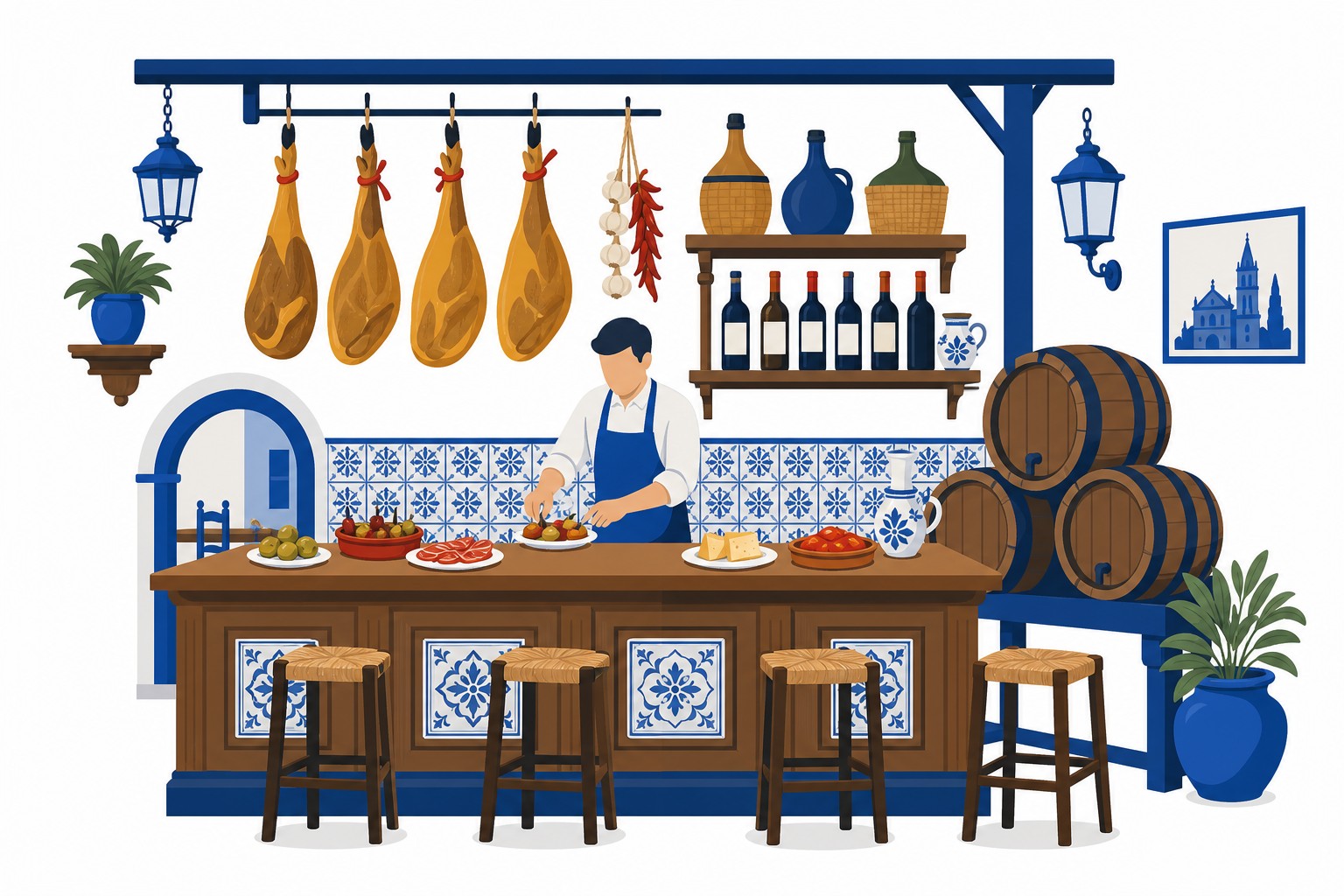 The Andalusian tavern setting where the practical, unglamorous version of tapas’ origin most likely actually took place.
The far more mundane, much better-supported explanation
Strip away both royal legends and the practical version is almost disappointingly simple: Andalusian tavern keepers covered customers’ wine and sherry glasses with a small plate, or directly with a slice of bread, ham, or cheese, for entirely unglamorous reasons — keeping dust, sand, and flies out of the drink in the intense regional heat, and slowing evaporation. Nobody needed a king’s decree for this. It’s the kind of small, repeated, practical habit that quietly becomes a tradition over generations, then gets a more flattering origin story attached to it after the fact — a pattern this blog keeps encountering in food history generally, not just in Spain.
Why the legend persists anyway
None of this makes the King Alfonso stories worthless — they’re genuinely part of how tapas culture talks about itself today, repeated by tour guides and tavern owners alike, and they capture something true about the dish’s role: a small bite of food, tied to a drink, meant to be shared and unhurried. But there’s a real difference between a charming founding myth and a historically supported origin, and tapas has both running in parallel, rarely distinguished from each other in casual retellings.
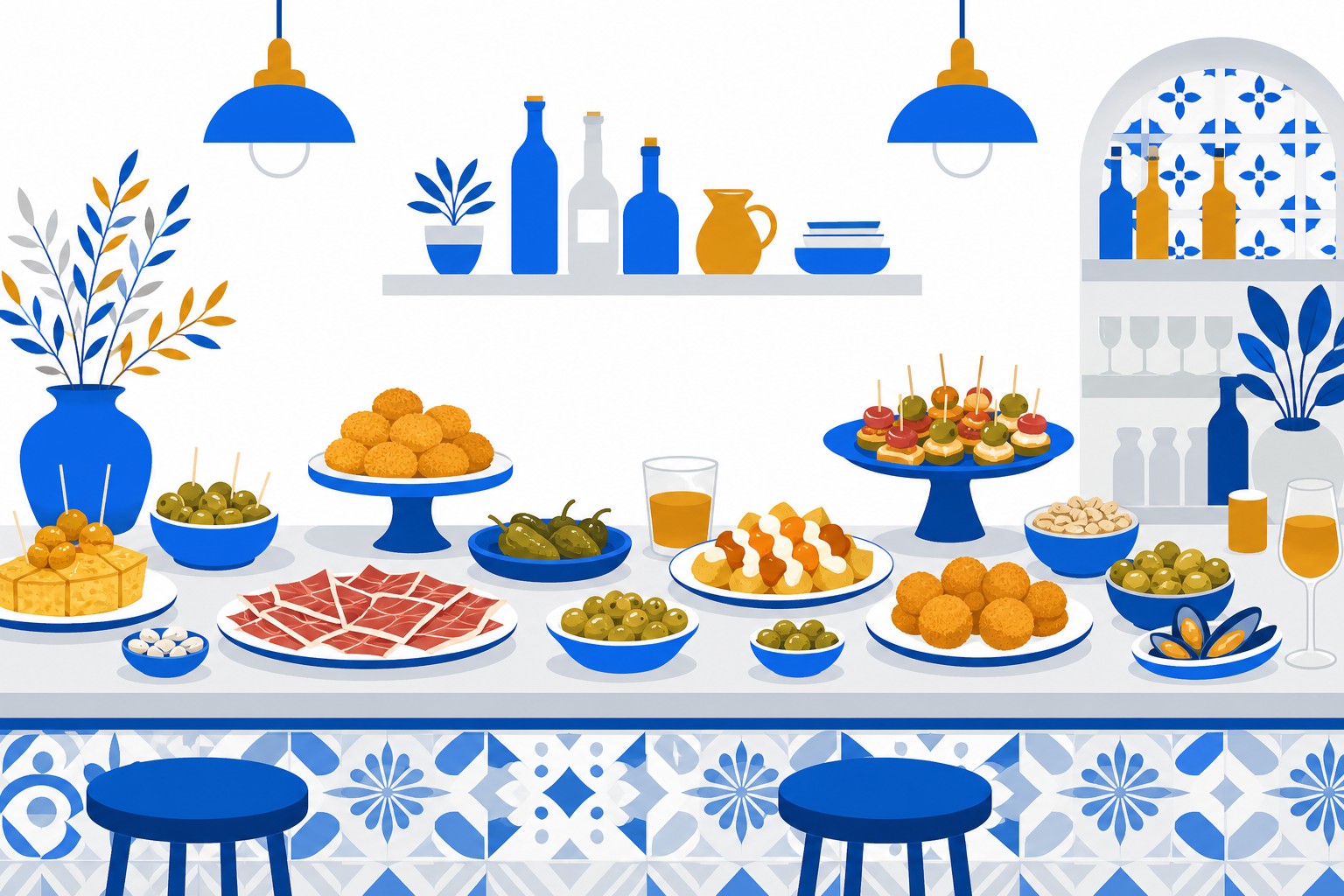 The modern tapas bar spread — descended from a practical habit of covering a glass, not a king’s decree.
What this means for a menu telling a tapas story
If tapas or its history feature on your menu’s marketing, the operational lesson is a familiar one on this blog: the story you tell guests and the numbers behind the dish are two separate systems, and only the story gets to be romantic.
- Honest framing when leaning on a founding legend — guests increasingly know enough food history to notice when a menu overstates a myth as settled fact.
- Recipe consistency for small-plate formats, where portion size and plating consistency matter disproportionately to the guest experience.
- Real costing per small plate, since tapas-style menus multiply the number of individually costed items dramatically compared to a standard entrée menu.
CalcMenu can’t settle which King Alfonso, if either, actually mattered. It can make sure every small plate on a tapas menu is costed with the same rigor as a single large one.
Running a tapas or small-plates concept? Book a free 15-minute call with our team — no commitment: Schedule a call.
Related reading
- A Seville brewery has trained over 17,000 young chefs and waiters since 1995 — with an 80% job-placement rate
- A Cistercian monastery’s octopus tribute surplus became Spain’s biggest single-dish food festival — the same order shaped Galicia’s wine terraces and its strangest delicacy too
- Pintxos have an exact, documented birthplace and decade — a 1930s San Sebastián bar, not a medieval legend
- The Manila galleon connected Mexico and the Philippines for 250 years
Sources
- The Art of Tapas — Google Arts & Culture, Real Academia de Gastronomía Española
- The history of Spanish tapas — Spain-Holiday
- History of the tapa — Native Spanish Tapas Tours
- The origins of tapas: history, legends, and tradition — Espagne Gourmet
Explore CalcMenu's recipe management software for restaurants, hotels & catering to see how it applies to your kitchen.
Related sectors
Comments
Comments coming soon.