
The science of gluten: how two proteins shape every pastry
Gluten is not one ingredient — it is a network built by two wheat proteins, glutenin and gliadin. Understanding how it forms, what develops it and what limits it is the difference between a crisp baguette and a melt-in-the-mouth génoise. Here is the science, and how CalcMenu turns it into repeatable recipes.
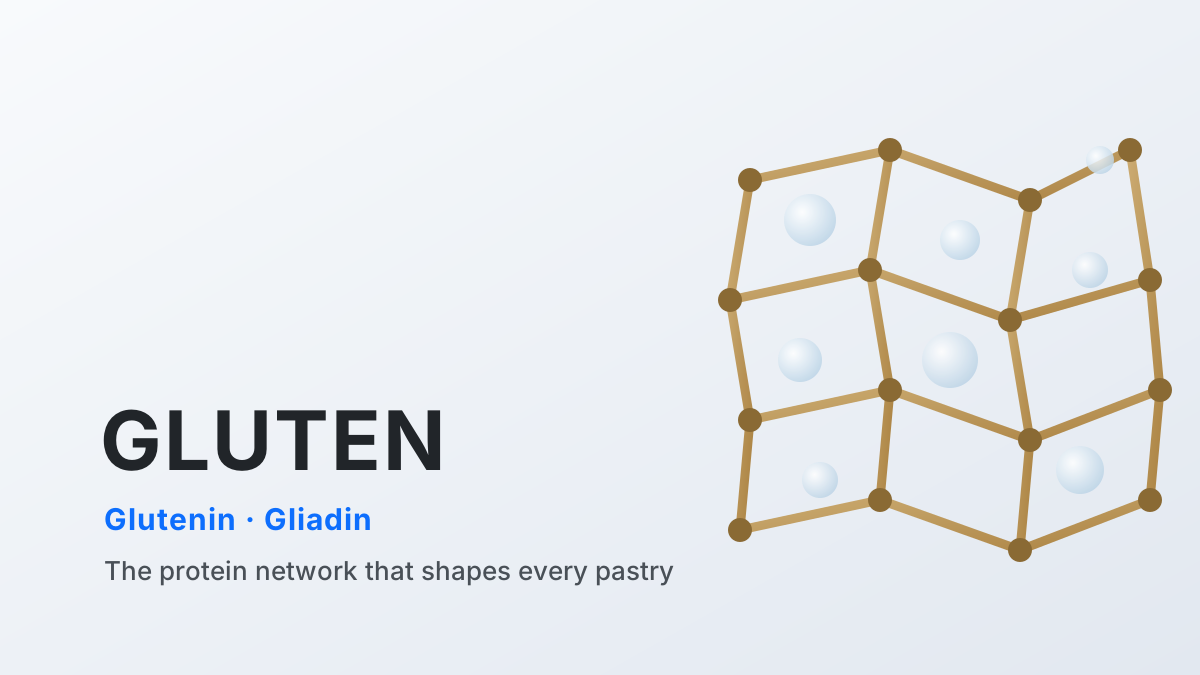
Pull a windowpane-strong dough out of a bowl and you are looking at one of the most elegant structures in the kitchen. Gluten fascinates every baker for a reason: it is not a single ingredient you add, but a network your hands and your process build. Get the balance right and you control texture, volume and bite. Get it wrong and the same flour gives you a flat, dense result — or a tight, chewy one.
This is a short tour of what gluten actually is, what develops it, what holds it back, and how much of it each product really needs. The chemistry is fixed; the craft is in controlling it — and that control is exactly what a structured recipe management system is built to make repeatable.
Two proteins, two roles
Gluten is not one ingredient. It forms from two families of proteins found in the endosperm of the wheat grain:
- Glutenin — a large polymer held together by interchain disulfide bonds. It provides elasticity and strength: the dough springs back, like a rubber band.
- Gliadin — a small monomer with few or no disulfide bonds. It provides extensibility and viscosity: the dough stretches, like plastic.
The balance between the two determines the behaviour of every dough. Too much elasticity and the dough fights you; too much extensibility and it slackens and tears. Great baking is the management of that ratio.
How the network forms
Three things build the gluten network, in order:
- Hydration. On contact with water, the proteins unfold. No water, no gluten — this is why hydration level is one of the most consequential numbers in any formula.
- Mechanical energy. Mixing and kneading align the protein chains and link them together. No energy, no network.
- The network itself. Once linked, the gluten web traps the gas produced by fermentation — and that is what gives structure and rise. No network, no structure.
Miss any one step and the chain breaks. That is why a good formula records not just quantities but hydration, mixing time and temperature — the variables that actually decide the outcome.
What develops gluten — and what limits it
Gluten is built with the right ingredients and the right conditions:
- High-protein flour. Bread flour (11–14% protein) provides more gluten-forming proteins.
- Adequate hydration. Water lets the proteins unfold and interact.
- Extended mixing or kneading. Mechanical energy aligns and links the chains.
- Salt. Tightens and strengthens the strands, improving elasticity and dough tolerance.
Just as important is knowing what weakens gluten — because in pastry you often want less of it:
- Fat coats the proteins before they hydrate, reducing development. This is literally where the word “shortening” comes from.
- Sugar is hygroscopic and competes with the proteins for water.
- Acids (lemon, vinegar, sourdough) weaken the network and reduce dough strength.
- Low-protein flour (pastry and cake flour) simply contains fewer gluten-forming proteins.
- Minimal mixing means fewer bonds and a weaker web.
Too much or too little gluten both hurt the final result. The key is balance and control — and control starts with a recipe that treats flour protein, fat and hydration as managed variables, not guesses.
How much gluten is enough?
The right amount depends entirely on the desired result. This is the part professional kitchens get wrong most often — chasing “strong” dough when the product calls for the opposite.
| Product | Gluten level | Why |
|---|---|---|
| Baguette | High | A strong network traps gas, giving an open crumb, volume and a crisp crust. |
| Feuilletage (puff) | Controlled medium | Enough strength to hold lamination and layers, without too much elasticity. |
| Pâte brisée | Low | Less gluten means a tender, crumbly texture that melts in the mouth. |
| Génoise / biscuit | Minimal | Very little gluten develops, for a light, airy, delicate crumb. |
Gluten is not good or bad. The key is to understand it — and to control it. A baguette and a shortcrust tart are the same protein chemistry steered in opposite directions.
Gluten in practice
Gluten behaves differently depending on the dough and the desired result, and three levers set that behaviour: development (time and mechanical energy), temperature (warm dough develops faster, cold dough slower) and hydration (essential to activate and build the network).
Well-developed gluten gives a strong, elastic dough with good gas retention, nice volume and an open crumb. Over-developed gluten does the opposite: tight, resistant dough that is difficult to shape, with a small, irregular crumb and a dry or chewy texture. The goal is to develop gluten enough to give strength and volume — but not so much that you lose tenderness. Balance is the secret of a perfect texture.
Crucially, gluten does not make bread rise. Fermentation produces the gas; gluten is the architect, not the engine. It builds the scaffold that keeps the gas inside so the dough can expand into a light, well-structured result instead of a flat, compact one. Think of gluten as the building that keeps the balloons inside.
A few things worth knowing
- The word “gluten” comes from the Latin gluten, meaning glue.
- Gluten represents roughly 75–80% of the proteins found in wheat, concentrated in the endosperm — the starchy core of the grain.
- Heat coagulates gluten irreversibly. Baking sets the structure for good.
- Celiac disease is not a gluten intolerance — it is an autoimmune condition, a distinction that matters enormously for anyone catering to guests who need genuinely gluten-free food.
When there is no gluten
Gluten-free pastry is a different science entirely. Without the glue, structure, elasticity and moisture have to be recreated with other ingredients and techniques: alternative flours (rice, almond, buckwheat, oat, chickpea) for structure and flavour; xanthan gum and guar gum for viscosity and binding; psyllium husk to mimic the gluten network; eggs for structure and emulsification; and above all technique — hydration, mixing, resting and baking control, where precision becomes your best ally.
This is where allergen data stops being a nicety and becomes a safety requirement. When a kitchen offers gluten-free options next to conventional ones, the recipe system has to carry that information cleanly — which is exactly what allergen and dietary tracking is for: one profile per recipe, flagged automatically, no reliance on memory.
From chemistry to repeatable recipes
Understanding gluten is the craft. Reproducing it — across a brigade, across sites, across seasons when your flour supplier changes protein content — is the operational challenge. That is where the science has to become data.
In CalcMenu, flour protein, hydration ratio, mixing method and process notes live on the recipe card itself, not in a head chef’s memory. Change the flour and the purchasing and specification data travels with it. Scale a génoise from 4 portions to 400 and the ratios hold. The result is that “the balance between the two proteins” stops being a feel that walks out the door when a chef leaves, and becomes a documented, repeatable process any team can execute.
Gluten is the invisible architect of texture. The kitchens that master it are the ones that stop treating it as a mystery and start treating it as something they can measure and control.
If you want to see how your recipes — from high-gluten breads to gluten-free desserts — can carry their full technical and allergen data in one place, book a 15-minute call.
Sources and further reading
- Educational inspiration: Ashissh Jamta, “Two proteins, two roles” gluten carousel (bakery & artisan pastry).
- Shewry, P.R. & Halford, N.G. (2002). Cereal seed storage proteins: structures, properties and role in grain utilization. Journal of Experimental Botany, 53(370).
- Wieser, H. (2007). Chemistry of gluten proteins. Food Microbiology, 24(2).
- Ahn, Y.-Y. et al. (2011). Flavor network and the principles of food pairing. Scientific Reports, 1:196.
Related sectors
Comments
Comments coming soon.