
The black octagon: how Latin America declared war on sugar — and what it changed
Chile put black warning seals on high-sugar products in 2016. Ten years later the model covers most of Latin America, purchases of sugary drinks fell measurably, thousands of products were reformulated — and a 2026 Lancet study links the policy to lower child obesity. What the octagon wave means for manufacturers and nutrition brands.
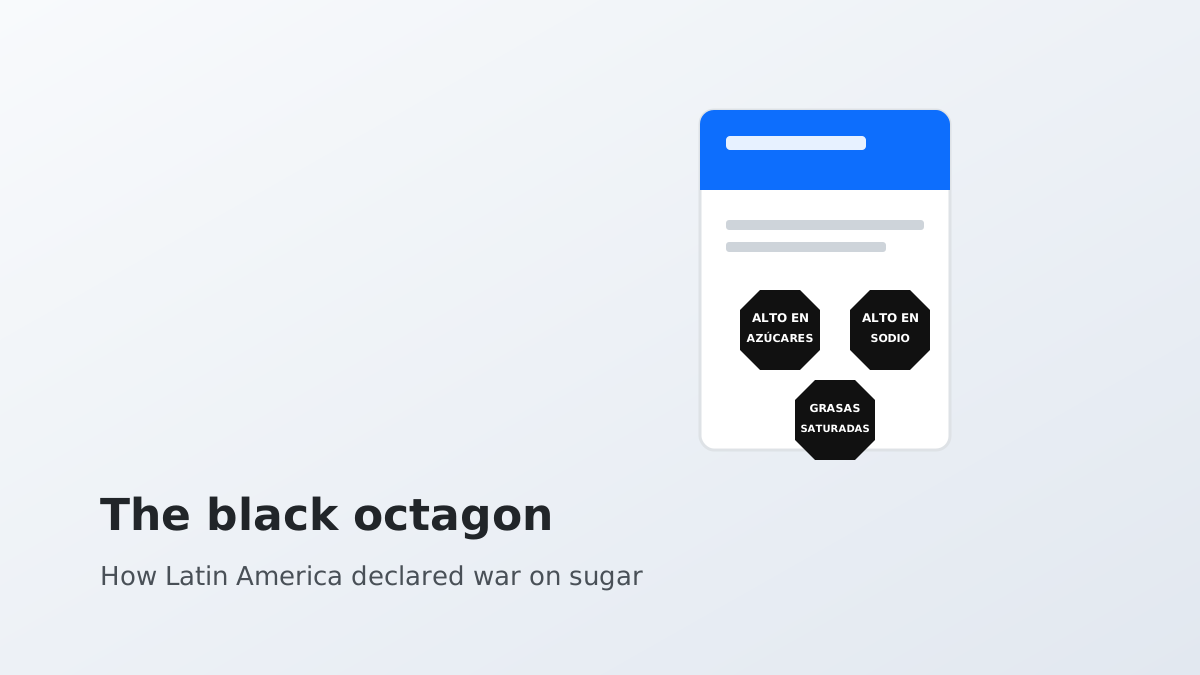
In June 2016, Chilean supermarkets changed overnight. Thousands of products appeared with stark black octagons on the front of the pack: ALTO EN AZÚCARES — high in sugar. High in saturated fat. High in sodium. High in calories. No interpretation required, no color codes to decode: a warning, in the style of a stop sign.
Ten years later, the octagon is the closest thing global nutrition policy has to a success story — and it has spread across an entire continent. If you manufacture food, run a nutrition brand, or supply retail or schools anywhere in Latin America, the octagon defines your product development. And if you operate elsewhere, it previews the logic regulators increasingly apply everywhere: measure the recipe, and say so on the front.
Chile: the experiment that worked
Chile’s law (Ley 20.606) combined three mechanisms: warning seals on any packaged product exceeding thresholds for sugar, saturated fat, sodium or calories; a ban on selling or promoting sealed products in schools; and restrictions on marketing them to children — no cartoon mascots, no ads in children’s television hours.
The results have been studied more thoroughly than almost any food policy in history:
- Purchases of “high-in” beverages fell by roughly 24% after the first phase.
- The declines in sugar, sodium and saturated fat purchased held and deepened three years in.
- About 15% of products were reformulated out of “high-in” status — over half of cold meats and more than a third of breakfast cereals dropped below the thresholds.
- And in 2026, a Lancet study following more than 300,000 children found those exposed to the full policy package for 18 months were measurably less likely to have overweight or obesity — the first plausibly causal evidence that a labeling law bends the childhood obesity curve.
The wave: one continent, one idea, many variants
Peru (2019) adopted black octagons with its own thresholds, extended them to advertising, and enforces actively. Mexico (2020) went further: up to five “EXCESO” seals per pack plus rectangular child warnings for sweeteners and caffeine — and reformulation followed, with the share of products exceeding limits dropping dramatically in several categories. Since March 2025, Mexican schools may not sell any product carrying even one seal. Uruguay (2021) runs four seals; Argentina (2022) implemented the strictest version, based on the PAHO nutrient profile, with five seals plus sweetener and caffeine warnings. Colombia (2023) adopted octagons and paired them with a first-of-its-kind tax on ultra-processed foods keyed to the same nutrient profile. Brazil (2022) chose a softer design — a black magnifying-glass label for sugar, saturated fat and sodium — which researchers already criticize as weaker than the octagon. Paraguay legislated Brazil-style seals in 2023; Ecuador, whose 2014 traffic-light label predates them all, is the instructive counterexample: high recognition, weak behavioral effect. Warning beats explaining.
Two caveats belong in any honest account. Uruguay loosened its thresholds under industry pressure. And Argentina is actively rolling parts of its law back — the counting rules were narrowed in late 2024 and the government has signaled it wants to reform or repeal the law. The octagon map is expanding, but it is not static; anyone selling into these markets needs to track it continuously.
What it means if you make or sell food
The octagon laws apply to packaged food, not restaurant menus. But they reach the professional kitchen and the food industry through three doors:
Product development is now nutrient profiling. Whether a product carries a seal is decided by thresholds — per 100 g or 100 ml, added versus total sugar, PAHO model versus national variants, all differing by country. A manufacturer selling the same recipe into Chile, Mexico and Brazil faces three different verdicts on the same formulation. The only workable approach is recipe-level nutrient calculation with reformulation simulation: know before the packaging is printed whether the recipe crosses a threshold, and what ingredient change takes it below.
Schools and caterers are covered. School food services across Chile, Mexico, Peru and Argentina cannot serve or sell sealed products. Caterers and suppliers into those channels must document, per item, that products stay below the limits — a per-recipe compliance question, not a marketing one.
Reformulation is a proven, competitive move. The data from Chile and Mexico shows companies reformulated at scale and quickly — meaning your competitors will. Being early means keeping shelf placement, school contracts and advertising freedom that sealed products lose.
This is precisely the problem recipe-level nutrition calculation exists to solve: every recipe carries its computed nutrient values from actual ingredients and yields, so you can test a formulation against any threshold model — and see instantly which recipes a new market’s rules would flag. For manufacturers, the same database drives labeling output, so the pack and the calculation can never drift apart.
The bigger picture: this logic is going global
The octagon is one instrument in a worldwide movement using regulation to improve food quality and reduce diet-related disease. Sugar taxes now exist in over a hundred countries — and the UK’s levy cut the sugar content of soft drinks by nearly half, mostly through quiet reformulation. The WHO has pushed industrial trans fats to the edge of extinction, with the EU capping them since 2021. Sodium is next: the US FDA has published voluntary reduction targets that explicitly include food service, and the WHO publishes benchmark limits for 70 food categories. Europe debates Nutri-Score; Singapore grades beverages at the point of sale.
Different instruments, one direction: the composition of what you serve and sell is becoming a regulated, published, comparable number. Operators whose recipes already know their own numbers will treat each new rule as an export setting. Everyone else will treat it as a crisis.
To see how CalcMenu computes nutrient profiles per recipe and simulates reformulation against any threshold model, request a demonstration.
Related sectors
Comments
Comments coming soon.