
Mexico NOM-051: what food-service operators must know about warning labels
Mexico's NOM-051 requires black octagon 'EXCESO' seals on packaged foods high in sugars, sodium, saturated fats or calories. With school bans in effect and enforcement tightening, the rule now reaches manufacturers, distributors and the caterers who serve sealed products.
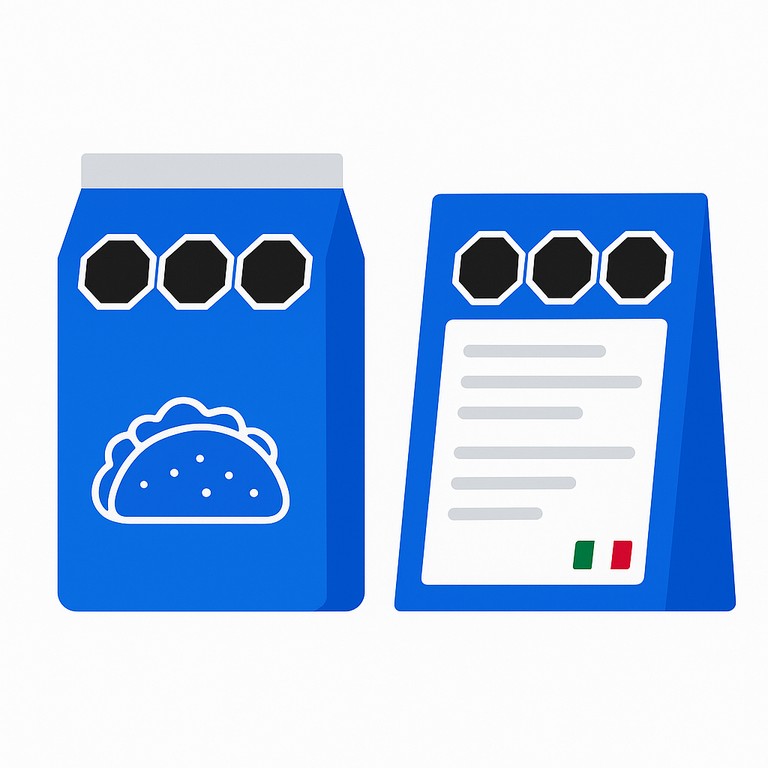
Mexico’s NOM-051 is one of the world’s strictest front-of-pack nutrition warning systems. Since 2020, packaged foods that exceed specific thresholds for sugars, sodium, saturated fat or total calories must carry black octagon seals declaring EXCESO — excess. Since 2023, child-directed warnings for sweeteners and caffeine were added. And since March 2025, Mexican schools cannot sell any product carrying even one seal.
For food-service operators, the rule matters in three ways: what you buy, what you serve, and what you can no longer offer in schools, hospitals or corporate cafeterias.
What NOM-051 requires
NOM-051 applies to pre-packaged foods and non-alcoholic beverages sold in Mexico. The label must appear on the front of the package and uses black octagons with white text. A product can carry up to five seals:
- EXCESO CALORÍAS — excess calories
- EXCESO AZÚCARES — excess sugars
- EXCESO SODIO — excess sodium
- EXCESO GRASAS SATURADAS — excess saturated fat
- EXCESO GRASAS TRANS — excess trans fat
For products targeting children, additional rectangular warnings are required for caffeine and non-caloric sweeteners.
The thresholds are per 100 g or 100 ml of product as sold, not per serving. That makes reformulation the only real compliance strategy: a smaller portion declaration does not remove a seal.
Why it reaches food service
Restaurants, cafeterias and caterers are not directly required to label their own freshly prepared dishes. But they are affected because:
- Sealed products enter their supply chain. Soft drinks, snacks, sauces, dressings, desserts and packaged ingredients may all carry seals.
- School contracts now exclude sealed products. Since March 2025, any product with one or more NOM-051 seals cannot be sold or served in Mexican schools. This changes procurement for school caterers and contract-food-service companies.
- Corporate and healthcare clients ask. Large employers and hospital groups increasingly write NOM-051 compliance into catering tenders.
The reformulation evidence
Mexico’s implementation has produced measurable reformulation. Independent studies show that the share of products exceeding sugar, sodium and saturated fat limits fell significantly in several categories within the first years. Companies that reformulated early kept shelf space, school contracts and advertising freedom that sealed products lost.
The lesson for food-service procurement: a supplier’s NOM-051 status is now a sourcing criterion, not just a label detail.
What operators should do now
- Audit your packaged inventory. Identify which products you buy that carry seals, especially those used in school, hospital or corporate accounts.
- Ask suppliers for NOM-051 status in writing. Do not rely on visual inspection alone; reformulated versions may look identical.
- Review menus for sealed beverages. Soft drinks are among the most commonly sealed products and are often the first category clients ask about.
- Document alternatives. For school catering, maintain a list of non-sealed equivalent products or move toward fresh preparation.
- Use recipe-level nutrient data. If you produce packaged items yourself — sauces, desserts, baked goods — calculate the full nutrient profile per 100 g before printing labels.
How CalcMenu helps
CalcMenu calculates nutrients per 100 g and per portion from real ingredient data. For operators producing their own packaged items, this means you can:
- predict whether a recipe crosses NOM-051 thresholds,
- simulate reformulation scenarios before committing to a new recipe,
- generate nutrition declarations and allergen statements,
- keep ingredient and supplier data updated so calculations stay current.
For procurement, the same ingredient database lets you compare products by nutrient profile, not just price.
Bottom line
NOM-051 is not a packaging rule only. It is a procurement and menu-planning rule for anyone serving packaged foods in Mexico. The operators who treat it as a sourcing criterion — and who can document nutrient profiles per recipe — will keep access to the contracts that sealed products lose.
Related sectors
Comments
Comments coming soon.