
Your food cost jumped 8 points. Before you blame the kitchen, check whether the number is true
Real food cost problems creep. Measurement errors jump. When the percentage moves eight points in one period, the first audit should be of the number itself — period cut-offs, transfers, stock valuation, supplier credits — not of the brigade. By Marc Enggist, CEO of EGS.
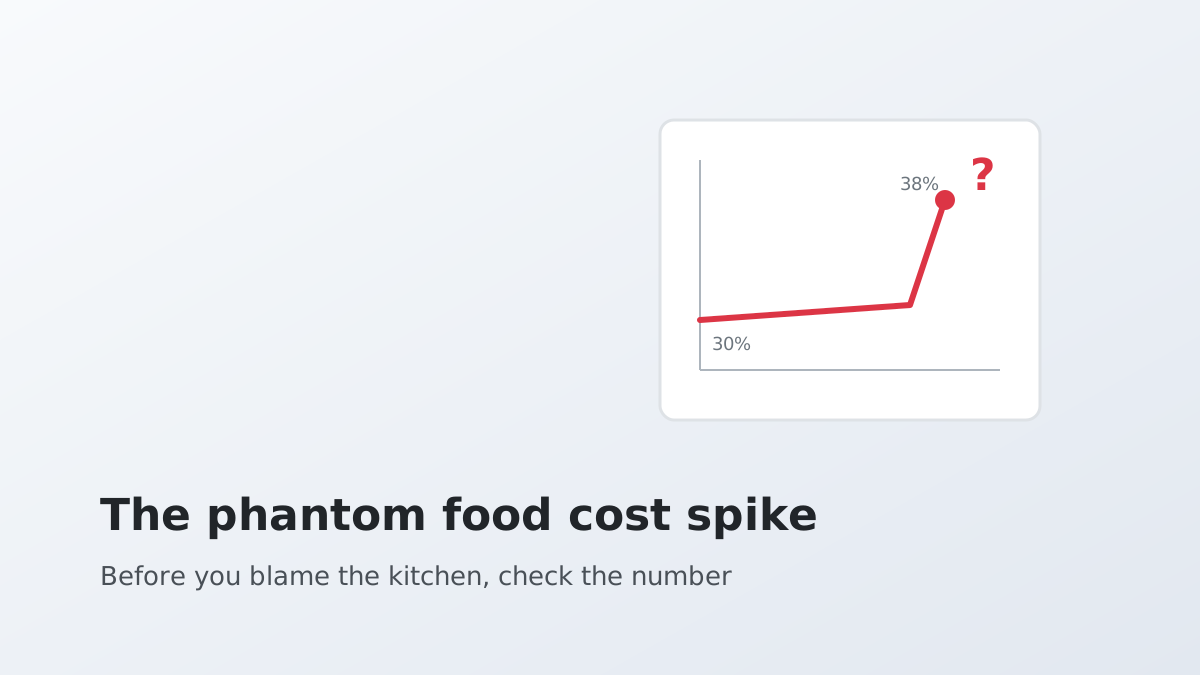
The month closes, the report lands, and the number is wrong in the worst way: food cost has gone from 30% to 38% in a single period. The F&B director calls the chef. The chef, who has seen this before, starts the ritual — pull the supplier price lists, re-check the portion sheets, walk the waste bins, interrogate the sous-chefs about staff meals. Two weeks of energy go into finding the leak.
I have watched versions of this scene throughout my career, and in a striking share of them there was no leak. The kitchen had not changed. The number had.
Creep versus jump
Here is the heuristic I wish every finance lead would pin above the desk: real food cost problems creep; measurement errors jump.
The genuine drivers of food cost deteriorate gradually, because they are the sum of hundreds of small daily decisions. Supplier prices drift a few percent a quarter. Portions loosen one ladle at a time as a brigade gets comfortable. Trim standards slip. Waste grows dish by dish. When these are your problem, the curve rises over months — annoying, but honest.
An eight-point move in one period is a different animal. For that to be real, something dramatic must have happened in the physical world: a commodity shock across your main categories, a theft operation, a freezer failure written off in one go. Those events exist, and you usually know about them before the report does. When the spike arrives without a story attached, the probability strongly favours the other explanation: the inputs to the calculation shifted, not the cost of cooking.
The four phantom causes
The period cut-off. Food cost lives and dies by what lands inside the period. A large delivery invoiced on the 30th but counted in the following month’s stock inflates this month’s consumption and deflates the next. One misdated invoice on a big order — a quarter’s worth of dry goods, say — can move a single site’s percentage by several points on its own. The tell: a mirror-image improvement next period that nobody can explain either.
The invisible transfer. In a group, food moves between sites constantly — the central kitchen sends prepared components to satellites, one unit bails out another before a banquet. If the sending site books the purchase and the receiving site books the revenue, the sender’s food cost explodes while the receiver posts numbers worthy of a magazine cover. Neither number describes a real kitchen. Unrecorded transfers are the single most common distortion I see in multi-site reporting.
The valuation switch. Opening stock at last purchase price, closing stock at average cost — or one site counting the cold room at gross weights while another counts trimmed yields. The consumption formula treats stock valuation as a fact, but valuation is a convention, and when the convention changes mid-stream, or differs between the people doing the counting, the difference lands directly in the food cost line. It looks exactly like the kitchen got sloppy. It is an accounting decision wearing a chef’s jacket.
The missing credit. Returned goods, short deliveries, price corrections, year-end supplier rebates — credits arrive late and irregularly, and they are booked with far less discipline than invoices. A period that happens to contain the purchases but not yet the corresponding credits overstates consumption. The kitchen paid the gross price on paper while negotiating the net price in reality, and the report punishes it for the difference.
Why one site survives this and thirty don’t
A single-site operator can afford a wrong number, because the number is not the only sensor. The owner walks the cold room, sees the delivery pallets, knows the banquet was cancelled, remembers the freezer breakdown. Presence corrects the report. When the percentage looks absurd, instinct says so, and the paper is questioned before the people are.
At fifteen or thirty sites, that correction loop is gone. The group F&B director cannot walk thirty cold rooms; the number is the visibility. A phantom spike triggers real actions — a formal warning to a site manager, a supplier renegotiation from a false baseline, a portion reduction that guests notice, a good chef who starts updating a CV because head office called twice about a number that was never true. And the symmetrical error is worse: a phantom improvement masks a genuine leak somewhere else, and nobody looks at all.
This is the quiet asymmetry of scale. The bigger the group, the more decisions rest on the report — and the more expensive every unverified figure becomes.
Audit the number first
None of this argues against holding kitchens accountable. It argues for a sequence. When food cost jumps, the first hour belongs to the calculation: were the period cut-offs clean, were all transfers booked in both directions, were opening and closing stock valued by the same convention, are there credits in transit. Only when the number survives that hour has the kitchen earned the audit.
Groups that run this discipline need the mechanics to support it — consumption calculated from recipes and booked movements rather than assembled by hand each month, transfers that debit and credit both sites in one operation, stock valued by one rule everywhere. That is the unglamorous machinery we have spent decades building into CalcMenu, and the reason is precisely this article: at scale, the most expensive item in your operation is not the beef, the butter or the saffron. It is an unverified number that people acted on.
Comments
Comments coming soon.