
Multiple food-service sites: 3 signs to unify
Menus, costs and allergens diverging across sites? Here is how a multi-site director regains control with a single source of truth.
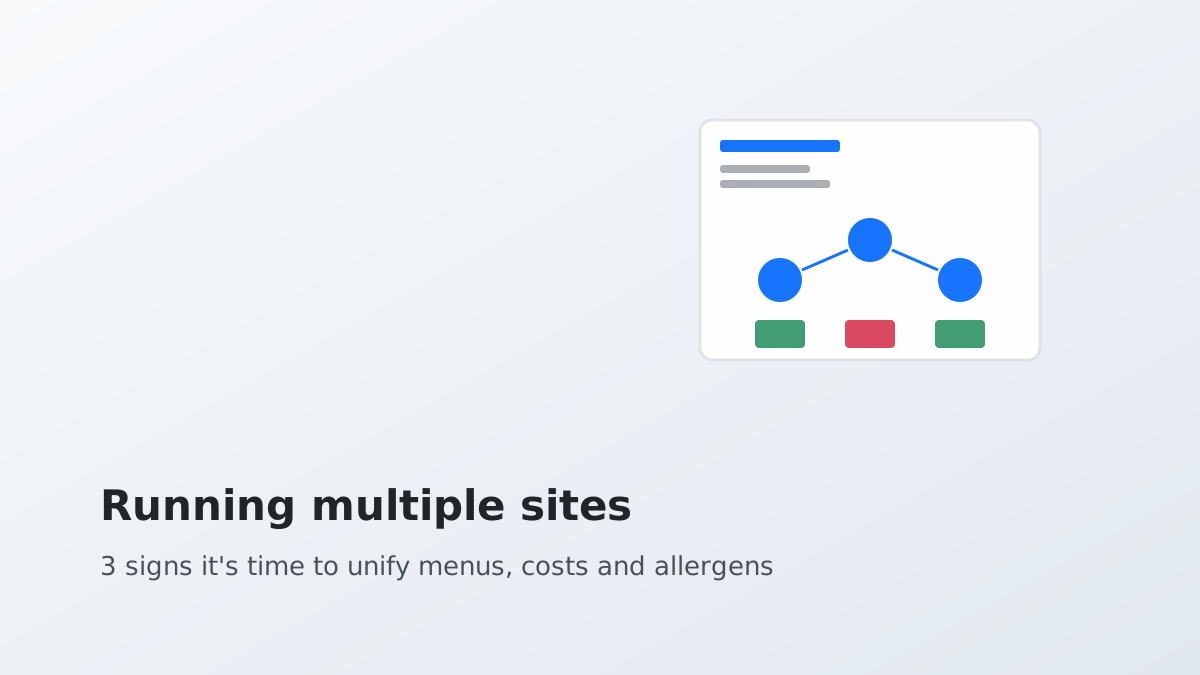
The multi-site director’s dream
One menu. Comparable costs. Allergens declared identically. For a director running several restaurants, care homes or canteens, that is the goal. But reality is often different: every chef has their own spreadsheet, every site calculates costs differently, and the same recipe has different names depending on the establishment.
The result: you cannot compare, you cannot standardise, and you discover variances too late.
Sign 1 — The same recipes have different costs
If the cost of a dish varies by 15 % from site to site without strategic reason, it is usually a symptom of unnormalised tools. One site calculates with supplier prices from six months ago, another forgets a garnish, a third uses a more generous portion.
Centralised software enforces a single calculation method. Each site keeps its local suppliers, but the recipe, weights and margin calculation come from the same model. The director sees variances immediately and can act.
Sign 2 — Menus evolve in silos
When a dish is withdrawn or an allergen changes, the information must reach all sites at the same time. With manual processes, some sites apply the new version, others do not. Regulatory and reputational risk grows.
CalcMenu versions recipes and menus. A change published by head office is available in every establishment. History shows who viewed the update and who applied it.
Sign 3 — Indicators arrive too late
A multi-site director cannot be on site every day. They need consolidated indicators: food cost by site, waste rate, label compliance, special-diet adherence. If these arrive as Excel files sent on the 10th of the following month, they only allow hindsight, not decisions.
A multi-site dashboard gives a real-time view. Anomalies are flagged as soon as they appear, not at month-end.
The single source of truth
The idea is not to impose the same menu everywhere. Each site keeps its local specialities. But reference data — recipes, allergens, costs, HACCP procedures — comes from a common base. That single source is what makes comparison, standardisation and improvement possible.
Concrete example
Take a chain of 10 brasseries. Before unification:
- 8 different versions of the spring menu;
- 4 cost-calculation methods;
- 2 sites with an incorrect allergen label detected late.
After unification in CalcMenu:
- A shared recipe base, with local adaptations allowed;
- The same theoretical cost for the same dish;
- Labels generated automatically from the validated recipe.
The director moves from crisis management to indicator-led management.
Conclusion
Running multiple sites does not mean controlling everything yourself. It means giving every site the same rules and the right tools to follow them. When data is unified, leadership can focus on what really matters: quality, profitability and safety.
Do you run multiple sites and want to unify your data? Book a multi-site discussion: Schedule a call.
Related sectors
Comments
Comments coming soon.