
Portion weight on the menu: from Sofia to your kitchen
In Sofia, Bulgaria, more and more restaurants print the weight of each dish directly on the menu. It is a small transparency gesture that changes purchasing decisions, kitchen costs and regulatory readiness. How portion weight is calculated and why your recipe software should already know it.
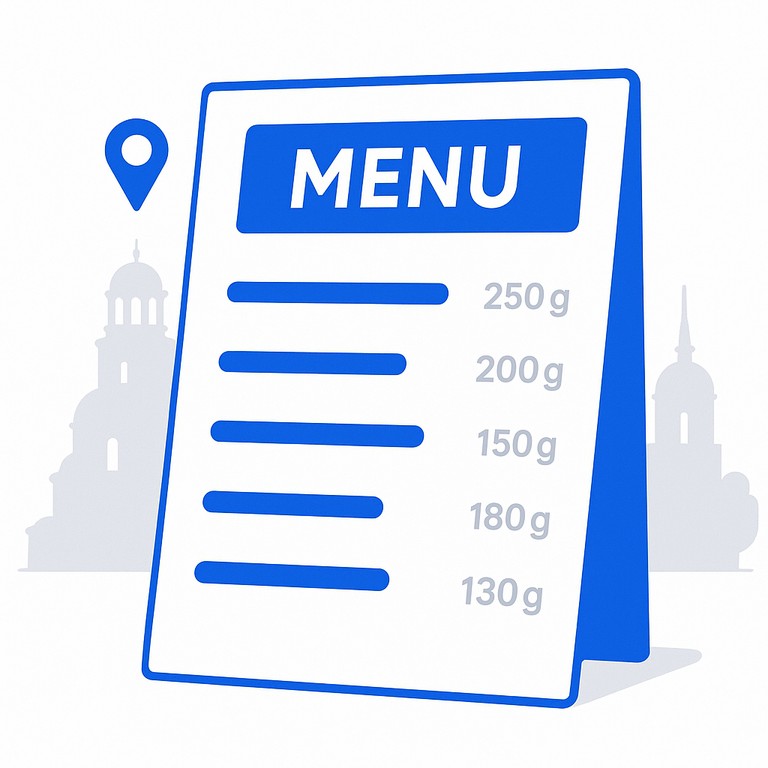
In a restaurant in Sofia, Bulgaria, the menu does not just list the dish and the price. Beneath each name, in the same size as the price, is a number: 320 g, 450 g, 180 g. It is the portion weight, declared before the guest orders.
For a traveler, it is a surprise. For the restaurant, it is a quiet operational discipline. And for any kitchen that calculates its recipes seriously, it is a signal of where menu transparency is heading.
Why put portion weight on the menu?
The reason is simple: guests want to know what they are buying. Is the schnitzel enough for two? Is the salad a side or a main? Is the steak 200 g or 350 g? Weight removes ambiguity. It also removes the silent complaint after the plate arrives: “I expected more.”
But the effect is not only on the guest side. When a kitchen commits to a portion weight on the menu, it commits to a standard in production. Every plate must match the declared weight. That standardization immediately improves three things:
- Food cost control. A 50 g overrun on a 300 g portion is a 17% cost increase that nobody notices until the end of the month.
- Waste reduction. When the target weight is explicit, prep teams stop over-serving “to be safe.”
- Menu engineering. You can compare dishes by value per gram, not just by selling price.
What “portion weight” actually means
The weight printed on the menu is usually the net serving weight of the dish as served: the edible portion the guest receives. It is not the raw weight of every ingredient added together, and it is not the weight before cooking loss.
For a burger, it might be the cooked patty plus bun and garnish as assembled. For a pasta dish, it is the plated pasta with sauce. For a grilled fish, it is the fillet after cooking, on the plate.
To declare it accurately, you need a recipe that records:
- the raw weight of each ingredient,
- the cooking yield (how much weight is lost or gained),
- the target net weight per portion.
This is exactly what a technical recipe card does. When it is digital, the calculation is automatic.
How CalcMenu knows the portion weight
In CalcMenu, every recipe carries its quantities, yields and portion factor. The software calculates:
- raw weight per portion from the ingredient list,
- cooked/net weight after applying yield factors,
- cost per portion from the real purchase prices.
If the kitchen changes a supplier, a yield or a garnish, the portion weight and cost recalculate immediately. There is no spreadsheet to update, no risk of printing an old weight on tomorrow’s menus.
The same data can then be exported to:
- printed menus and menu boards,
- digital signage,
- online ordering platforms,
- allergen and nutrition labels.
Is it a legal requirement?
In the European Union, there is no general obligation to declare portion weight on restaurant menus. The EU food information regulation (1169/2011) focuses on pre-packed foods and on allergen information for non-prepacked foods served to consumers.
But national practices differ. And consumer expectations are moving faster than regulation. When one restaurant in a market shows portion weights, others look less transparent by comparison. In Bulgaria, as in other markets, the practice is spreading first through chains and fast-casual concepts that want to signal honesty.
What to do next
If you are considering adding portion weights to your menus, start with your top 20 dishes:
- Check that each recipe has a defined portion count and net target weight.
- Calculate the real cooked weight from your current yields.
- Print a test menu and measure actual plates against the declared weight for one week.
- Adjust recipes or declared weights until the variance is under 5%.
Once the data is clean, publishing the weight on the menu is just another output from the same recipe database.
Bottom line
Portion weight on the menu is not a Bulgarian curiosity. It is a small change in how restaurants communicate value — and a larger change in how kitchens must control production. The restaurants that already manage recipes digitally have the answer before the question is asked.
Related reading
Explore CalcMenu's recipe management software for restaurants, hotels & catering to see how it applies to your kitchen.
Related sectors
Comments
Comments coming soon.