
Vegetable cuts explained: technique, texture and yield
Julienne, brunoise, paysanne, chiffonade — the classic vegetable cuts are not decoration, they are a cooking parameter. A practical guide to what each cut is for, how it changes cook time and nutrient retention, and how to write it into a recipe so it holds across a whole team.
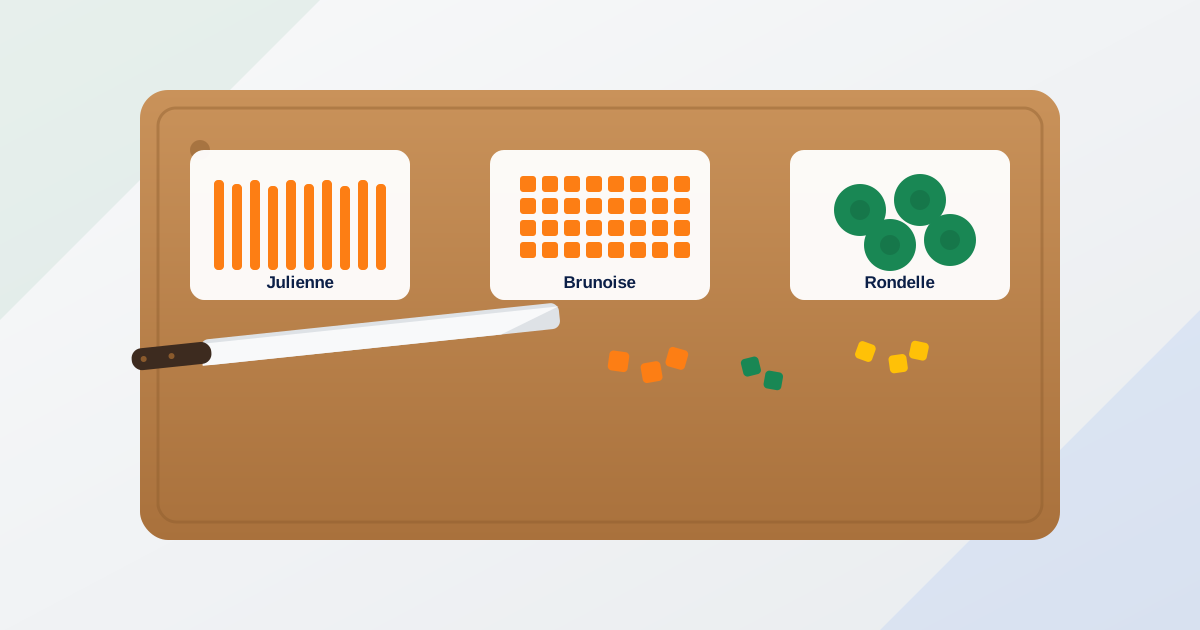
Ask two cooks to “cut the carrots” and, without a shared standard, you get two different dishes. One dices roughly for a stock; the other slices thin for a stir-fry. Neither is wrong — but if the recipe called for brunoise and needed to cook in ninety seconds at pass, only one of them delivers the dish as designed.
The cut is not garnish. It is a cooking parameter, on par with temperature and time — because it decides how much surface area meets the heat, how evenly a piece cooks through, and how much of the vegetable’s water and nutrients stay inside it. Get it wrong and the effects show up everywhere: uneven doneness, inconsistent plates, higher trim loss, and a food cost that drifts from what the recipe card promised.
The classic cuts, and what each one is actually for
Professional kitchens didn’t invent this vocabulary for tradition’s sake — each cut solves a specific problem of cook time, texture or presentation.
Mirepoix (rough cut, ~1–2 cm, uneven): for stocks, sauces and braises that will be strained or blended. Precision doesn’t matter because the vegetable’s job is to give up its flavour, not to be eaten as-is.
Paysanne (thin flat pieces, ~3 mm, irregular shape): for rustic soups and braises where the vegetable stays in the dish and needs to cook quickly without needing a knife at the table.
Julienne (matchsticks, ~2 × 2 × 50 mm): for stir-fries, garnishes and raw salads where fast, even cooking and a delicate bite matter. It’s also the starting cut for brunoise.
Batonnet (baton, ~6 × 6 × 50 mm): a coarser julienne — the classic French fry cut, and the base cut for a proper dice.
Brunoise (fine dice, ~2–3 mm cube): julienne, turned and cut again. Used for garnishes, fine sauces and anywhere texture needs to be nearly invisible on the plate. The most labour-intensive cut on this list, and the easiest to get inconsistent without training.
Macédoine / dice (medium cube, ~1 cm): the workhorse cut for vegetable medleys, salads and pan-roasted sides — small enough to cook evenly, large enough to keep some bite.
Chiffonade (fine ribbons): for leafy vegetables and herbs — stack, roll, slice across. Used raw as a garnish or added at the very end of cooking so the leaf doesn’t wilt into nothing.
Rondelle and oblique/roll cut (rounds or angled pieces): for cylindrical vegetables like carrots or zucchini. The oblique cut increases the cut surface without shrinking the piece — useful when a dish needs faster cooking but still wants visible, substantial pieces.
Tourné (turned, seven-sided barrel shape): classical presentation cut for potatoes and root vegetables, prized for even cooking on all faces and a refined plate. Rare outside fine dining because of the labour and trim loss involved.
| Cut | Typical size | Best for |
|---|---|---|
| Mirepoix | 1–2 cm, rough | Stocks, sauces, braises (strained) |
| Paysanne | ~3 mm, flat | Rustic soups, quick braises |
| Julienne | 2×2×50 mm | Stir-fries, raw salads, garnish |
| Batonnet | 6×6×50 mm | Fries, base cut for dicing |
| Brunoise | 2–3 mm cube | Fine garnish, sauces |
| Macédoine / dice | ~1 cm cube | Medleys, salads, roasted sides |
| Chiffonade | Fine ribbons | Leafy greens and herbs, raw or last-minute |
| Rondelle / oblique | Rounds or angled | Stir-fries, roasted vegetables |
| Tourné | 7-sided barrel | Fine-dining presentation |
Why the cut changes what happens in the pan
A smaller cut exposes more surface area per gram of vegetable. That single fact explains most of what a cut controls:
Cook time and evenness. More surface area means heat penetrates faster and more uniformly — a brunoise carrot is tender in a fraction of the time a mirepoix chunk needs, and every piece in the batch finishes at roughly the same moment. Mixed cut sizes in the same pan are a common, avoidable cause of some pieces being raw while others are mush.
Moisture and nutrient loss. The same surface area that speeds cooking also speeds moisture loss and oxidation once a vegetable is cut. Finely cut vegetables left too long before cooking lose colour, crispness and water-soluble vitamins faster than the same vegetable held whole or roughly cut. This is why fine cuts are usually a last step before cooking or plating, not a prep-list item done hours ahead.
Seasoning and sauce contact. More surface area also means more contact with salt, acid and sauce — a fine dice picks up seasoning far more readily than a large chunk, which is part of why brunoise reads as more intensely flavoured than the same vegetable in mirepoix, even from the identical batch.
Yield and trim loss. Cuts that require more shaping — tourné above all, but also a clean, uniform brunoise — waste more of the vegetable as trim. That loss is real cost: a kitchen that doesn’t track it is pricing the dish on the raw weight bought, not the weight that actually lands on the plate.
The cut is also a food safety window
Once a vegetable is cut, its safe holding time is shorter than the whole product’s — more exposed surface means faster bacterial growth as well as faster nutrient loss. A batch of brunoise prepped at 8 a.m. and held past its safe window is a different risk than a whole carrot sitting in the walk-in. Cut-vegetable prep needs its own cold-chain discipline: labelled, timed, and used within the window the recipe assumes — not “whenever it gets used.”
The cut is a texture spec, not just a look
In care catering — hospitals, EMS, rehabilitation centres — the cut of a vegetable is a clinical decision, not a stylistic one. The IDDSI framework defines texture levels for people with dysphagia, and the knife cut is often the first line of defence: a coarse dice served to a resident prescribed Level 5 – minced and moist is not a plating choice, it’s a safety failure that can lead to choking.
- A fine dice or brunoise, cooked soft, maps closely to Level 5 (minced and moist).
- A larger, fork-tender cut without a knife needed fits Level 6 (soft and bite-sized).
- Regular cuts are for Level 7 guests only.
A kitchen serving both a fine-dining room and a care unit from the same production line needs the cut written into the recipe as precisely as the cooking time — which is exactly the kind of ambiguity CalcMenu’s texture and IDDSI tools are built to remove.
From knife skill to house standard
The gap between a well-trained chef and the rest of the brigade is rarely about ingredients or timing — it’s about cuts that were never written down. “Small dice” means something different to every cook until it’s specified: 1 cm, not “small”; brunoise, not “fine.”
That precision belongs in the recipe itself. A CalcMenu tech sheet carries the exact cut for every ingredient alongside the method and cooking parameters, in the team’s language — so the mise en place looks the same whether it’s built by the head chef or the commis on a Tuesday morning, in one kitchen or across ten sites.
Two things follow directly from getting the cut right and recorded:
Food cost that reflects reality. Trim loss varies by cut — a tourné loses far more to the peeler than a rough dice. When a recipe’s food cost is built from the actual yield after cutting, not the raw weight bought, the number on the dashboard matches the number on the plate.
Prep time you can actually schedule. Brunoise takes longer than mirepoix by an order of magnitude. A recipe that states the cut lets a kitchen estimate real prep time per cover instead of guessing — which matters as much for a 40-cover à la carte service as for a 400-resident care kitchen planning tomorrow’s production.
The short version for the kitchen wall
- Match the cut to the cook time — small cuts cook fast and even, large cuts hold up in long braises.
- Cut fine vegetables last, not hours ahead — surface area that speeds cooking also speeds spoilage.
- Track trim loss — the cut changes real yield, and real yield sets real food cost.
- In care settings, the cut is a safety spec — check it against the resident’s IDDSI level, not just the recipe’s look.
- Write the cut into the recipe, in millimetres, not adjectives.
To see how CalcMenu turns knife-skill know-how into a tech sheet your whole team can follow, request a demonstration.
Related sectors
Comments
Comments coming soon.