
France: 'May contain' labels need justification
Generic 'may contain' claims remain voluntary in France, but the Netherlands requires justified statements from 2026 and EU-wide rules are coming. What's changing, why it matters for foodservice, and how to prepare.
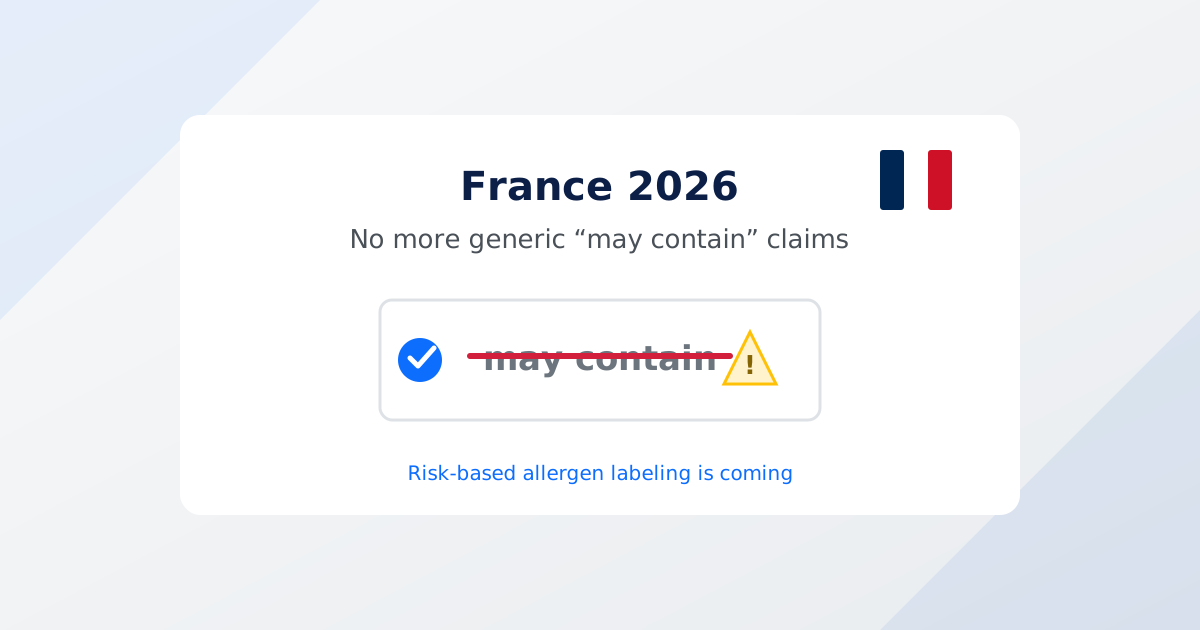
A turning point for allergen labels
Since 13 December 2014, EU Regulation 1169/2011 has required the declaration of 14 allergens in food. In France, décret n° 2015-447 extended this from July 2015 to non-prepackaged food as well, so it applies to both pre-packaged products and dishes served in institutional, hotel, and commercial catering.
Yet one practice has become widespread: the “may contain” statement added “just in case.” This precautionary claim reassured operators but ultimately confused consumers — a dish could “may contain” almost every allergen, with no real sense of the actual risk.
In France, however, no rule makes that approach non-compliant from 2026: precautionary labelling remains voluntary, though the DGCCRF has long advised using it only as a last resort, backed by a genuine cross-contamination risk analysis. The 2026 deadline actually belongs to the Netherlands, where from 1 January 2026 the NVWA will only permit “may contain” warnings justified by a documented risk assessment — with harmonised EU-wide rules expected around late 2027.
What exactly is changing
In France, precautionary “may contain” labels remain voluntary: DGCCRF guidance treats them as a last resort, to be justified by a genuine allergen risk analysis, and EU Regulation 1169/2011 already requires voluntary information not to mislead. A binding obligation to back each statement with a documented quantitative risk assessment currently exists only in the Netherlands, enforced by the NVWA from 1 January 2026, with harmonised EU rules expected around late 2027.
In practical terms this means:
- You must know exactly the ingredients and sub-ingredients of every recipe.
- You must evaluate cross-contamination risk by workstation and production line.
- You must document the method used to display the information.
- You must be able to prove, during an inspection, that the claim was justified.
Why this affects all foodservice
In France, no 2026 measure extends such a justification requirement to foodservice: operators — institutional, commercial, catering, bakeries, and more — must declare the 14 allergens actually present and manage cross-contamination under HACCP. Still, once an establishment displays allergen information — on a menu, buffet label, or sandwich wrapper — it must be able to justify it.
A hygiene inspection may ask for:
- the recipe valid at the time of sale;
- the allergen list calculated from ingredients;
- the change history;
- traceability of the batches used.
And in the United States?
The picture is very different across the Atlantic. Under FALCPA (the Food Allergen Labeling and Consumer Protection Act), the United States requires the labeling of 9 major allergens — sesame became the ninth on 1 January 2023 through the FASTER Act — but only on packaged foods. No US federal rule requires allergen declaration for restaurant food served non-prepackaged.
That is starting to change at state level: California’s SB 68, effective 1 July 2026, requires chains with 20 or more locations to provide written disclosure of all 9 major allergens for each menu item — a first sign that the US is beginning to converge with the EU approach.
How CalcMenu helps you prepare
CalcMenu automatically calculates allergens from recorded ingredients. Every recipe change is versioned and timestamped. The generated label or menu always reflects the latest validated version.
For precautionary claims, the tool lets you:
- link a risk analysis to each recipe;
- document sensitive workstations and production lines;
- generate consistent labels without manual copying;
- keep a history for inspection purposes.
What to do now
- Inventory every “may contain” statement used in menus and on labels.
- Verify that each statement is backed by a documented risk analysis.
- Centralize recipes in one system to avoid discrepancies across sites.
- Train teams not to use the claim as a precautionary reflex.
Conclusion
The end of generic “may contain” claims is good news for consumer safety, but it requires real documentation work in the kitchen. Recipe-management software that connects allergens, recipes, and labels is no longer a convenience — it’s the baseline tool for staying compliant.
Want to prepare your operation for this change? Request a compliance demo: Book a call.
Related sectors
Comments
Comments coming soon.