
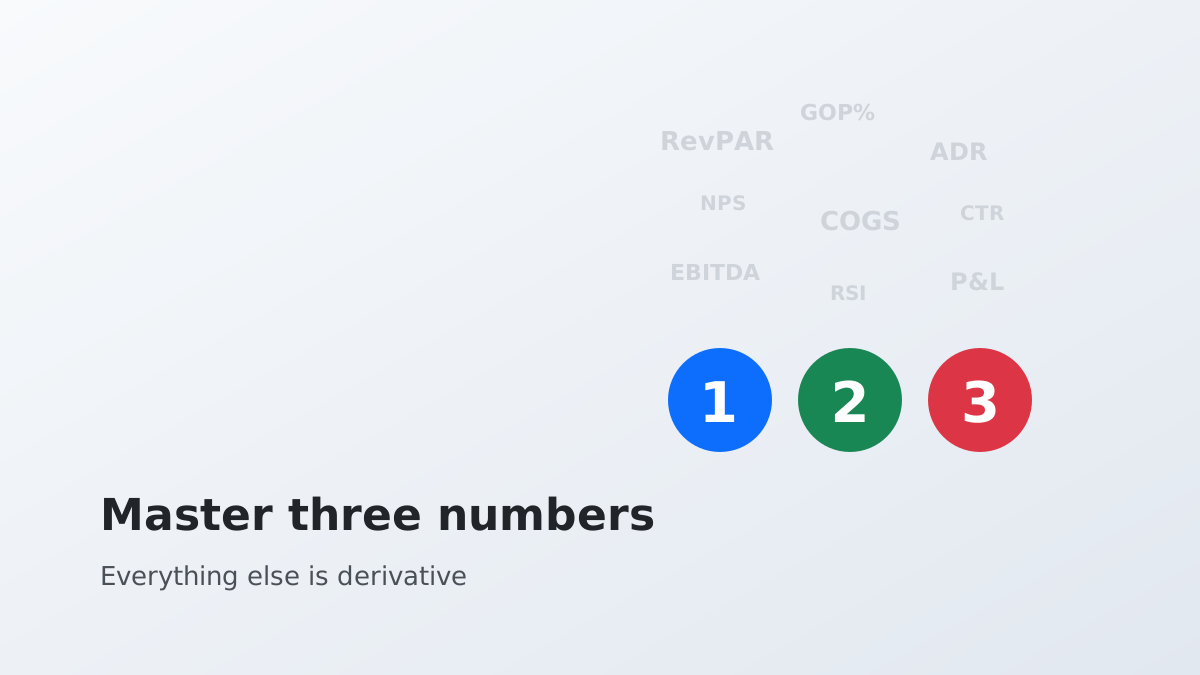
Forget mastering fifteen departments. Master three numbers
Career roadmaps for hospitality promise fifteen departments and seventeen KPIs. The best-performing food service groups do something else: they are ruthless about three numbers — recipe cost accuracy, inventory variance, allergen data integrity — and treat everything else as derivative. By Marc Enggist, CEO & Co-Founder, EGS.
By Marc Enggist, CEO & Co-Founder, EGS Enggist & Grandjean Software
There is a genre of content circulating in hospitality right now: the career roadmap. Fifteen departments to master. Seventeen KPIs every leader should know. Twenty skills, twelve months, one triumphant flag on a mountaintop.
I understand the appeal. It looks comprehensive. It feels like a plan.
But I have spent my career building costing systems for food operations, and I can tell you what the best-performing groups I work with actually do. They do not master everything. They are ruthless about three numbers — and they treat everything else as derivative.
1. Recipe cost accuracy
Not what the recipe cost when someone entered it into the system two years ago. What it costs today, at today’s supplier prices, at every site where it is produced.
This distinction sounds trivial. It is not. Ingredient prices in Europe have moved violently over the past few years — dairy, oils, eggs, energy-intensive products. A recipe database that was accurate at entry decays quietly with every supplier price change that nobody carries through to the recipe level. Six months later, your menu engineering is built on fiction: dishes you believe carry a 68% margin are running at 61%, and the “star” items your teams are trained to push are quietly your weakest performers.
The test is simple. Pick five high-volume recipes. Ask what they cost today. If the answer requires someone to open a spreadsheet and update prices manually, your recipe costs are not a number. They are an archaeological record.
2. Inventory variance
The gap between what your system says you have and what is actually on the shelf.
This is the least glamorous number in food operations, and it is the most diagnostic — because it tells you whether any of your other numbers can be trusted. A group with 2% variance has a controlled operation and a reliable food cost figure. A group with 8% variance does not have a food cost figure at all; it has a rumour.
Here is the pattern I have seen repeated again and again: a food cost percentage jumps sharply in one period, and management launches a hunt through the kitchen — portions, waste, supplier prices, theft. Real cost problems rarely behave that way. Real problems creep: prices drift upward, portions loosen gradually, waste accumulates. When a number jumps, the cause is usually the measurement, not the meal. A period cut-off error. A transfer between production and outlets that nobody recorded. Opening stock valued differently than closing stock. A supplier credit that never landed.
Inventory variance is where those phantoms live. Watch it, and you know when your food cost number deserves attention and when it deserves suspicion.
3. Allergen data integrity
A purist will object that this is not a “number” like the other two, and the purist is right. Call it an error rate: the percentage of menus, labels and declarations across your sites that do not match the current, correct recipe data.
For a multi-site operation, that rate needs to be zero — because this is the only figure on any KPI list that can close you down. Food cost problems erode margin. Allergen problems end contracts, trigger regulators, and in the worst case put a guest in a hospital.
The structural danger is fragmentation. The recipe lives in one system, the menu in another, the buffet label is retyped by hand at site level, and a chef substitutes an ingredient on a Tuesday without the label ever hearing about it. Every manual re-entry point is a place where the declaration and the reality can diverge. Compliance is not a document you produce for the auditor. It is an architecture question: does allergen information flow from a single source of truth to every menu, label and site — or does it get copied?
Anything less than a single source is legal exposure wearing a compliance costume.
Why everything else is derivative
Waste, portioning, purchasing discipline, menu engineering — these are the levers everyone talks about, and they matter. But they are all downstream of the three numbers.
You cannot manage waste you cannot measure against an accurate theoretical cost. You cannot evaluate portioning without trusting the recipe yield. You cannot negotiate with suppliers effectively when you do not know which price movements actually hurt your margin. Fix the three numbers, and every operational problem becomes visible and rankable. Skip them, and no dashboard, however beautiful, will save you — it will simply render fiction in high resolution.
There is also a scale threshold worth being honest about. At a single restaurant, a good chef compensates for bad data with presence and instinct. She knows her cold room by feel, notices when the salmon deliveries look lighter, senses when portions have drifted. That works — at one site.
At fifteen or thirty sites, nobody’s instinct reaches that far. A group F&B director manages entirely through numbers. Which means the quality of the numbers is the quality of the management. This is why the same operator who ran one brilliant restaurant can struggle running twelve average ones: the skill that made the first succeed does not scale, and the systems that would replace it were never built.
The uncomfortable conclusion
Most groups believe they have this covered because they have an ERP. They usually don’t. SAP or Odoo knows your invoices, your stock values, your payments. It does not know your recipes — the transformation layer where purchased ingredients become sold dishes, where yields, sub-recipes and substitutions live. That gap between what finance sees and what the kitchen does is precisely where margin dies and where allergen declarations drift. Closing it is what dedicated recipe and production systems such as CalcMenu exist to do — alongside the ERP, never instead of it.
So if you run food operations across multiple sites, the question is not which of seventeen KPIs to watch this quarter.
It is whether your numbers deserve to be watched at all.
Marc Enggist is CEO and co-founder of EGS Enggist & Grandjean Software, builders of food costing and recipe management systems for institutional operations. EGS serves multi-site food service groups, contract caterers, hotel groups and retail food producers across Europe and beyond.
Comments
Comments coming soon.