
Singapore Nutri-Grade labels: what operators must know
Singapore's Nutri-Grade beverage marking scheme sets strict labelling requirements for pre-packaged and freshly prepared drinks. Here is what food-service operators need to do to stay compliant and avoid penalties.
What Is the Nutri-Grade Scheme?
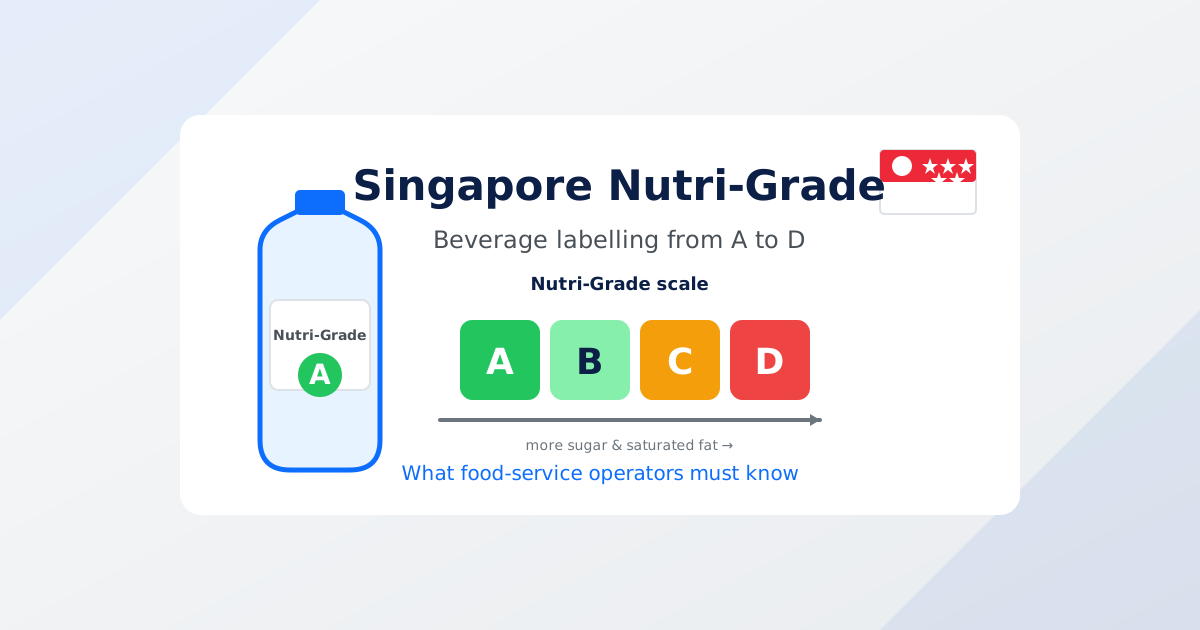
Singapore’s Nutri-Grade marking scheme, administered by the Ministry of Health (MOH) and implemented by the Health Promotion Board (HPB), requires beverages to carry a front-of-pack mark — A, B, C, or D — based on their sugar and saturated fat content per 100 ml. The scheme applies to pre-packaged beverages sold in retail and food-service settings, as well as freshly prepared drinks sold at food establishments. Grade D beverages are subject to an advertising prohibition, and grades C and D must display the Nutri-Grade mark prominently on the label or point-of-sale material.
Nutri-Grade thresholds (per 100 ml)
Grade Total sugar Saturated fat A ≤ 1 g ≤ 0.7 g B ≤ 5 g ≤ 1.2 g C ≤ 10 g ≤ 2.8 g D > 10 g > 2.8 g A beverage is assigned the grade of its worst-performing nutrient — high sugar or high saturated fat can each push a drink into a lower grade. For the latest thresholds, consult the Health Promotion Board (HPB).
This is not optional guidance. Non-compliance can result in enforcement action under the Food Regulations, overseen by MOH and HPB.
Who Is Affected in Food Service?
The scheme casts a wide net. If your operation falls into any of the following categories, you need to act now:
- Hospitals and care homes serving pre-packaged juices, milk drinks, or nutritional supplements
- Hotels and airlines offering bottled or canned beverages as part of meal service
- Food manufacturers producing ready-to-drink products for the Singapore market
- Catering operations preparing fresh bubble teas, smoothies, or flavoured drinks on-site
Freshly prepared beverages sold at food establishments must display the Nutri-Grade mark at the point of sale — on menus, menu boards, or tags — so customers can make informed choices before they order.
Timeline and exemptions The Nutri-Grade mark became mandatory for pre-packaged beverages on 30 December 2022 and for freshly prepared beverages on 30 December 2023. Excluded from the scheme are alcoholic beverages (more than 0.5% alcohol by volume) and special purpose foods such as infant formula, follow-up formula and foods for special medical purposes. Drinks like plain water and unsweetened black coffee or tea remain in scope but typically achieve Grade A or B, for which displaying the mark is optional (full-cream milk, however, is usually Grade C due to its saturated fat, so the mark is mandatory on prepackaged full-cream milk). In addition, smaller food businesses — with revenue of S$1 million or less in the latest financial year, selling at fewer than 10 food premises — are exempt from the requirements for freshly prepared beverages. Always confirm the latest scope with MOH or HPB.
Key Labelling Requirements at a Glance
Here is what the Nutri-Grade regulations, overseen by MOH and HPB, mandate for compliance:
- Grade calculation: Based on grams of sugar and saturated fat per 100 ml of the beverage as consumed.
- Mark placement: The Nutri-Grade mark must appear on the front of pack for pre-packaged drinks, or clearly at the point of sale for freshly prepared drinks.
- Advertising ban: Grade D beverages cannot be advertised on media platforms such as broadcast, print, out-of-home and online channels. Advertising at the point of sale (e.g. in-store shelf talkers or promotional signage) remains permitted, provided the beverage’s Nutri-Grade mark is clearly displayed.
- Recipe consistency: If you change a recipe — even slightly — you must recalculate the grade and update all labels and point-of-sale materials accordingly.
That last point is critical for food-service teams who tweak recipes seasonally or in response to ingredient availability.
How CalcMenu Helps You Stay Compliant
CalcMenu’s recipe management engine makes it straightforward to track the nutritional values of every beverage on your menu. When a recipe changes, the system recalculates sugar and saturated fat content automatically, giving you the data needed to determine the correct Nutri-Grade classification.
With integrated label printing, CalcMenu can generate updated labels with nutritional data (sugar and saturated fat per 100 ml), which you can use to create Nutri-Grade compliant labels. For buffet and menu displays, electronic shelf labels update dish names, allergens and prices automatically when recipes change. For multi-site operations such as hospital networks or hotel chains, this is particularly valuable: one central recipe update rolls out consistently across every location.
Dietary profiles and allergen tracking work alongside Nutri-Grade data, giving your team a single source of truth for all compliance-related information on each product.
Practical Steps to Take Today
- Audit your beverage menu — identify all pre-packaged and freshly prepared drinks in scope.
- Calculate Nutri-Grade scores using current recipe data and HPB’s published thresholds.
- Update labels and point-of-sale materials to display the correct grade mark.
- Set up a review trigger so any recipe change automatically flags a label update requirement.
- Train front-of-house and production staff on what the grades mean and why they matter.
From Cost Centre to Profit Engine: Why Compliance Is a Commercial Asset
Too many food-service leaders still view the kitchen as a necessary cost — a department that eats margin rather than one that creates it. Nutri-Grade is a chance to flip that mindset. When every recipe, label and nutritional datapoint is treated as a commercial asset, compliance stops being a tax and starts becoming a reason for customers to choose you.
At first sight the scheme looks like another cost: calculate grades, redesign menus, reprint labels, train staff. But operators who do it well turn transparency into a marketing story. A menu that clearly highlights Grade A and B options attracts health-conscious guests, corporate catering contracts and procurement teams who need documented nutritional data. Hiding Grade D drinks behind vague descriptions is a short-term tactic that becomes a liability the moment a regulator or social-media reviewer spots it.
The business case is not identical across segments:
- City hotels and business restaurants serve guests who decide quickly and return often. Clear Nutri-Grade marks speed up ordering, reduce decision fatigue and protect repeat business. For these operators, accuracy is part of brand trust.
- Resorts and leisure destinations sell indulgence, so the challenge is different. Guests expect treats, but they also expect transparency. Resorts that proactively label drinks — and offer a balanced mix of A/B and occasional C/D choices — can charge premium prices for credibility rather than competing on portion size alone.
- Hospitals, care homes and corporate cafeterias are procurement-driven. Tenders increasingly ask for nutritional transparency and regulatory documentation. A kitchen that can export Nutri-Grade data per recipe wins contracts that a spreadsheet-run kitchen cannot defend.
- Independent restaurants and small chains often fear the admin burden most. Yet they are also the most agile. A single updated recipe in CalcMenu recalculates nutritional data immediately; with the label connector or POS integration (currently rolling out in Europe), this can flow through to menus and labels in minutes, giving them the same operational signal as a large chain without the head-office overhead.
The shift is therefore cultural as much as technical. When the kitchen is treated as a profit engine, regulatory compliance becomes a competitive advantage instead of a defensive chore.
Beyond Nutri-Grade: The Wider Daily Challenges
Nutri-Grade is one piece of a much larger puzzle. Guests and procurement teams are asking more from menus every day, and the same recipe data that powers Nutri-Grade compliance can answer most of those questions.
Health and wellness is no longer a niche. Corporate catering tenders, school contracts and hospital procurement now ask for verified nutritional profiles, not just calorie counts. A menu positioned as “balanced” needs data behind it — sugar, salt, saturated fat, fibre — and that data must update automatically when a supplier changes.
Children and family menus are under particular scrutiny. Parents, schools and regulators want smaller portions, lower sugar and clear allergens. The same drink that earns a Grade C for adults may need a reformulation for a kids’ menu, and that change must be reflected in every label and point-of-sale material instantly.
Plant-based and vegan options add complexity. Oat, almond, soy and coconut milks have very different sugar and saturated-fat profiles from dairy. A swap that seems healthy can push a beverage into Grade C or D. Without a recipe system that recalculates grades in real time, operators risk label claims they cannot defend.
Homemade and craft positioning is a marketing asset, but it also raises the bar on documentation. “Fait maison” or “house-made” promises freshness and transparency — and regulators expect traceability to match. Every ingredient, sub-recipe and batch must be documented without burying the chef in paperwork.
Local, organic and seasonal sourcing brings volatility. A local fruit supplier may deliver different sugar concentrations depending on the season. An organic syrup may replace a conventional one with a different nutritional profile. Menus that celebrate seasonality need recipe management that absorbs those changes and updates labels, costs and supplier records in one move.
CalcMenu’s recipe engine treats all of these as variations of the same problem: if the recipe is the single source of truth, then compliance, costing, labelling and procurement update together. Nutri-Grade becomes the entry point, not the end point.
Stay Ahead of the Curve
Singapore’s regulatory environment for food and beverage is evolving quickly, and Nutri-Grade is a clear signal that nutritional transparency is now a baseline expectation — not a differentiator. Operators who build compliance into their daily workflows, rather than treating it as a periodic audit task, will be far better positioned as requirements tighten further.
Want to see how CalcMenu can streamline your Nutri-Grade compliance across every site and every menu cycle? Book a 15-minute call with Marc at https://calendly.com/marceng/15-min-call-calcmenu-marc and get a concrete look at what the platform can do for your operation.
Disclaimer: This article is for informational purposes only and does not constitute legal advice. Regulatory thresholds, scope and enforcement practices may change. Always verify the latest requirements with the Singapore Food Agency (SFA) or the Health Promotion Board (HPB) before making compliance decisions.
Related sectors
Comments
Comments coming soon.