
The five food gammes: the real cost of raw vs. convenience
1ère to 5ème gamme isn't just a supplier catalogue filter — it's a cost decision with four parts: purchase price, labor, storage space and planning risk. A practical guide to the five processing levels and how to actually compare them, kitchen by kitchen.
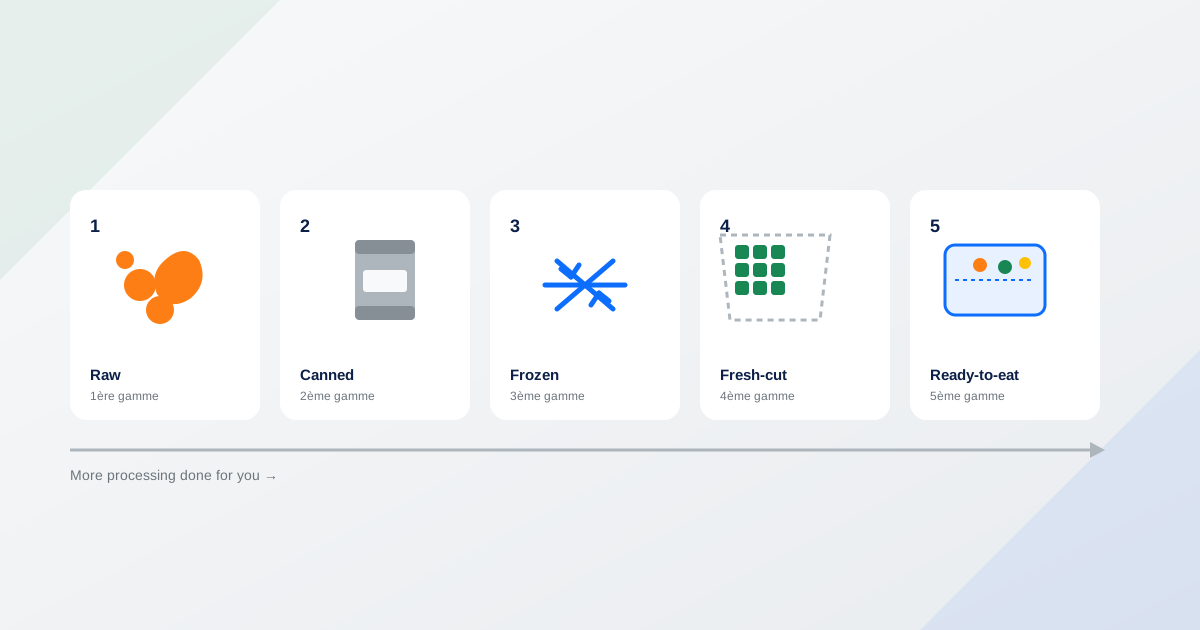
A kitchen buying carrots is really choosing between five different products: raw carrots, canned carrots, frozen carrots, pre-washed pre-cut carrots, or a vacuum-packed cooked carrot purée ready to reheat. French foodservice groups these under gamme — a processing-level classification running 1 to 5 — and the price on the delivery note is only one line of a four-line real cost:
Purchase price — what the supplier charges per kilo, which is what most comparisons stop at. Labor — the peeling, cutting, cooking and portioning minutes your own team spends, priced at a real hourly wage. Space — the storage footprint each gamme demands: dry shelving, chilled volume or freezer capacity, and the equipment and floor space a cutting line needs that a bag of pre-cut vegetables doesn’t. Planning risk — what a wrong forecast costs: raw stock that spoils before it’s used, or a rush order at a premium because a par level ran out.
Get that four-part sum wrong in either direction and it shows up on the P&L: a small satellite kitchen buying raw 1ère gamme vegetables it has no staff-hours, freezer space or planning slack to handle drowns in overtime and waste; a 400-cover central production kitchen buying 4ème gamme convenience cuts pays a processing premium on volume it had the labor, space and planning capacity to cut in-house for a fraction of the cost.
The five gammes, in plain terms
1ère gamme — fresh, raw, unprocessed. Whole vegetables, meat, fish as harvested or delivered. Maximum flexibility and the lowest raw cost per kilo, but every peeling, cutting and portioning minute is on your kitchen’s clock.
2ème gamme — canned / sterilized (conserves). Heat-treated and shelf-stable at room temperature. Long shelf life, no cold-chain cost, but heat processing changes texture and some nutrient content versus fresh.
3ème gamme — frozen (surgelés). Blast-frozen shortly after harvest or preparation, which locks in nutrients close to fresh levels. Needs freezer capacity and a thaw step, but is often the best quality-to-labor ratio for vegetables out of season.
4ème gamme — fresh-cut, ready-to-use raw. Washed, peeled, cut and bagged, but never cooked — this is exactly the output of the knife cuts covered in our guide to vegetable cuts: someone did the julienne or brunoise for you, upstream, at scale. Short shelf life, strict cold chain, but near-zero prep time and near-zero trim loss on your side.
5ème gamme — cooked, vacuum-packed, ready-to-eat. Sous-vide or pasteurised, refrigerated, reheat-and-serve. Maximum labor saving, the highest price per kilo, and the least room for a kitchen to put its own signature on the dish.
| Gamme | State | Shelf life | Labor on your side |
|---|---|---|---|
| 1ère | Raw, fresh | Days | Full prep: peel, cut, cook |
| 2ème | Canned | Months, ambient | Open, drain, finish |
| 3ème | Frozen | Months, frozen | Thaw, cook |
| 4ème | Fresh-cut, raw | Days, chilled | Cook only |
| 5ème | Cooked, ready-to-eat | Days–weeks, chilled | Reheat, plate |
Suppliers worth knowing, market by market:
Switzerland — a fragmented ecosystem of specialists, each strong in one gamme: Léguriviera (1ère, a French-speaking Switzerland wholesaler with over 3,800 raw references) also runs its own fresh-cut line; Hero Foodservice (2ème, Lenzburg, a century in canned and conserved produce); Kadi (3ème, Langenthal, frozen and potato specialist supplying over 12,000 Swiss restaurants since 1951); Eisberg (4ème, Swiss market leader in fresh-cut convenience salads and vegetables); Traitafina (5ème, Lenzburg, ready-to-serve gastronomy products).
France — larger, more vertically integrated generalists rather than single-gamme specialists: Davigel supplies fresh and frozen product across nearly the whole range — including hospital and collective catering specifically — from three French factories and roughly 1,500 references.
Germany — the most consolidated of the markets checked here: apetito covers cook-chill and frozen ready meals for senior care and Essen auf Rädern (meals-on-wheels) delivery end to end, with its own dedicated IDDSI-compliant dysphagia line (winVitalis) built in rather than bought from a separate specialist.
Italy — supply anchored in farmer cooperatives rather than industrial groups: Orogel is Italy’s leading frozen-vegetable producer for foodservice, owned by a cooperative of roughly 1,600 member farmers, IQF-frozen close to harvest.
Netherlands — a market shifting gamme in real time: HAK, built on canned and jarred vegetables since 1952, has launched “HAK Fresh” to move into fresh-cut convenience products, effectively migrating its own product line from 2ème toward 4ème gamme as demand shifts.
Spain — one category leader with outsized scale: Florette España, which pioneered 4ème gamme (IV gama) in Spain in the late 1980s, now holds over 50% of the foodservice fresh-cut segment and supplies more than 15,000 restaurants from six production sites.
Dysphagia and texture-modified specialists, beyond the general gammes above: Emotion Food Company (Lausanne, Switzerland) makes thickening and gelling powders purpose-built for dysphagia care; Oh Purée (Bernese Jura, Switzerland) makes pre-shaped, IDDSI-textured meals from fresh ingredients; Nutrisens (Lyon area, France) has specialised in modified-texture meals for over 20 years, developed with dietitians and speech therapists for EHPADs and hospitals.
The pattern across markets: the more consolidated the market, the more a single supplier bundles gammes and dysphagia solutions together (Germany’s apetito), while the more fragmented the market, the more a kitchen needs to combine specialists per gamme itself (Switzerland). Neither is inherently better — but it changes how many supplier relationships, delivery schedules and traceability records a purchasing team ends up managing, which is its own planning cost on top of the four above.
Labor: the cost most comparisons stop at
Suppliers price each gamme per kilo, which makes 1ère gamme look cheapest and 5ème gamme look expensive. That comparison is incomplete until you add the labor cost of the steps the supplier already did for you — and labor is the biggest of the four lines, but not the only one.
Small kitchens and satellite units — a care home annex, a small café, a site with two cooks covering 60 covers — rarely have spare prep-hours. An hour spent julienning carrots is an hour not spent on service, and overtime or temp staff to cover it usually costs more than the price gap between 1ère and 4ème gamme. For these profiles, 4ème and 5ème gamme are often the cheaper real choice, even though the invoice says otherwise.
Mid-size kitchens with a dedicated prep station — enough volume to keep one or two people cutting through service, but not enough to justify centralised production — sit in the middle. Here the right gamme is usually vegetable-by-vegetable: keep the high-visibility, high-margin dishes on 1ère gamme where the kitchen’s knife work is part of the value, and buy 3ème or 4ème gamme for the high-volume, low-margin base preparations (mirepoix for stocks, diced onion by the kilo) where the cut doesn’t carry flavour or presentation value.
Large-volume and multi-site operations — a central production kitchen supplying several satellite sites — change the economics entirely. At scale, in-house cutting labor amortises across hundreds of covers, and buying 1ère gamme raw with an efficient cutting line is usually the cheapest option per portion by a wide margin. The catch is that this only works with the planning to match: forecasted volumes, batch scheduling and a central production workflow that gets the cut product to every site’s cold chain on time. Without that discipline, a central kitchen quietly reverts to buying convenience gammes anyway, just to de-risk the schedule.
Volume swings matter as much as average volume. A kitchen with a stable 200 covers a day can staff and plan around 1ère gamme. A kitchen swinging between 80 and 300 covers on short notice — banquets, seasonal sites, event catering — often can’t flex its prep staff fast enough, and leans on 4ème/5ème gamme specifically to absorb the swing without overtime.
Space: the cost that never appears on an invoice
Every gamme trades one kind of storage footprint for another, and small kitchens usually feel this before they feel the labor cost. 1ère gamme raw needs the most volume per usable kilo — whole vegetables, their peelings and trim all occupy space before anything reaches a plate — plus a cutting station (bench, boards, a dedicated sink) that a kitchen buying pre-cut product doesn’t need at all. 2ème gamme canned is the cheapest to store: ambient shelving, no cold chain, but bulky cans for a given usable weight. 3ème gamme frozen is usually the tightest real constraint — freezer capacity is expensive to add and most kitchens run it close to full, so buying more frozen stock than the freezer can hold isn’t a labor problem, it’s a wall. 4ème and 5ème gamme are the most space-efficient per usable portion — pre-trimmed, denser, no waste to store — but they demand strict chilled space and a much faster stock turnover, since their shelf life is short and a delivery that arrives before there’s cold space for it is a food-safety problem, not just a logistics one.
A kitchen that’s short on freezer or chiller square metres is not free to simply “buy the cheaper gamme” — the storage capacity has to exist before the purchasing decision does.
Planning: what a good forecast is actually worth
The fourth line is the one that only shows up when the forecast is wrong. Buying 1ère gamme raw at volume means trusting a covers forecast days in advance — order too much and the trim you didn’t use spoils before the next delivery; order too little and a rush top-up arrives at a spot-market premium, if it arrives at all. Higher gammes reduce this risk because the shelf life is engineered and the portion yield is consistent and known in advance, which is exactly why kitchens with volatile, hard-to-forecast covers lean toward them even when the per-kilo price is worse — they are effectively paying to convert forecast risk into a fixed, predictable cost.
That trade only pays off with real par-level and reorder discipline behind it: a procurement workflow that tracks forecasted need against stock on hand can keep a kitchen on cheaper 1ère gamme without the spoilage or emergency-order costs that would otherwise push it toward convenience gammes by default.
Shelf life and HACCP get stricter as the gamme goes up
Every processing step removed from your kitchen is a processing step that happened somewhere else, and it has to be trusted somewhere else. Cold-chain discipline gets less forgiving as gamme increases: 1ère gamme raw vegetables tolerate a cold-room temperature excursion far better than an opened bag of 4ème gamme cut salad, and a vacuum-packed 5ème gamme dish carries a real Clostridium botulinum risk if the cold chain or the use-by date is broken. Receiving checks, storage temperature logs and use-by tracking all need to get more rigorous, not less, as a kitchen shifts its purchasing toward higher gammes — the labor saved on the cutting board has to be reinvested somewhere in the food-safety chain.
Traceability gets harder, not easier, with convenience
A whole raw carrot has one traceable origin. A bag of 4ème gamme mixed vegetables can blend a dozen supplier lots in a single pack, and a 5ème gamme ready meal adds the manufacturer’s own recipe and process on top of that. If a recall hits, a kitchen buying higher-gamme products needs to trace into someone else’s supply chain, not just its own storeroom — which is exactly the gap Blaze Trace is built to close: batch traceability that follows the product from raw material to plate, including recalls targeted to the exact covers affected, not a blanket “throw away everything from that week.”
Where this lands for care catering
In hospitals, EMS and rehabilitation centres, 5ème gamme is not just a convenience choice — it is often the only realistic way to deliver texture-modified meals at scale, since IDDSI-compliant purées and minced-and-moist preparations are difficult to produce consistently on-site for hundreds of residents every service. That’s exactly the gap the dysphagia specialists listed above are built for — pre-shaped purées from a kitchen like Oh Purée, or in-house texturing powders from a supplier like Emotion Food Company, Nutrisens or apetito’s winVitalis line. The trade-off is the same one covered in our IDDSI guide: the further a dish moves from the kitchen’s own hands, the more the texture level served has to be verified against what was prescribed, not assumed from the label.
A simple way to decide
- Low staff, small or swinging volume → lean toward 4ème/5ème gamme; buy back the labor you don’t have, and the chilled space you’d need for raw stock and trim.
- Stable mid volume, one prep station → split by dish: 1ère gamme where the cut is the value, 3ème/4ème gamme for the base preparations — sized to what the prep station and cold storage can actually hold.
- High, stable volume with a real prep line → 1ère gamme raw usually wins per portion, but only with the storage capacity and the production planning to back it.
- Multi-site with a central kitchen → centralise the cutting labor, the cutting-line space and the forecasting once at 1ère gamme, and let multi-site recipe standards carry the same cut and cost to every site.
- Freezer or chiller space is tight → that’s a hard constraint before it’s a cost comparison; plan the gamme mix around the storage you actually have, not the storage you’d need.
- Whatever the mix, food cost should compare landed cost per portion — purchase price, labor, storage and planning risk together — not price per kilo, and every gamme above 1ère needs the receiving, cold-chain and traceability discipline to match.
To see how CalcMenu compares the real cost per portion across gammes — purchase price, labor time, yield and par-level planning together — and keeps the traceability record when you buy convenience, request a demonstration.
Related sectors
Comments
Comments coming soon.