
Rethermalization Carts: The Backbone of a Cold-Chain Kitchen Strategy
Rethermalization carts are what make centralized cook-chill production viable for multi-site care facilities. Here's how to unlock their full potential with the right software layer.
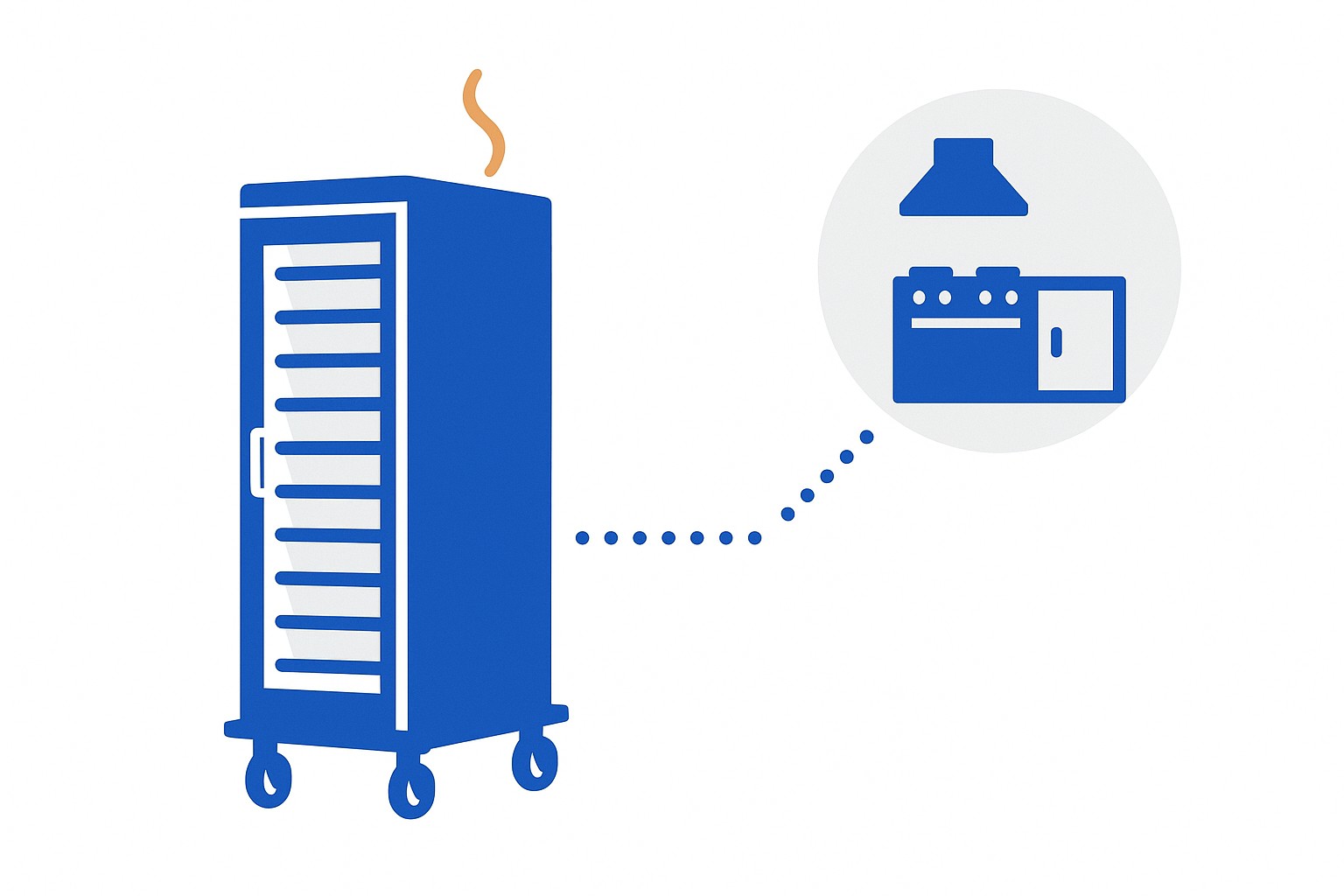
Why the Rethermalization Cart Is More Than Just Equipment
In a hospital, care home, or rehabilitation centre, the rethermalization cart often sits quietly at the end of the meal delivery chain — easy to overlook, yet absolutely central to everything that comes before it. Strip it away, and the entire cold-chain model collapses. Keep it, and you unlock one of the most cost-effective production strategies in institutional catering: centralized cook-chill.
The premise is straightforward. A single central kitchen prepares large batches of meals, chills them rapidly, and distributes them to multiple care units. At the point of service, rethermalization carts bring each tray back to safe serving temperature — without a satellite kitchen in sight. But making this work reliably, at scale, and in compliance with HACCP standards requires more than good equipment. It requires the right data flowing at every step.
Spreading Costs Across More Meals
The financial logic behind cook-chill is compelling. Fixed production costs — skilled staff, energy, equipment depreciation — are absorbed across a far greater number of meal covers when one central kitchen supplies several units rather than each unit cooking independently. A chef’s time spent perfecting a braised chicken recipe benefits 300 residents instead of 30.
But that equation only holds if production is precisely planned. Over-producing drives food waste. Under-producing means gaps on trays and unhappy residents. Accurate meal forecasting, tied directly to dietary profiles and occupancy data, is what keeps the math working in your favour.
This is where software like CalcMenu becomes the operational backbone. Meal ordering data from each care unit feeds directly into centralized production planning. Kitchen managers know exactly how many portions of each dish — and each dietary variant — to prepare before a single ingredient is pulled from cold storage.
HACCP Compliance Without the Paperwork Pile
Rethermalization introduces specific critical control points. Core temperatures must reach safe thresholds. Carts must be validated and monitored. Records must be kept. In a paper-based environment, this becomes a daily administrative burden — and an audit liability.
Digital HACCP tracking eliminates manual temperature logs and ensures that every batch, every delivery, and every rethermalization cycle is documented automatically. If something falls outside acceptable parameters, alerts trigger immediately rather than surfacing during a quarterly review.
CalcMenu’s integrated HACCP module captures these checkpoints in real time, giving quality managers a clear, auditable trail from central kitchen to bedside tray.
Allergen Safety at the Tray Level
One of the most critical challenges in multi-unit cook-chill is ensuring that individual dietary requirements survive the journey from recipe to rethermalized tray. A resident with a fish allergy or a texture-modified diet cannot rely on verbal handoffs between departments.
CalcMenu connects recipe-level allergen data directly to meal ordering and label printing. Each tray label — generated via NiceLabel integration — carries the resident’s name, dietary profile, and relevant allergen flags. Staff at the care unit don’t need to cross-reference spreadsheets. The information is right there, printed clearly, before the cart even leaves the central kitchen.
Turning Equipment Into a System
A rethermalization cart is hardware. What surrounds it — the planning, the compliance tracking, the allergen management, the production scheduling — is what determines whether your cold-chain investment actually delivers on its promise.
Facilities that treat the cart as the end of the chain tend to struggle with consistency. Those that build a connected data layer from menu planning through to tray delivery find that centralized production genuinely reduces costs, improves resident safety, and gives their teams room to breathe.
Curious how CalcMenu fits into your facility’s cook-chill workflow? Book a 15-minute call and we’ll walk through your setup, your current pain points, and where a connected F&B management system can make the biggest difference.
Explore CalcMenu's recipe and menu software for nursing homes to see how it applies to your kitchen.
Related sectors
Comments
Comments coming soon.