
In-house butchery: when it actually pays off
Buying whole carcasses and breaking them down yourself looks like an obvious saving on price per kilo — until you count the skilled labor, the dedicated space, and the whole-animal problem: a carcass yields far more than the cuts your menu actually sells. A practical guide to when your own butchery pays off, including why camps and cruise galleys are often the clearest case of all.
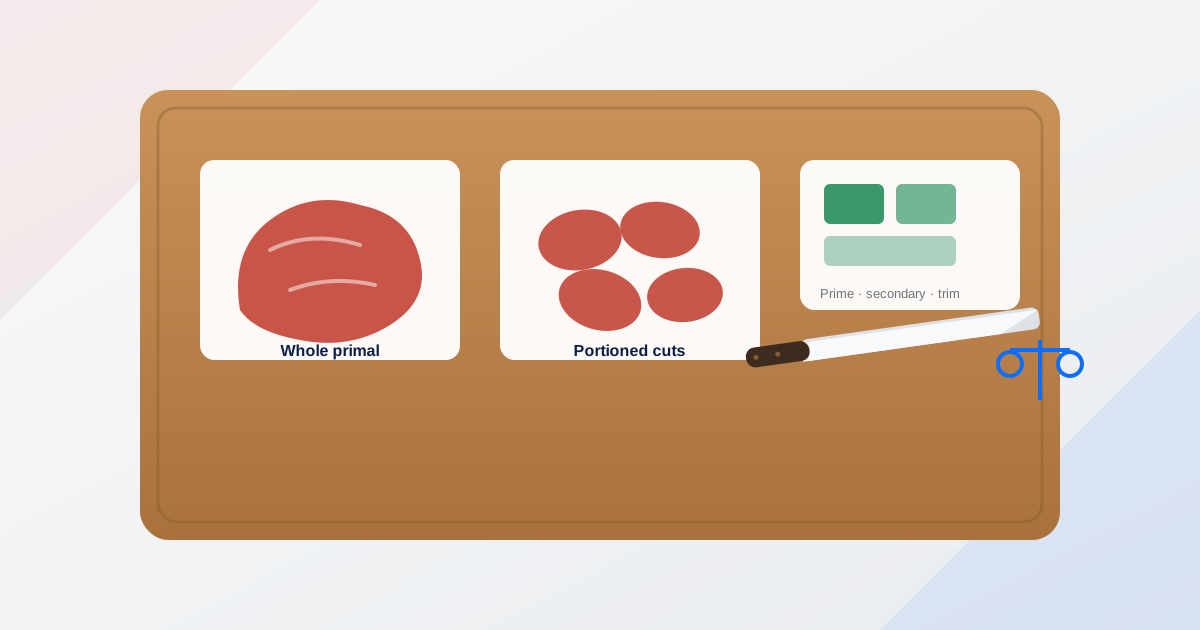
Buying meat is really the same choice as buying vegetables: whole and unprocessed, or already broken down for you. A whole carcass or primal cut is the 1ère gamme of the meat counter — cheapest per kilo, and every bone-out, trim and portion cut is on your kitchen’s clock instead of the supplier’s. Portioned, vacuum-packed cuts are the convenience end — priced per steak, ready to cook, with someone else’s labor already paid for.
The instinct is to assume whole-carcass buying always wins on cost, because the price-per-kilo gap between a whole beef flank and a trimmed, portioned filet can be enormous. It doesn’t always win — and the reason has less to do with labor cost, real as that is, than with a problem vegetables don’t have: a carcass yields far more than the cuts your menu actually sells.
The whole-animal problem
A beef carcass isn’t one product — it’s dozens, of wildly different value. Filet and rib-eye make up a small fraction of the animal and carry most of the margin; shank, flank, trim and bone make up much more of the weight and carry little to none, often ending up as mince, stock or a discounted special. A kitchen that buys the whole carcass has, in effect, bought all of it — and its profit on the deal depends on selling through the entire yield, not just the cuts that were the reason for buying it.
This is the single biggest factor in whether in-house butchery pays off, and it has nothing to do with knife skill:
Menu breadth absorbs secondary cuts. A steakhouse or a full-service kitchen with braises, stocks, terrines and a rotating specials board can turn shank into a braise and trim into a bolognese at good margin — the whole carcass gets sold, just across several dishes instead of one. A kitchen with a narrow menu built around two or three premium cuts has nowhere to put the rest, and ends up selling secondary cuts at cost or below just to move them before they spoil.
Volume determines whether whole-animal buying is even practical. A carcass or a primal is a large, indivisible unit. A kitchen with the covers to move a whole hindquarter within its useful shelf life benefits from the price gap; a kitchen that would still be working through the same primal three weeks later is trading a lower purchase price for spoilage risk and freezer space it doesn’t have.
The real cost, in four parts
The same four-part framework that applies to buying meat and vegetables applies here, with butchery adding weight to two of them in particular.
Purchase price — whole carcasses and primals cost meaningfully less per kilo than pre-cut, portioned product, because the supplier’s cutting labor and yield loss haven’t been priced in yet.
Labor — skilled butchery is specialist labor, not general kitchen prep. A trained butcher costs more per hour than a line cook, takes longer to train and is harder to hire and retain than most other kitchen roles — this is usually the deciding factor before space or planning ever come into it.
Space — a legally compliant butchery needs its own zoned, temperature-controlled cutting room, separated from other food prep to control cross-contamination, plus equipment (bandsaw, vacuum sealer, hanging or aging space) that a kitchen buying portioned meat simply doesn’t need. This is capital cost, not just square metres.
Planning risk — this is where the whole-animal problem shows up on the P&L. Getting the covers forecast wrong on a portioned filet means one cut sits too long. Getting it wrong on a whole carcass means an entire, uneven mix of cuts sits too long, and the ones that don’t move fast enough are the ones that were never going to move fast to begin with.
Yield tracking is not optional
Butchery yield is the percentage of a carcass or primal that ends up as sellable product after bone, fat, sinew and trim are removed — and it varies by cut, by supplier, by season, and by the skill of whoever’s holding the knife. A beef primal can lose 25–40% of its purchase weight to trim and bone before a single portion is cut, and that loss is invisible on the delivery note; it only shows up in what actually reaches a plate.
A kitchen that prices its dishes from the primal’s purchase price, without tracking real yield after breakdown, is quietly understating its food cost on every dish that uses in-house-butchered meat — often by a wide margin. This is the same trap covered in our guide to vegetable cuts: the cut changes the real yield, and the real yield is what sets the real food cost, not the price per kilo on the invoice.
Dry-aging adds a further, often-overlooked layer to that yield calculation: hanging a primal for several weeks in a controlled environment trims further weight through moisture loss and a surface crust that gets cut away before the meat is portioned, on top of the trim and bone loss from breakdown itself. It’s a real quality differentiator — but it’s also real, additional yield loss that has to be priced in, not a free upgrade.
Swiss meat specialists worth knowing: Bell Food Group (Basel, founded 1869 as an ox butchery) controls the full chain from slaughter through cutting and charcuterie for retail, foodservice and institutional catering; Ernst Sutter AG (Gossau, St. Gallen) runs five production sites and two logistics platforms supplying butchers, wholesale and the food industry across Switzerland. Both are useful reference points for what a kitchen is actually buying back when it chooses portioned meat over doing the cutting itself.
HACCP gets more demanding, not less
Raw meat handling is one of the highest-risk categories in any kitchen’s HACCP plan, and running a butchery multiplies the control points rather than removing them. A dedicated cutting room needs its own temperature logs, its own cleaning and sanitation schedule separate from general food prep, and strict handling protocols to prevent cross-contamination between raw meat and everything else moving through the kitchen — plus, in most jurisdictions, its own specific permits and inspection requirements that a kitchen buying pre-portioned meat never has to hold. None of this is a reason to avoid in-house butchery; it’s a cost and a discipline that has to be budgeted for alongside the labor and the equipment.
Traceability cuts both ways
Whole-carcass buying actually gives a kitchen the cleanest traceability available — every cut on the menu traces back to one animal, one farm, one slaughter date, which is exactly the kind of origin story that supports a premium, local-sourcing menu position. Blaze Trace is built to carry that record from the animal through every cut and every dish it ends up in, so the traceability a butchery earns on the sourcing side isn’t lost once the carcass is broken down into a dozen different preparations.
The trade-off is blast radius. A recall or a food-safety issue tied to one animal affects everything cut from it, across every dish on the menu that used it — where a kitchen buying pre-portioned meat from multiple suppliers has that risk already diversified across sources before it ever reaches the kitchen.
Where scale changes everything: camps and cruise galleys
Every constraint above assumes a normal, independent kitchen: uncertain covers, a lean brigade, and space that costs money to add. Remote camps and cruise ship galleys don’t share those assumptions, which is exactly why in-house butchery often makes more sense for them than for a typical restaurant of comparable size.
The planning risk mostly disappears. The whole-animal problem is really a forecasting problem — an uneven mix of cuts has to move before it spoils, and that only works with a reliable forecast of who’s eating and how much. A mining camp or a construction site knows its headcount days or weeks out because it’s contracted labor on a roster, not walk-in covers. A cruise ship knows its passenger and crew count for the entire voyage before it leaves port. That’s about as close to a guaranteed forecast as foodservice gets, and it’s precisely the input that makes buying a whole carcass safe instead of risky.
The labor is often already there. A camp or a ship doesn’t staff its kitchen for a single dining room — it staffs for multiple meal periods a day, seven days a week, often in shifts, to feed a captive population that has nowhere else to eat. A brigade sized for that kind of continuous, high-volume operation can absorb a dedicated butcher role that a 40-cover restaurant could never justify on its own; the marginal labor cost of adding butchery to an already-large kitchen team is much smaller than adding it from scratch.
The space is already dimensioned for bulk. Remote sites can’t call in a same-day top-up delivery, and a ship can’t pull into port mid-voyage — both provision in large, infrequent batches by necessity, which means the walk-ins, freezers and cold-chain discipline for bulk storage already exist as baseline infrastructure, not as a new investment specifically for butchery. A dedicated cutting room is a smaller incremental step from there than it would be for a kitchen that normally receives small, frequent deliveries.
The whole-animal problem solves itself through menu breadth. A cruise ship runs a buffet, a specialty steakhouse, room service and a separate crew mess off the same galley — more than enough outlets to route a whole carcass’s worth of cuts, from filet to shank, at the right price point in each venue. A camp kitchen runs a multi-week rotating menu specifically to avoid feeding the same roster the same three dishes on repeat, which naturally spreads secondary cuts across braises, stews and daily specials instead of concentrating demand on two or three premium cuts.
Compliance is already at a high baseline. Cruise galleys already operate under some of the strictest sanitation and inspection regimes in foodservice, and remote camps typically answer to client and regulatory audits that assume rigorous cold-chain and HACCP documentation regardless of butchery. Adding a cutting room’s control points to a kitchen that’s already disciplined at that level is a smaller lift than introducing the same rigor into a kitchen that’s never had to hold it.
None of this makes butchery automatic for every camp or every ship — a small camp galley feeding forty people still faces the same volume ceiling as any small kitchen. But the two factors that usually rule out in-house butchery for an independent restaurant — unpredictable demand and a lean brigade — are structurally the two things camps and cruise operations are least likely to have.
Where it pays off, and where it doesn’t
High-volume kitchens with broad menus — steakhouses, full-service restaurants with braises and stocks on the menu, multi-outlet operations that can route secondary cuts to different dishes — are where whole-carcass buying wins clearly. The purchase-price saving is real, and the menu has somewhere to put every part of the animal.
A deliberate quality or sourcing story — dry-aging as a menu feature, a single-farm or single-breed sourcing narrative, nose-to-tail positioning — can justify in-house butchery even at a smaller scale, because the differentiation is the point, not just the cost saving.
Multi-site operations can get the economics of whole-carcass buying without every site running its own cutting room: a central butchery breaks down carcasses once, and multi-site recipe standards carry consistent cuts, yields and costs to every satellite kitchen — the same logic covered for vegetable prep in our guide to food gammes.
Camps and cruise galleys are the clearest case of all, for the reasons above: predictable captive headcounts, brigades already sized for continuous high-volume service, bulk-provisioning infrastructure that already exists, and enough dining outlets to absorb a whole animal’s worth of cuts.
Small kitchens, narrow menus, and volatile covers are usually better served buying portioned cuts, even at a materially higher price per kilo — the labor, space and planning risk of whole-animal buying rarely pays back without the volume and menu breadth to sell through everything a carcass yields.
A simple way to decide
- Menu can’t absorb secondary cuts → buy portioned; the whole-animal problem will cost more than the price-per-kilo saving.
- Volume can’t move a whole primal within its shelf life → buy portioned, or buy smaller sub-primals instead of whole carcasses.
- No dedicated, compliant cutting space or trained butcher on staff → the labor and space cost usually outweighs the purchase-price saving.
- Quality story is part of the pitch (dry-aging, single-farm sourcing, nose-to-tail) → in-house butchery earns its keep even below the volume threshold that would justify it on price alone.
- Multi-site with real volume → centralise the butchery once, and carry the yield and cost standard to every site.
- Camp, cruise or another captive-population operation → the usual objections (unpredictable demand, lean brigade) often don’t apply; butchery is worth a serious look even at a scale that wouldn’t justify it for an independent restaurant.
- Whatever the model, food cost has to be built from actual post-butchery yield, not purchase weight, and every stage from carcass to plate needs the HACCP and traceability discipline to match.
To see how CalcMenu tracks real yield from carcass to portion, keeps the HACCP record for every cutting stage, and carries the traceability from animal to dish, request a demonstration.
Related sectors
Comments
Comments coming soon.