
France Can't Stop Opening All-You-Can-Eat Restaurants. America Can't Stop Closing Them.
Nearly a thousand new all-you-can-eat restaurants opened in France in two years, while Golden Corral, Sizzler, and most of America's big buffet chains have spent the same period shrinking or filing for bankruptcy. Same format, opposite trajectories, at the same time. The real economics, the built-in traps, and the waste problem — worst during Ramadan iftar buffets — that the format has never fully solved.
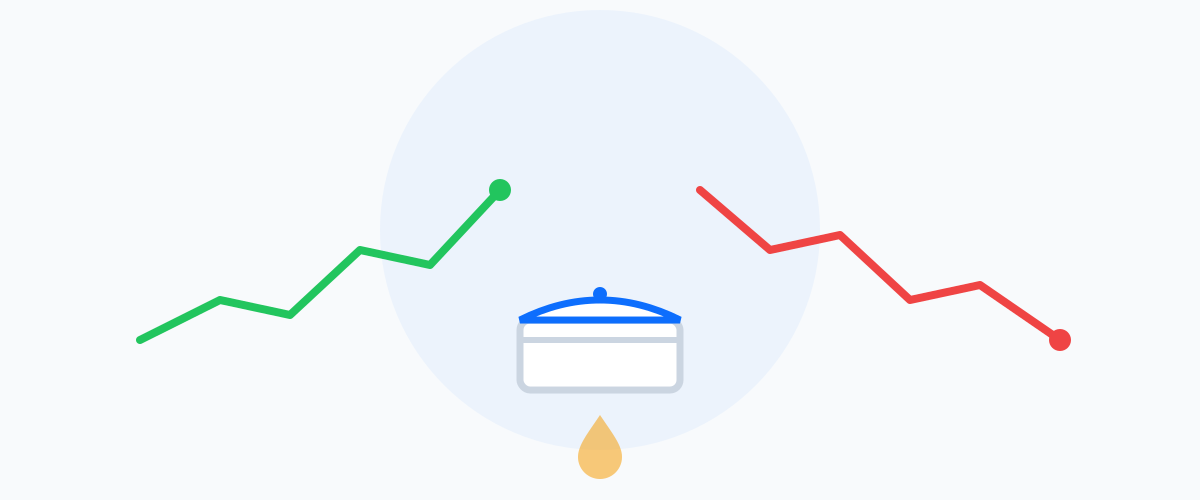
Two countries, the same restaurant format, the same two-year window, moving in exactly opposite directions. In France, close to a thousand new all-you-can-eat restaurants have opened in two years. In the US over the same period, some of the country’s largest buffet chains have been shrinking, filing for bankruptcy, or disappearing entirely. Neither trend is an accident, and the gap between them is a genuinely useful lesson in what actually makes the “unlimited food, one price” model work — and what quietly breaks it.
The French boom is real, and it’s bigger than nostalgia
According to Bernard Boutboul, president of the food-service consultancy Gira, close to a thousand new all-you-can-eat restaurants (buffets à volonté) opened in France in just two years, on top of more than 10,000 already operating. This isn’t a story about discount cafeterias limping along — the flagship of the trend, Les Grands Buffets in Narbonne, posted €27 million in revenue in 2024, pulls roughly 400,000 visitors a year, and had already taken 200,000 online reservations for 2026 within weeks of opening the booking window. The format has diversified well past the Chinese buffets that pioneered it in France: Moroccan, Brazilian rodizio, Indian, Lebanese, Japanese, Caribbean, Breton and traditional French versions are all expanding at once.
Two forces are driving it. The obvious one is economic: falling household purchasing power makes a fixed, known, all-inclusive price genuinely attractive when eating out at all feels like a bigger decision than it used to. The less obvious one is a real quality shift — a new generation of chefs and restaurateurs has been actively rebuilding the format around better ingredients and real craft, deliberately shedding the “sad industrial buffet” reputation the concept has carried for decades.
America’s version of the same format is shrinking fast
Run the same search on the other side of the Atlantic and the story flips. Buffet-focused chains had already been declining through the 2010s as health-conscious dining gained ground, and then the pandemic hit the model specifically hard — self-service, shared serving spoons, and communal food stations were exactly the wrong optics at exactly the wrong time. Golden Corral shrank from roughly 490 locations to around 300, with its largest single franchise operator filing for bankruptcy carrying $49.7 million in debt. Other chains didn’t survive at all: Old Country Buffet, HomeTown Buffet, and Ryan’s all shut every remaining location in a 2021 bankruptcy, and Sizzler — once running over 250 restaurants — dropped to under 100 and filed for Chapter 11 in 2020. In 2019 alone, before any of that, roughly 10% of the country’s buffet concepts had already closed.
Golden Corral’s own comeback is the clue to what’s actually going on. Rather than doubling down on pure self-service AYCE, the chain leaned into a more flexible, partial table-service model, cutting labor waste and repositioning the experience — and its sales came back double-digit percentages above pre-pandemic levels. The chains that just tried to keep running the old low-cost, high-volume, minimal-craft version of the format kept closing. The one that changed what the format actually delivered didn’t.
The real economics: it was never really a food-margin business
This is the part that explains both the boom and the traps at once. All-you-can-eat restaurants generally break even on food cost and make their actual profit from minimized labor — self-service removes most of the need for table service, and kitchens run with a skeleton crew of line cooks replenishing trays rather than firing individual plates. The entry price isn’t really “buy as much food as this covers” — it’s a filtering mechanism: price it too low and the room fills with the heaviest eaters looking purely for volume; price it too high and only the biggest appetites bother showing up. The profitable sweet spot is the price point that pulls in a mix — enough light eaters and moderate eaters to offset the minority who genuinely eat their money’s worth, with a large-party dining room naturally balancing the two.
None of this works, at any price point, without the operator actually knowing their real average cost per cover — not a guess, an actual number, built from real portion and ingredient data. Get that number wrong in either direction and the “sweet spot” price is either leaving margin on the table or quietly bleeding on every single guest who takes it up.
The traps built into the format
A few mechanisms do most of the work, and they’re worth knowing whichever side of the counter you’re on:
- Menu sequencing. Buffet lines are laid out to put the high-satiety, low-cost items first — bread, salad, starches — before a guest ever reaches the expensive protein station. By the time most people get there, they’re already partway full.
- Small serving utensils and plates. The same portion-control mechanism we’ve covered for buffet waste generally doubles as a profit lever here: smaller tools mean smaller first-pass servings, which means more trips and a naturally lower total intake per guest than a large plate and a large spoon would produce.
- The “maximize value” psychological trap — pointed the wrong way. A fixed price genuinely does push people to eat more than they normally would, driven by a sense that anything left “on the table” is money wasted. But the format’s solvency depends on the average guest still not actually eating anywhere near the theoretical maximum — the trap is that almost everyone feels like they’re getting a great deal while very few are anywhere close to breaking the model.
The honest version of “all you can eat” is closer to “all you’ll actually choose to eat once the room, the tools and the sequencing have quietly nudged you” — which is a very different, and much more calculable, number than the name implies.
The waste problem the format has never solved — worst around Ramadan iftar buffets
The same mechanics that make AYCE profitable in normal operation break down badly in one recurring, high-stakes context: the iftar buffet, the meal breaking the daily fast during Ramadan. General estimates put Ramadan-period food waste at roughly 20–25% of what’s purchased or prepared — well above a typical month — and restaurant and hotel iftar buffets specifically have been flagged as a major driver, with only about half the food put out actually getting eaten. In Turkey, roughly 90% of survey respondents believe food waste increases during Ramadan, and it isn’t just a Turkish pattern — Malaysia’s national waste-management agency has reported over 270,000 tonnes of food discarded during Ramadan in a single season.
The reason iftar buffets specifically make this worse isn’t mysterious: guests arrive genuinely hungry after a full day’s fast, over-serve themselves at the moment of maximum appetite and lowest self-control, and cultural norms around generosity and abundance at the breaking of the fast work directly against the portion-discipline that keeps a normal AYCE buffet’s waste in check. It’s the standard all-you-can-eat over-taking psychology, deliberately amplified by timing and occasion — and the fine-for-leftovers policies we’ve seen spread from Switzerland to the UK to Saudi Arabia are, in large part, a direct response to exactly this pattern repeating every single year.
What this actually means if you’re running one
Three things hold up across both the French boom and the American bust:
- Know your real average cost per cover, not your theoretical maximum. The entire pricing-as-filter model depends on this being an actual measured number — built from correct portions and correct supplier unit conversions — not an estimate. Get it wrong and there’s no menu price to adjust after the fact; the guest already walked in at a fixed rate.
- The format survives on craft, not just volume. France’s boom is a quality story as much as a price story; America’s bust was, in large part, a chain running the cheapest possible version of the format into a market that stopped wanting it. The fixed-price mechanic works at very different quality tiers — but only if the tier is a deliberate choice, not a cost-cutting drift.
- Waste isn’t a side effect here, it’s the main risk. Unlike à la carte, where a bad guess about demand shows up as next week’s ordering adjustment, an AYCE buffet’s food cost is sunk the moment it’s set out. Every uneaten tray is pure loss with no recovery lever — which is exactly why the operators who track it seriously outlast the ones who treat “unlimited” as a marketing line instead of a number to manage.
Related reading
- The channel-by-channel playbook for portion control — the discipline problem in fine dining, the over-serving problem at buffets, and the compliance problem in institutional kitchens.
- How the modern all-you-can-eat buffet was invented as a 1946 Las Vegas trap for gamblers, and the waste-fee policies operators now use to police it.
Considering an all-you-can-eat format, or trying to find out if your existing one is actually profitable per cover? Book a free 15-minute call with our team — no commitment: Schedule a call.
Sources
- Les buffets à volonté, mode ou réponse à la crise économique ? — France 3 Régions
- Buffets à volonté : un festin qui fait recette — L’Hôtellerie Restauration
- Buffet chains close hundreds of locations nationwide — TheStreet
- This Popular Buffet Chain Has Shut Down Almost Half of Its Locations — Eat This, Not That
- How Golden Corral Pulled Itself Out Of Restaurant Ruin — Mashed
- The Psychology and Economics Behind “All-You-Can-Eat” Restaurants — On The Node
- How All-You-Can-Eat Buffets Use Psychology to Make Money — Psychology Today
- Towards a Waste-Free Ramadan Iftar — EcoMENA
Related sectors
Comments
Comments coming soon.