
Pour cost 101: why 20% is the bar industry's favorite number — and why a single ounce mistake can wreck it
Pour cost is food cost's beverage twin, but a bartender's hand is the portion-control device — and the UK legally locks it down while the US doesn't. Here's the math, the targets, and the regulatory gap.
The one number every bar manager quotes and almost nobody measures correctly
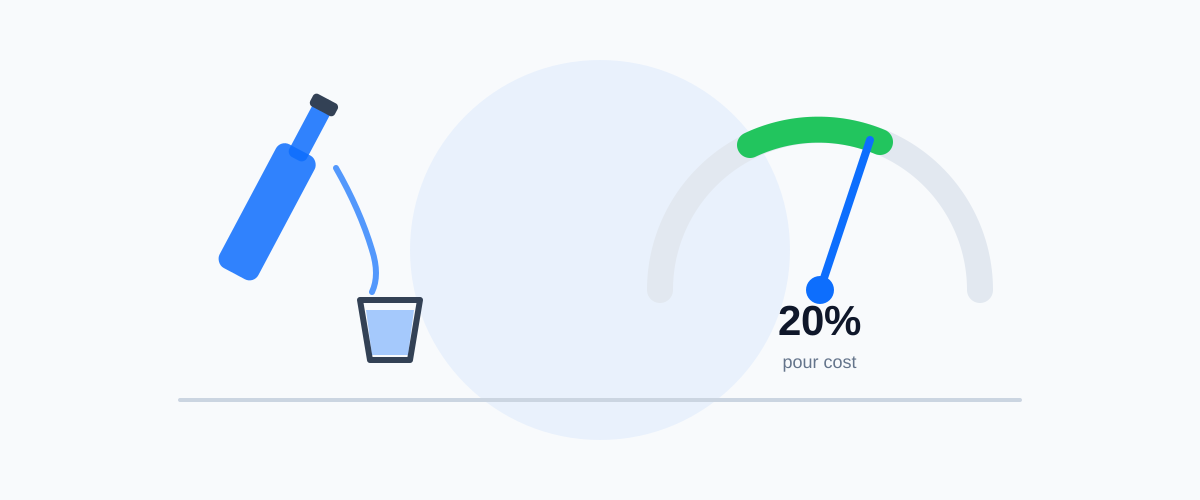
Ask any bar manager for their pour cost and you’ll get an answer instantly — usually somewhere around 20%. Ask them when they last actually calculated it, ingredient by ingredient, and the confidence drops fast. Pour cost is the direct beverage equivalent of food cost percentage: (cost of the spirit poured ÷ selling price of the drink) × 100. Pour $2 of vodka into a $10 cocktail and your pour cost on that spirit is 20%. It’s the same math kitchens have run for decades — except the portion-control device on a bar isn’t a scale. It’s a human hand holding a bottle.
What “good” actually means, by category
The industry’s long-standing rule of thumb targets a blended pour cost of roughly 18–24% across a bar program, with 20% cited as the common benchmark. But that single number hides real variation by category. Spirits and spirit-forward cocktails — the highest-margin pour on the list — typically run 15–22%. Beer runs higher: draft usually lands around 20–26%, bottled or canned beer 24–28%, because it’s bought and sold in fixed units with less markup room than a mixed spirit. Wine by the glass runs highest of all, often 22–34%, driven by a cost problem spirits don’t have: an opened bottle that doesn’t sell before it oxidizes is a total loss, not a slow leak. Running every drink on your menu against one flat 20% target, instead of category-specific bands, is a fast way to misprice half the bar.
The pour size problem: America measures by habit, Britain measures by law
In the US, the “standard pour” for spirits is 1.5 ounces (about 44ml) — not because any law says so, but because it’s the pour that delivers one NIAAA-defined standard drink of 80-proof liquor (1.5 oz at 40% ABV = 0.6 oz / 18ml of pure alcohol, the same alcohol content as a 12 oz (355ml) beer or 5 oz (150ml) glass of wine). Nothing compels a US bar to pour exactly that; it’s convention, reinforced by jiggers that happen to be sized 1.5 oz on one side.
The UK does it by statute. Under the Weights and Measures Act framework, gin, rum, vodka and whisky sold by the glass in England and Wales must be served in 25ml or 35ml measures (or exact multiples), and a premises must pick one size and stick to it — not offer both. Other spirits (tequila, brandy, liqueurs) aren’t covered, and cocktails mixing three or more spirits are exempt entirely. Non-compliance is a real enforcement risk, not a guideline: fines up to £5,000 for using the wrong measure. For a multi-market operator running the same cocktail menu across Swiss, French, UK and other venues, that’s not trivia — it’s a genuine build difference in the recipe itself, not just the price.
Why pour cost slips even when food cost doesn’t
Kitchens have scales, recipe cards, and a chef checking plates. Bars mostly don’t. Free-pouring — counting in your head instead of measuring — is still the default style in a huge share of bars, and it’s inherently variable: even a skilled bartender’s hand drifts by a fraction of an ounce, more under rush conditions, more with staff turnover, and more the moment a new hire hasn’t built consistent muscle memory yet. Beverage-cost consultancy Bar-i, drawing on data from tens of thousands of bar inventory audits, has found bars typically pour roughly 15% more alcohol than they actually sell — a gap that shows up nowhere on a POS report because the drink still rings in at the same price regardless of how generous the pour was. On a bar doing meaningful volume, that gap compounds into real money, month after month, invisibly.
That’s the structural difference from food cost: a kitchen’s portion control is a physical object (a scale, a portion scoop) that doesn’t get tired or rushed. A bar’s portion control is a person’s hand, repeated hundreds of times a shift, under time pressure, with a new person doing it every time the roster changes.
Why this matters for anyone costing a menu
None of this is really about liquor — it’s about the same discipline food cost already demands, applied somewhere it’s easy to skip. A cocktail is a recipe: base spirit, modifiers, garnish, mixer, each with a real ingredient cost. If you can cost a braised short rib to the gram, there’s no reason a Negroni should be priced from a gut feeling about what “sounds right” on the menu.
How CalcMenu helps
CalcMenu doesn’t put a sensor on your speed pourer or plug into your POS to track every ounce in real time — that’s not what it does, and we won’t pretend otherwise. What it does do is let you cost a cocktail exactly the way you cost a kitchen dish: build it as a recipe with real ingredient quantities and current supplier prices, track yield and waste the same way you’d track trim loss on a protein, and keep pricing consistent across every site running the same menu. If your gin costs jump or you switch to a pricier mixer, you see the margin impact on every affected cocktail immediately — the same visibility you already rely on for food, just pointed at the bar.
Related reading
- Calculate your own pour cost with our free calculator
- Bars were never just about drinks — the same costing discipline that built the modern cocktail menu applies here too
- Vanilla shows how a single volatile ingredient can quietly wreck a recipe’s margin — the same risk applies to a bar’s pour cost
Want to see what your bar program is really costing you? Book a free 15-minute call with our team — no commitment: Schedule a call.
Sources
- Bar Pour Cost & Beverage Margin Guide — Tableview
- What Is a Good Beverage Cost Percentage for a Restaurant? — Purimax
- What Is A Standard Drink? — National Institute on Alcohol Abuse and Alcoholism (NIAAA)
- Weights and measures: the law — Specified quantities, GOV.UK
- Guide to Weights and Measures for Bars, Pubs and Restaurants — Gardiff Catering
- Poor Beverage Inventory Is Costing Your Bar $25,000 a Year — Here’s the Math — Bar-i
Related sectors
Comments
Comments coming soon.