
Profitability #3 — Yields and cooking losses: the margin you never measured
A beef tenderloin invoiced at $23/kg actually costs $32.66/kg once trim loss is accounted for — 42% more than the price on the delivery note. Yield loss happens twice, not once: once in the trim, once in the pan. What as-purchased and edible-portion actually mean, real trim and cooking-loss numbers, and why a recipe costed on invoice price is quietly wrong before service even starts.
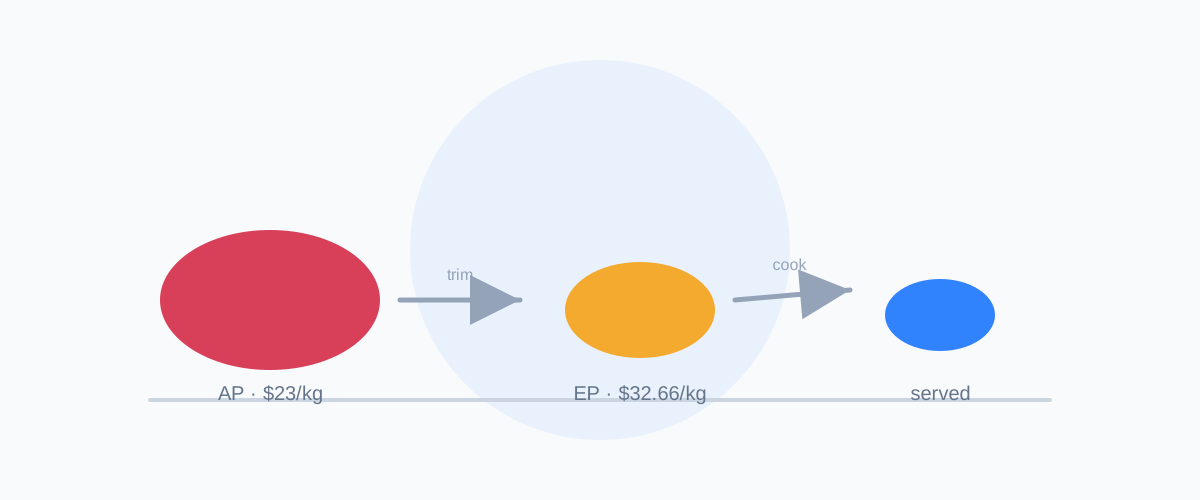
The invoice price was never the real price
A beef tenderloin lands on the loading dock at $23 per kilogram. That’s the number on the invoice, the number in the purchasing system, the number a rushed recipe costing exercise reaches for first. It is not what the kitchen actually paid for the meat that ends up on the plate. Trim the silverskin, the chain and the fat the way a filet has to be trimmed, and a typical whole tenderloin yields 70–75% of its original weight as usable meat. Do the arithmetic at 70%, and that $23/kg cut is actually costing $32.66/kg once it’s ready to cook — 42% more than the invoice ever said.
Nothing was hidden and nothing was wasted improperly. This is what butchery is. But if the recipe card was costed against the $23 figure, the dish has been underpriced — or under-margined — since the day it was written.
As-purchased, edible-portion, and the formula in between
Two terms do all the work here. As-purchased (AP) is the weight and price on the invoice — the whole cut, the whole fish, the case of onions, before anyone touches it. Edible portion (EP) is what’s actually left to cook and serve after trim, bone, skin, peel and unusable scrap are removed. The relationship between them is yield percentage:
Yield % = EP weight ÷ AP weight
Yield-adjusted cost per unit = AP price per unit ÷ yield %
That second formula is the one that matters for a recipe card. Cost a dish using the AP price and skip the division, and every recipe using that ingredient understates its true cost by exactly the size of the trim loss — quietly, consistently, on every single plate sold.
Yield loss happens twice, not once
It’s tempting to treat “yield” as a single number, but two separate losses stack on top of each other, and they come from different places:
- Trim yield — the loss from butchery, filleting or peeling, before anything touches heat. This is what turns a whole tenderloin into a trimmed filet, a whole salmon into skin-on fillets, a case of onions into diced onion ready for the pan.
- Cooking yield — the separate loss from moisture leaving the product during cooking. A peer-reviewed study of US retail beef cuts found roasted whole cuts lose roughly 26–36% of their weight during cooking, with wet-heat methods like braising and poaching losing 4–7 percentage points less than dry-heat roasting or grilling — a genuinely useful planning number if a dish’s method is still flexible.
A recipe that only accounts for trim loss and ignores cooking loss — or the reverse — is still wrong. Both losses apply, one after the other, to the same piece of meat.
Real numbers, and where they get fuzzy
Trim and cooking yields aren’t folklore — they’re measured, and the standard industry reference, The Book of Yields by Francis T. Lynch (now in its 9th edition, co-authored with Lisa M. Brefere), catalogues weight-to-volume and yield data for more than 1,400 ingredients. Some commonly cited figures, worth using as planning numbers rather than exact constants since cut, grade and prep skill all move them:
- Beef tenderloin, trimmed of silverskin, chain and fat: roughly 70–75%.
- Whole salmon to skin-on fillet: a genuinely wide range, roughly 55–72% depending on whether the fish arrives head-on or head-off and gutted — worth confirming against your own supplier’s cut, not assuming a single figure.
- Whole chicken to boneless, skinless breast meat alone: commonly cited around 25–30% of the bird’s total weight — illustrative rather than a formal standard, since it depends heavily on bird size and butchery precision.
- Common produce, per the Culinary Institute of America’s own teaching reference: large onions around 89%, carrots (no tops) around 82%, green cabbage around 79% — though other trade sources cite meaningfully lower numbers for more processed cuts, like diced onion closer to 63%, so the prep stage matters as much as the vegetable.
The CIA’s own kitchen-calculations teaching material makes the point plainly: yield percentage is what turns a purchase order into an accurate one, because it’s the only number that tells a kitchen how much AP product actually needs to be bought to get the EP quantity a recipe requires.
This is the same gap Profitability #1 already named
If a recipe’s cost is built from AP price without the yield adjustment, it isn’t a rounding error — it’s exactly the prep yield loss beyond the recipe’s assumed yield described in Profitability #1 as one of the six real, structural causes of the gap between theoretical and actual food cost. Get the yield percentage wrong at the recipe-costing stage, and theoretical food cost is wrong before a single plate is served — the gap isn’t creeping in during service, it was built into the recipe card from day one.
It also quietly breaks the menu engineering math from Profitability #2. A dish’s contribution margin is selling price minus true ingredient cost — and “true” has to mean yield-adjusted cost, not invoice price. A tenderloin dish costed at $23/kg instead of $32.66/kg looks like a comfortable Star. Costed correctly, it might be a Plowhorse that needs a price adjustment, or worse. The quadrant a dish lands in can flip entirely once yield is done properly.
How CalcMenu handles yield without the spreadsheet
- Yield percentage stored per ingredient, not guessed per recipe — trim yield and cooking yield tracked separately, so both losses apply correctly instead of being estimated once and hoped to cover everything.
- Recipe cost calculated from EP cost automatically — every recipe using that ingredient recalculates the moment the yield percentage or the AP price changes, with no manual re-costing cycle to fall behind on.
- Real yield testing feeds the system, not the other way round — when a kitchen actually weighs a trim or a cook loss, that measured number replaces the estimate for every recipe that ingredient touches, everywhere it’s used.
- Multi-site consistency — the same cut can yield differently by site depending on supplier and butchery skill; a group needs that visible per site, not blended into one average that’s wrong everywhere.
CalcMenu doesn’t trim the meat or run the yield test — that’s still a knife, a scale and five minutes in a kitchen. It makes sure that once the yield is measured, it’s applied to every recipe that depends on it, automatically, instead of living in one person’s memory or one spreadsheet nobody else opens.
Before you trust a recipe’s cost
Four questions worth asking about any recipe currently on the menu:
- Is this recipe costed from the AP invoice price, or from the yield-adjusted EP cost?
- Does the yield figure account for trim loss and cooking loss separately, or is one of them being ignored?
- When did anyone last actually weigh a trim or a cook loss, rather than relying on a textbook estimate?
- If a dish’s true cost is 30–40% higher than its recipe card says, would anyone have noticed before now?
If the honest answer to the first question is “the invoice price,” the margin on that dish has never actually been measured — only assumed.
Want to see every recipe’s true, yield-adjusted cost — not the invoice price? Book a free 15-minute call with our team — no commitment: Schedule a call.
Sources
- The Book of Yields, 8th edition — Wiley
- The Book of Yields, 9th edition — Bookstores.com
- Beef tenderloin butchering yield factors — Chefs Resources
- IMPS 100 Fresh Beef specifications — USDA Agricultural Marketing Service
- Salmon yields — Chefs Resources
- Protein, fat, moisture and cooking yields of US retail beef cuts — ScienceDirect
- USDA Table of Cooking Yields for Meat and Poultry — Ag Data Commons
- Never Assume 100% Ingredient Yield — meez
- Kitchen Calculations, Technique of the Quarter — Culinary Institute of America
Related sectors
Comments
Comments coming soon.