
A 750ml Bottle Pours Anywhere From 3 to 6 Glasses — and Almost No One Is Costing the Gap
The same bottle of wine yields 3, 4, 5, or 6 glasses depending on which legal pour size you pick — and the bottle you don't finish tonight is a cost almost no wine-by-the-glass program actually tracks.
One bottle, three different yields, and nobody agrees which one is right
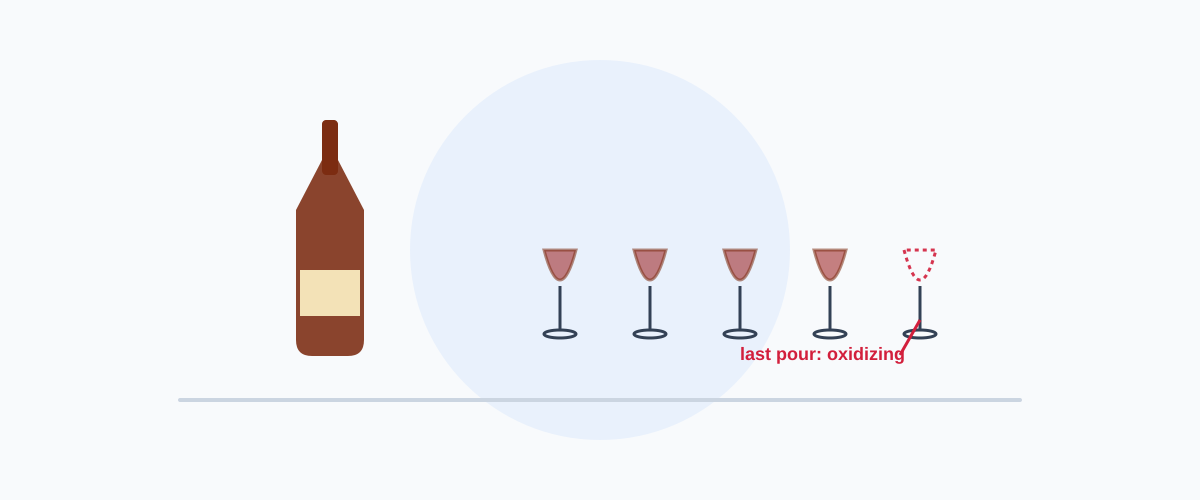
A standard 750ml bottle of wine is not a fixed number of glasses. Pour it in the size most US restaurants use and it’s five. Pour it in the UK’s smallest legal measure and it’s six. Pour it into a “large glass” and it drops to three. Same bottle, same wholesale cost, a swing of 100% in how many portions you actually get out of it — and that’s before a single drop is lost to spoilage. Most wine-by-the-glass (BTG) programs cost the bottle once, pick a pour size once, and never revisit either number again.
The yield math: pour size is a cost decision, not a service style
In the US, the de facto standard BTG pour is 5 ounces (about 150ml), dividing a 750ml bottle into exactly five glasses. Some venues pour a more generous 6oz (177ml) glass, dropping the yield to four.
In the UK, pour size isn’t a house preference — it’s regulated. Under the Weights and Measures Act 1985, any venue selling still wine by the glass must make it available in a 125ml measure, and the standard multiples used across the trade are 125ml, 175ml, and 250ml. Run those against a 750ml bottle:
- 125ml pour → 6 glasses per bottle
- 175ml pour → 4 glasses per bottle (with roughly 50ml left over)
- 250ml pour → 3 glasses per bottle
That’s the entire range: a single bottle can legitimately yield 3, 4, 5, or 6 glasses depending on which size sits on the wine list — and every one of those choices changes the cost per glass. A £21 bottle poured at 125ml costs roughly £3.50 a glass in wine; poured at 250ml, the same bottle costs roughly £7 a glass. If the menu price doesn’t move proportionally with the pour size, the pour cost percentage — and the margin — moves for you, silently, glass by glass, every night.
The oxidation clock: how long an open bottle actually has
Once a bottle is opened, the yield math runs against a clock. The Wine & Spirit Education Trust (WSET) puts the baseline plainly: a re-corked bottle of red or white wine kept in the fridge stays reasonably fresh for up to five days; sparkling wine, even with a Champagne stopper, is good for about the same window before it goes flat. Left at room temperature or poured without any preservation, that window shrinks fast — oxidation works day by day, not week by week.
That five-day clock is what wine-preservation technology is built to stop. A vacuum pump like Vacu Vin claims roughly two extra weeks of life by pulling air out of the bottle. Argon-based systems go further: Coravin’s needle-through-cork system lets a venue pour a glass without removing the cork, replacing the displaced wine with inert argon gas — the company states this keeps a bottle fresh for up to four weeks with its stopper-based systems, and claims screwcap wines preserved this way can last up to three months. Commercial dispensing units like Enomatic use a similar argon/nitrogen barrier at bar scale, marketed as holding an open bottle for 30+ days, with the manufacturer citing average industry losses of around 20% from spoilage, over-pouring, and shrinkage that the system is designed to close.
Whether or not a venue invests in that hardware, the fact doesn’t change: an open bottle without preservation is a five-day asset, not a five-glass one.
The last-glass problem nobody puts on a cost report
Here’s the part of BTG economics that rarely makes it into a food-and-beverage report: the final glass in an opened bottle. By the time a bottle is down to its last pour, it’s often not “worth” reopening for one more service — so that last glass gets poured as a comp, quietly discarded at close, or left until it’s undrinkable and tipped out. None of that typically gets logged as a cost. The first four glasses sold at full margin; the fifth simply evaporates from the P&L without ever being counted as waste — even though it was 20% of what the bottle cost.
This is the quiet cousin of a well-documented industry problem: pour-cost guidance across the trade routinely tells operators to build a buffer of 15–25% on top of the theoretical glass price specifically to absorb spoilage and over-pour that never gets itemized bottle by bottle. That buffer is an admission that the last glass — and the wine lost getting there — is a real, recurring cost most BTG programs manage by pricing around rather than measuring directly.
Why glass pricing and bottle pricing are deliberately different numbers
Wine directors don’t price a glass by simply dividing the bottle price by the pour count — the gap is intentional, not sloppy. Industry guidance generally targets a 20–28% pour cost for wine by the glass, a little richer than the 20–25% typical for bottle sales, but the bigger lever is how BTG selection reshapes bottle economics. A 2021 study in the Journal of Wine Economics, analyzing New York City restaurant wine lists, found that when a restaurant offers a wine both by the glass and by the bottle, the bottle price runs about 5% higher and the bottle margin about 12.2% higher than for comparable wines sold only by the bottle. Putting a wine on the by-the-glass list doesn’t just add a revenue line — it changes how that same wine is priced everywhere else on the list, because the BTG option carries spoilage risk a full-bottle sale never does.
Why this matters for anyone costing a menu
Wine by the glass looks like the simplest item on a beverage list to cost — one bottle, divide by pours, done. In practice it’s a moving yield percentage (pour size), a decaying asset (the open-bottle clock), and a cost that mostly goes untracked (the orphan last glass), stacked under a pricing strategy that’s supposed to already account for all three. Get any one piece wrong and the pour cost % on the wine list quietly drifts away from what the P&L assumes it is.
How CalcMenu helps
CalcMenu doesn’t sell wine-preservation hardware and it isn’t trying to be one — its job is recipe and yield costing, and a wine bottle poured by the glass is exactly that: a multi-portion product with a yield percentage, the same as a whole salmon broken into fillets or a wheel of cheese cut into portions.
- Yield-based costing — set the actual pour size (125ml, 150ml, 175ml, 250ml, whatever the list uses) against the bottle cost, and CalcMenu calculates the true cost per glass and the pour cost % automatically, instead of a static number nobody updates when a supplier price changes.
- Waste tracking against a defined yield — log what’s actually poured, comped, or tipped out against the theoretical yield, so the “last glass” stops disappearing from the numbers and starts showing up as a real, visible line.
- Recipe-level margin visibility — because pricing is tied to true cost per portion, a wine director can see immediately whether a given glass price still hits target pour cost after a vintage’s wholesale price moves, the same way any other recipe on the menu gets re-costed.
The physics of oxidation and the economics of the last glass aren’t things software can change. What CalcMenu changes is whether anyone in the building can actually see them before they show up as a margin problem at month-end.
Related reading
- Pour cost 101 covers the same US/UK measurement gap from the spirits side of the bar
- A $14 cocktail’s real cost hides in garnish and ice the same way a wine glass’s real cost hides in spoilage
- Espresso dial-in shows the same “waste that never gets logged” pattern, just on the coffee side of the bar
Want to see what your wine program is really costing you? Book a free 15-minute call with our team — no commitment: Schedule a call.
Sources
- The best ways to preserve wine after opening — WSET
- How Long Does Wine Last Once Opened? — Coravin
- Legal wine measures — Poppleston Allen
- How Enomatic fine wine preservation elevates cellars — Tempus Magazine
- WineEmotion: Argon Gas and Long-Lasting Wine Preservation
- How to Price Wine By the Glass — BinWise
- Restaurant Wines: Bottle Margins and the By-the-Glass Option — Dearden, Guo & Meyerhoefer, Journal of Wine Economics, Vol. 16, Issue 3 (2021), Cambridge Core
- A Complete Guide to Wine Bottle Sizes, Glassware, and Pours — Oh! Beverage Co.
Related sectors
Comments
Comments coming soon.